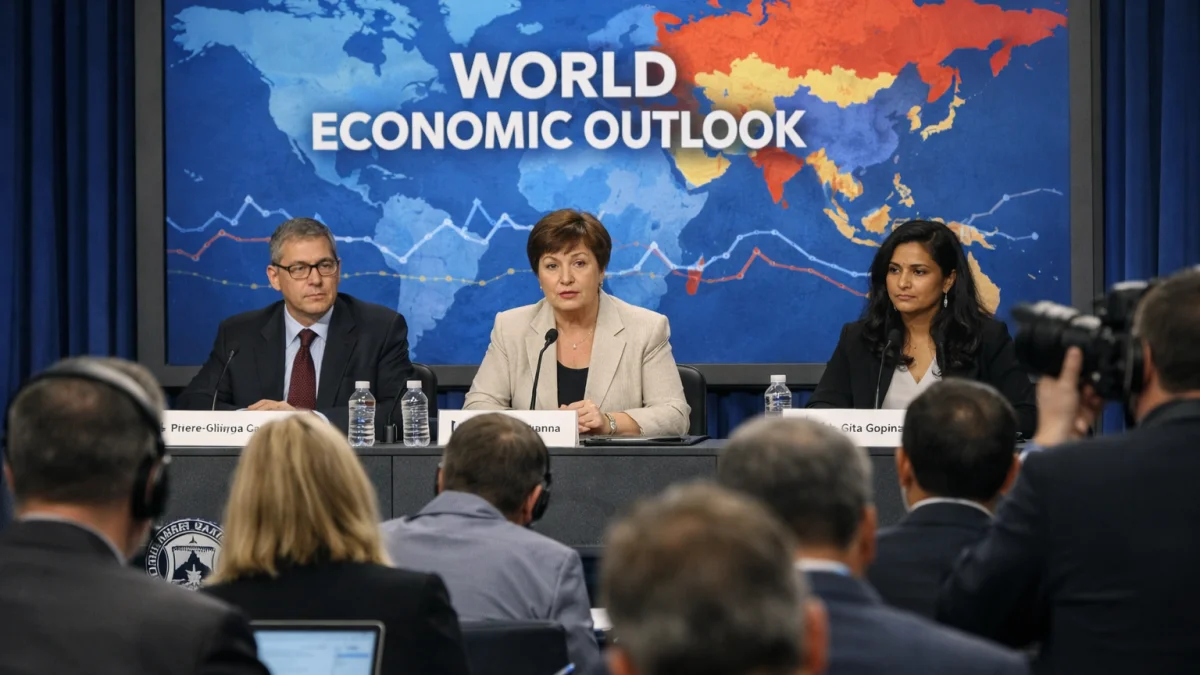
The International Monetary Fund’s latest World Economic Outlook update portrays a global economy increasingly shaped by two opposing forces: the economic disruption caused by conflict in the Middle East and the investment surge driven by artificial intelligence and advanced technologies. While the IMF trimmed its forecast for global growth in 2026 to 3.0% from its previous projection of 3.1%, it maintained that the cumulative outlook over 2026 and 2027 remains broadly unchanged, anticipating growth to recover to 3.4% next year as geopolitical pressures ease and technology investment continues to support activity.
The report marks a shift from viewing the global economy as moving largely in tandem toward lower inflation and moderate expansion. Instead, the IMF argues that growth is becoming increasingly uneven across countries depending on their exposure to energy markets, geopolitical tensions, and participation in global technology supply chains. That divergence has become a defining feature of the post-pandemic global economy and is likely to shape policy decisions well beyond this year.
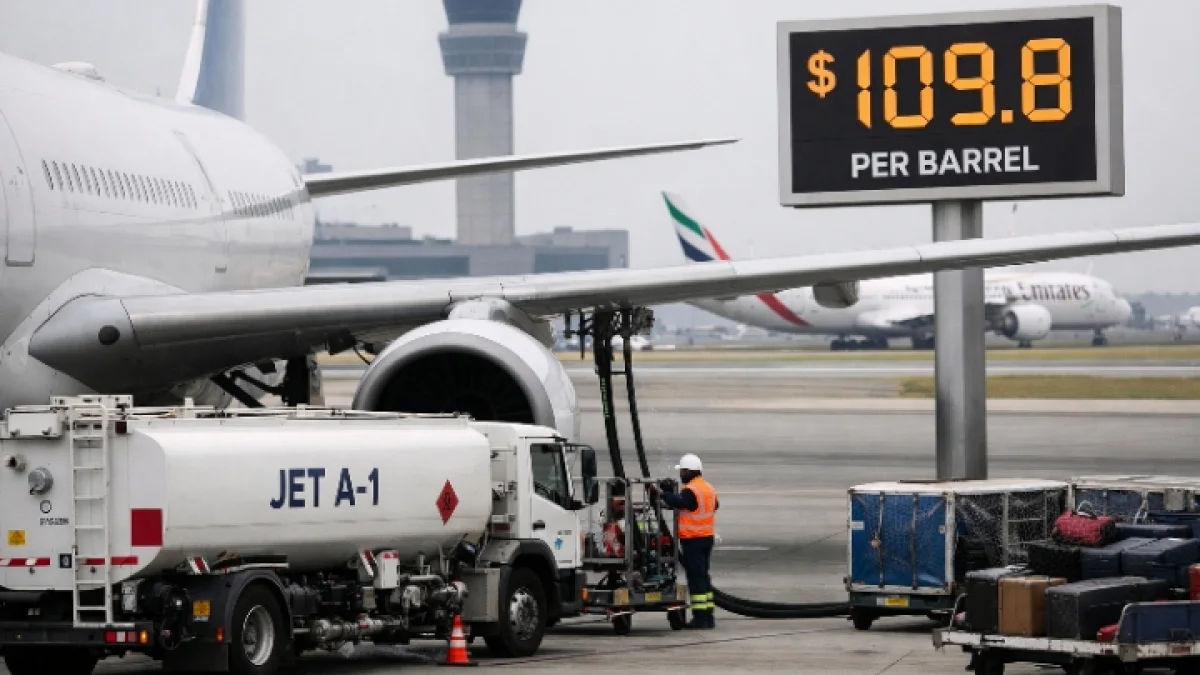
The most immediate drag on the outlook remains the consequences of the Middle East conflict. Higher energy prices, disruptions to shipping routes, and uncertainty surrounding the Strait of Hormuz have increased costs for many economies, particularly those dependent on imported fuel. Although oil prices rose sharply following the conflict, the IMF said the shock proved less severe than initially feared because inventories were drawn down, production outside the Gulf expanded, and many economies proved less energy-intensive than in previous decades. Financial conditions also tightened only temporarily before stabilizing.
At the same time, the IMF identifies artificial intelligence as a significant offsetting force. Strong investment in semiconductors, data centers, cloud infrastructure, and related technologies has boosted demand across economies integrated into global technology value chains. Rather than producing immediate economy-wide productivity gains, however, AI is currently contributing primarily through higher investment spending. This has supported growth in technology-producing economies even as broader geopolitical uncertainty weighs on global trade and business confidence.
The unequal distribution of these benefits is central to the IMF's assessment. Economies with strong positions in advanced manufacturing and AI-related exports have generally seen stronger performance than expected. By contrast, many low-income economies and commodity-importing countries face weaker prospects because they are simultaneously exposed to higher energy costs and lack meaningful participation in the technology investment cycle. This widening divergence illustrates how structural economic characteristics increasingly influence resilience to global shocks.
Inflation also remains a key concern. The IMF raised its forecast for global headline inflation to about 4.7% in 2026, indicating that the disinflation trend established since early 2024 has stalled. Higher energy costs have complicated the task facing central banks, although underlying core inflation has remained comparatively stable. IMF officials emphasized that monetary policy responses should continue to prioritize price stability while reflecting national circumstances, particularly the differing impacts of commodity prices and technology-driven demand.
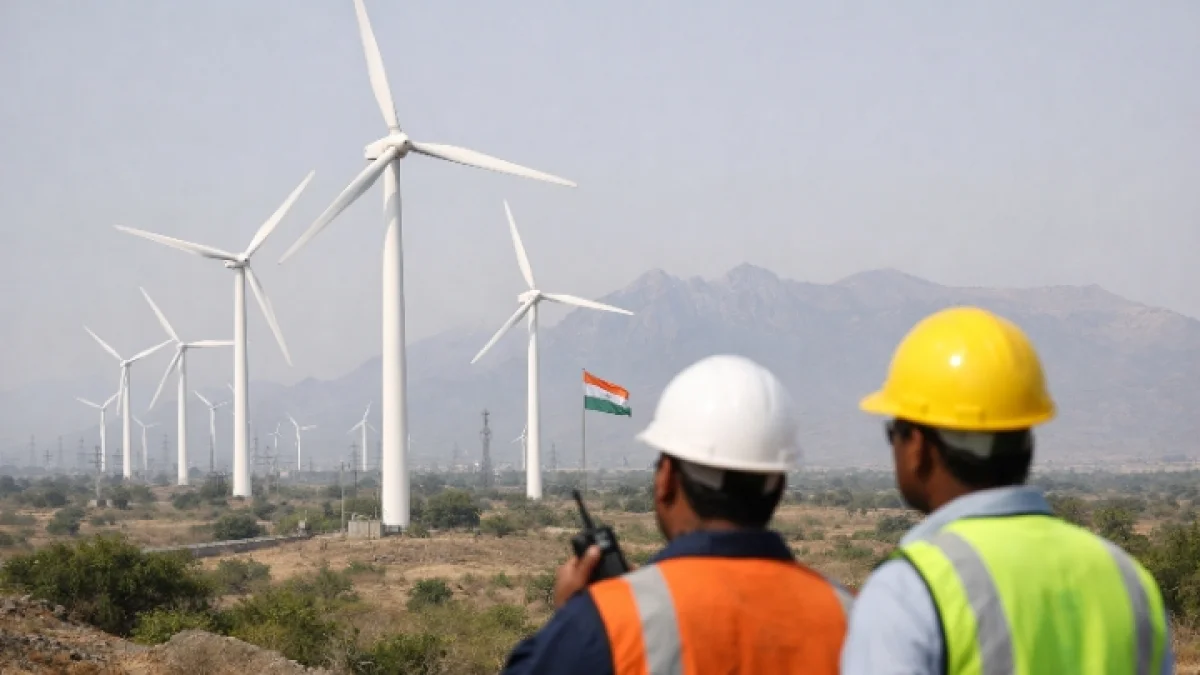
Regional differences reinforce the report's central message. The IMF expects the Middle East and Central Asia to experience the sharpest near-term deterioration because of the direct effects of conflict. Several advanced economies also face slower growth owing to higher energy costs. Conversely, countries benefiting from strong technology exports or investment have generally received more favorable revisions. India remains among the world's fastest-growing major economies despite a modest downgrade, while China's outlook has been supported by infrastructure spending and technology exports even as structural weaknesses in its property sector persist.
The report also highlights broader structural risks that extend beyond the current conflict. IMF officials identify renewed geopolitical escalation, prolonged trade fragmentation, and the possibility of a correction in AI-related financial markets as important downside risks. While current investment in artificial intelligence is supporting demand, the Fund cautions that financial markets may eventually reassess expectations surrounding AI profitability. Conversely, faster productivity gains from AI adoption or quicker normalization of global shipping routes could strengthen growth beyond current projections.
Policy recommendations remain broadly consistent with previous IMF guidance but reflect today's more fragmented environment. The Fund advises governments to unwind temporary energy-related fiscal support once conditions normalize while rebuilding fiscal space after years of elevated public spending. It also stresses the importance of structural reforms, continued investment in energy resilience, and policies that improve economies' ability to adapt to technological change. According to the IMF, maintaining credible macroeconomic policy frameworks will be particularly important as countries confront simultaneous geopolitical and technological transformations.
The latest outlook therefore presents neither a uniformly pessimistic nor optimistic assessment. Instead, it describes a global economy increasingly divided between countries benefiting from technology-driven investment and those bearing the costs of geopolitical disruption. While the IMF expects global growth to strengthen in 2027 if current assumptions hold, it emphasizes that the outlook remains contingent on continued stabilization in energy markets, the evolution of the Middle East conflict, inflation trends, and whether investment in artificial intelligence ultimately translates into sustained productivity gains. Those factors remain under close monitoring by the Fund and policymakers worldwide.