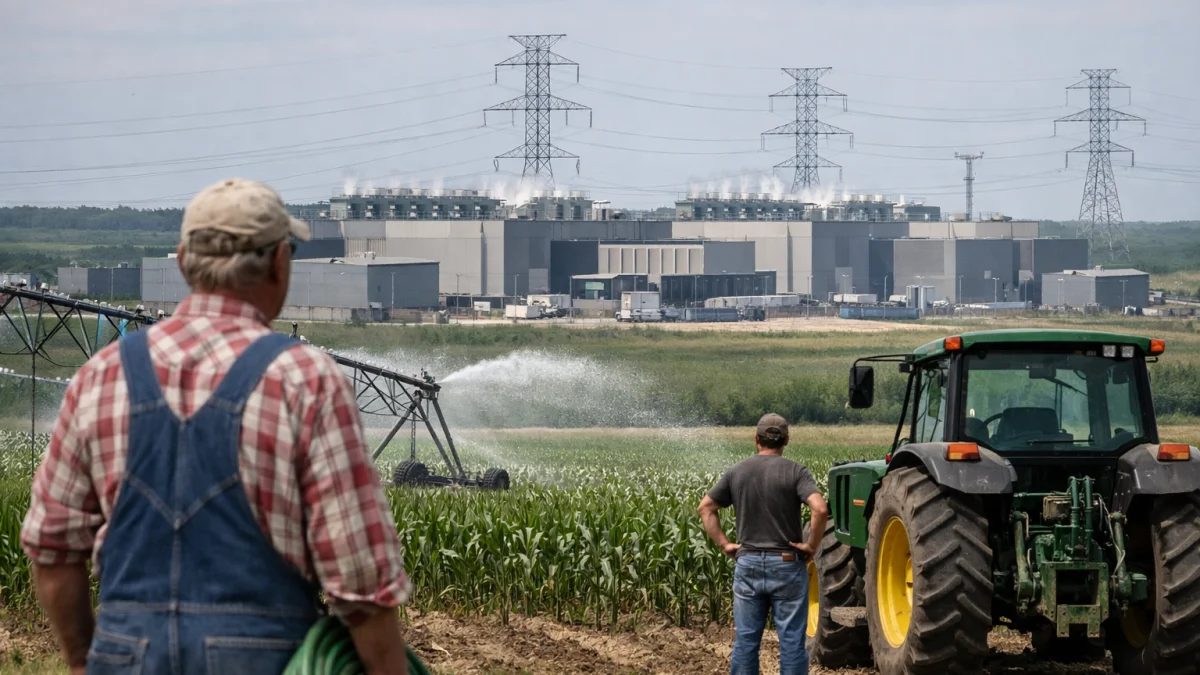
The offer that reached rancher Clint McRae in Montana reflected a transformation spreading across rural America. Land long valued for grazing cattle and raising crops had become attractive for another reason: it was flat, relatively inexpensive and close to the electricity and water supplies that technology companies increasingly need to power artificial intelligence.
McRae chose to speak publicly about what he sees as a growing competition between agriculture and the digital economy. In interviews reported this month, he warned that data centers requiring city-scale electricity and substantial water for cooling could permanently reshape communities whose livelihoods depend on farming and ranching. His concerns echo those of producers in several states where AI-driven infrastructure is moving beyond traditional technology hubs into agricultural regions.
The debate extends well beyond individual land sales. Across rural America, farmers, local officials, utility planners and technology companies are confronting difficult questions about how to balance economic development with food production, water security and affordable electricity.
The rapid expansion of AI has sharply increased demand for large data centers capable of processing enormous computing workloads. Developers increasingly seek rural locations where land is more readily available and high-voltage transmission lines can support energy-intensive facilities. At the same time, many agricultural communities are coping with drought, volatile commodity prices and rising production costs, making multimillion-dollar purchase offers difficult for some landowners to ignore.
Not every farmer is willing to sell.
In Mason County, Kentucky, Ida Huddleston and her daughter, Delsia Bare, rejected a proposal that would have converted part of their family's farm into a large AI data center. The family told People magazine they initially accepted a $26 million offer before reversing course, saying the land had remained in their family for more than two centuries and represented more than its market value. They have since joined legal and community efforts opposing the project, arguing that concerns over water, electricity and the area's rural character deserve greater scrutiny.
Such disputes are becoming more common as communities weigh competing visions of prosperity. Supporters of data centers point to construction jobs, tax revenue, infrastructure improvements and long-term investment. Technology companies argue their facilities can coexist with agriculture while supporting the computing capacity needed for AI, cloud services and digital commerce.
Meta, for example, said this week it would expand its Louisiana AI data center to 5 gigawatts of computing capacity, increasing investment in the project to more than $50 billion. The company said local businesses have already received more than $1.6 billion in contracts since construction began and that it plans to spend more than $1 billion on roads, water and wastewater infrastructure.
Yet many rural residents remain uneasy about the cumulative effects.
A survey released in late June by researchers from the University of Illinois and Purdue University found rural Americans expressed greater concern than suburban and urban residents about data center expansion. Respondents identified higher electricity costs as their biggest worry, followed by the conversion of farmland and pressure on water resources. Researchers said many uncertainties remain regarding the long-term impacts as AI infrastructure expands across the Midwest and other farming regions.
Those concerns reflect practical realities for producers who rely on stable supplies of electricity for irrigation, grain storage, livestock operations and food processing. Water availability is equally critical, particularly in regions already experiencing recurring drought.
Academic researchers studying water use have warned that future data center growth could require hundreds of millions of gallons of additional daily water capacity nationwide by 2030 if current cooling practices continue, although improvements in efficiency could reduce that demand. They also note that the impacts are likely to be concentrated in the communities hosting the facilities rather than spread evenly across the country.
For farming communities, the debate is not simply about technology versus agriculture.
Many producers already depend on AI-powered tools for precision agriculture, weather forecasting, irrigation management and livestock monitoring. The same computing infrastructure driving concern over land and resources also underpins technologies that many farmers increasingly use to improve yields and reduce costs. That overlap illustrates the complexity facing rural communities that benefit from digital innovation while questioning where and how the infrastructure should be built.
State governments are beginning to respond. Legislatures around the country have considered measures addressing electricity pricing, water use, zoning and environmental review for large data centers. On Tuesday, New York became the first U.S. state to impose a one-year moratorium on construction of large new data centers, citing concerns over power costs, water supplies and impacts on host communities as lawmakers seek time to evaluate broader regulatory approaches.
The outcome of these debates could influence how the next phase of America's AI economy develops. Technology companies continue to announce multibillion-dollar investments, while rural communities increasingly ask who will bear the costs and who will share the benefits.
For farmers like McRae and families such as Huddleston's, the question reaches beyond economics. The fields attracting data center developers today are the same landscapes that have sustained generations of agricultural production. As AI infrastructure spreads deeper into rural America, those communities are finding themselves at the center of a national conversation over how land, water and electricity should be allocated in an increasingly digital economy.