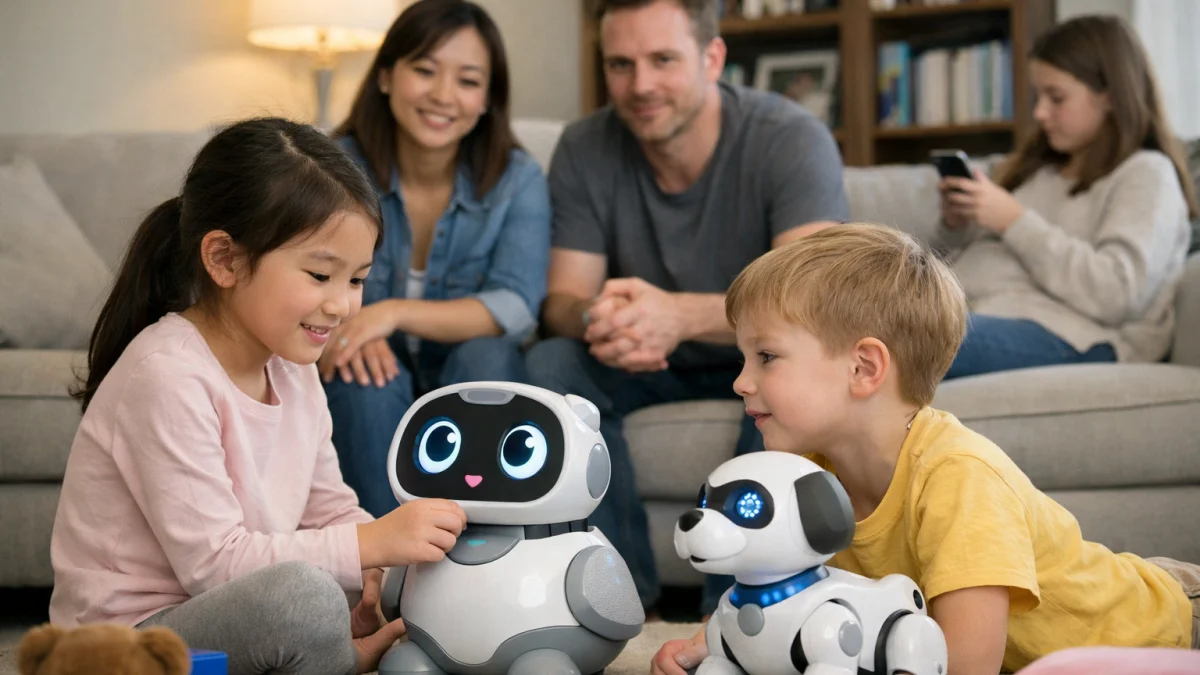
Children are increasingly encountering artificial intelligence not only on phones and computers but in the toys they hug, talk to and carry through their daily routines, forcing parents to weigh promises of learning and companionship against concerns over privacy, emotional attachment and child development.
The shift has unfolded quickly. Plush animals that tell personalized stories, robots that remember previous conversations and voice-enabled companions marketed as educational helpers have moved from technology demonstrations to retail shelves in several countries during the past year. Manufacturers describe them as tools that encourage creativity, language skills and curiosity. Parents, researchers and policymakers are asking a different question: what happens when a child's favorite toy starts behaving like a conversational companion?
The debate reflects a broader transformation in children's relationship with artificial intelligence. While generative AI first entered classrooms through writing assistants and homework tools, companies are increasingly embedding similar technology inside physical toys designed for younger children.
Research released in January by Common Sense Media found nearly half of parents had either purchased or considered buying an AI-enabled toy. Most respondents expressed interest in educational uses, but more than eight in 10 were concerned about the collection of children's personal information. The organization also found that most parents did not want AI toys to serve as friends, highlighting a distinction many families draw between technology as a learning aid and technology as an emotional companion.
That distinction is becoming harder to maintain as products grow more sophisticated.
New generations of AI toys can remember previous conversations, tailor stories to individual children and respond to questions in ways that resemble chatbot interactions. Some manufacturers market these capabilities as creating more engaging experiences while reducing screen time by shifting AI interaction into physical play.
Researchers studying children's interactions with such devices say youngsters often treat them as social beings rather than simple machines.
A 2026 study by researchers from the University of Washington and collaborating institutions observed children between the ages of six and 11 interacting with several AI toys. The researchers found that participants showed curiosity and frequently approached the toys as social entities, although technical limitations often interrupted those expectations. The authors argued that designers should make AI behavior more transparent and developmentally appropriate as the technology becomes more common.
Those findings echo earlier research on smart speakers, which showed many children overestimated AI systems' intelligence and had limited understanding of how they worked or what happened to the information they shared.
Families are also navigating the technology faster than many parents realize.
The Family Online Safety Institute reported this month that children in the United States and Australia consistently described using generative AI more frequently than their parents believed. In its survey of more than 4,000 parents and children, 38% of children said they had used generative AI during the previous week, compared with 27% of parents who believed their children had done so. Researchers described similar gaps across other online activities, suggesting many parents underestimate how deeply AI has entered children's everyday lives.
As adoption grows, scientists say evidence about long-term developmental effects remains limited.
A June overview published in the Journal of Medical Internet Research noted that millions of AI-enabled toys are being marketed despite relatively little research examining their effects on young children's development. Experts interviewed for the publication called for stronger safeguards, clearer labeling and more evidence before conversational AI becomes commonplace in early childhood.
Industry representatives argue the technology can enrich learning when carefully designed. Manufacturers increasingly describe AI toys as assistants that encourage storytelling, answer questions or introduce coding and language exercises. Some companies also emphasize parental controls, conversation logs and privacy settings intended to reassure families.
The commercial opportunity is expanding rapidly, particularly in Asia, where manufacturers have introduced memory-enabled plush toys, interactive storytelling devices and conversational companions aimed at children. Chinese companies have promoted AI toys as combining entertainment, education and personalized interaction, while officials have simultaneously introduced ethical guidance emphasizing that AI should not replace genuine human relationships.
Regulators and consumer advocates are watching closely.
Policy discussions in several jurisdictions increasingly focus on whether conversational toys should meet standards beyond traditional toy safety requirements. Privacy protections, disclosure of AI capabilities, data retention practices and safeguards against emotional manipulation have all emerged as areas of concern among researchers and lawmakers.
For many families, however, the questions remain practical rather than theoretical.
Parents deciding whether to bring an AI companion into the home must balance educational possibilities with uncertainty about how children interpret conversations with machines. Experts generally recommend that adults remain actively involved, treating AI interactions as opportunities for discussion rather than replacements for human relationships or imaginative play.
That emphasis on shared participation reflects another finding emerging across recent research: children's understanding of AI develops most effectively when parents and caregivers engage alongside them rather than leaving the technology to explain itself. Studies examining family use of AI suggest many parents are learning at the same time as their children, turning conversations about how AI works, what it remembers and where its information comes from into part of everyday digital literacy.
As AI companions become increasingly familiar fixtures in toy boxes instead of computer screens, families are helping shape one of the earliest chapters in children's relationship with artificial intelligence—one conversation, one story and one carefully considered household decision at a time.