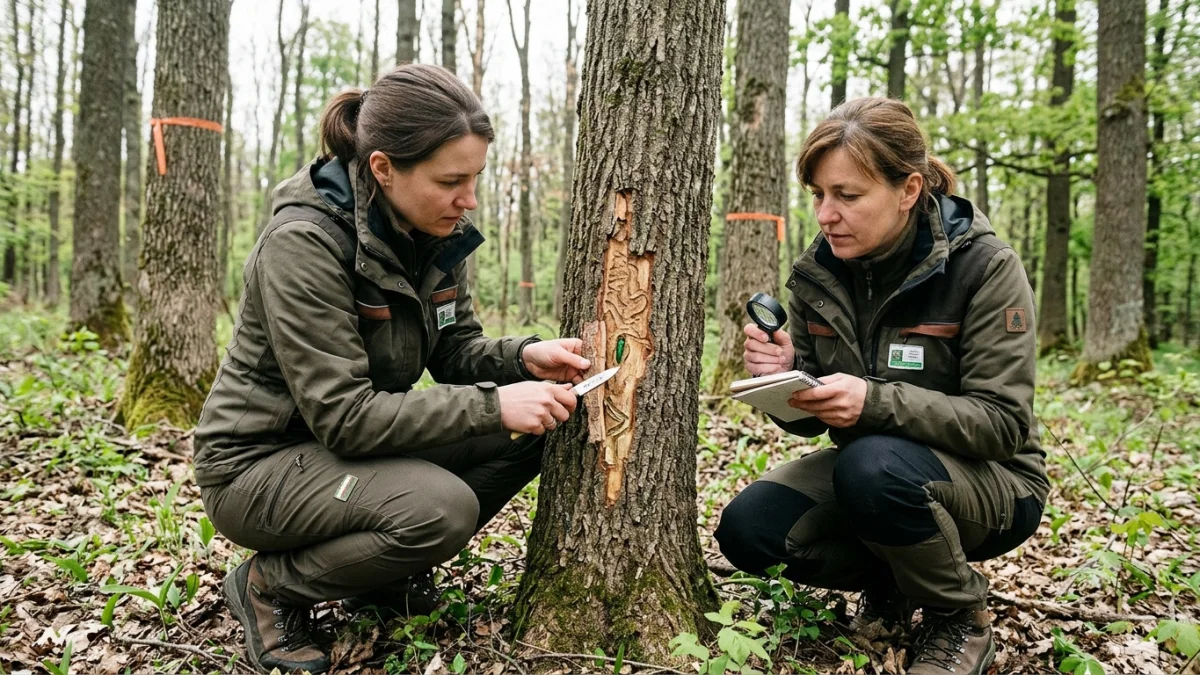
The first confirmed detection of the emerald ash borer within the European Union marks a significant turning point in Europe's long-running effort to protect its forests from one of the world's most destructive invasive tree pests. Authorities in Hungary and Slovakia confirmed findings of the beetle near their borders with Ukraine in recent weeks, prompting intensified surveillance, quarantine measures and renewed discussion among European agriculture ministers over coordinated containment efforts.
The development matters because the emerald ash borer, Agrilus planipennis, has a well-documented history of causing extensive ecological and economic damage after establishing itself outside its native range in northeastern Asia. Since its accidental introduction into North America more than two decades ago, the insect has killed hundreds of millions of ash trees, transforming urban landscapes, increasing forestry costs and disrupting forest ecosystems. It later spread across parts of European Russia and Ukraine, bringing the pest steadily closer to EU territory. The confirmed detections in Hungary and Slovakia indicate that this progression has now crossed an important geographic and regulatory threshold.
Hungary's National Plant Protection Organization reported that two adult beetles were captured in a pheromone trap near Beregsurány in June, while Slovak authorities later confirmed multiple beetles in Streda nad Bodrogom, approximately 60 kilometers away. Hungarian authorities have classified the finding as a transient, actionable infestation under surveillance while expanding delimitation surveys and coordinating with neighboring countries.
The European Union had already designated the emerald ash borer as a priority quarantine pest before its arrival. That status reflects assessments that early detection and rapid intervention offer the best chance of slowing establishment. Once the insect becomes widespread, eradication has proved extremely difficult elsewhere because larvae develop beneath tree bark, making infestations hard to detect until visible canopy decline appears.
The timing is particularly challenging for European forests because ash trees are already under sustained pressure from ash dieback, a fungal disease that has spread widely across the continent over the past three decades. Researchers have warned that the combination of ash dieback and emerald ash borer could create overlapping threats that further reduce ash populations and complicate long-term conservation efforts. While the disease and the insect attack trees differently, both weaken the resilience of native ash species and increase management challenges for forestry agencies.
The latest detections therefore represent more than an isolated pest finding. They test the EU's plant health framework, which has increasingly emphasized coordinated surveillance, information sharing and restrictions on the movement of potentially contaminated plant material. The issue was formally raised during the July meeting of EU agriculture ministers, highlighting that governments increasingly view invasive forest pests as a cross-border policy challenge rather than solely a national forestry concern.
Scientific experience from North America suggests that human activity often accelerates the spread of the emerald ash borer. While adult beetles disperse naturally over relatively limited distances, long-distance movement has frequently occurred through the transport of infested firewood, logs, nursery stock and other untreated ash products. That history explains why European authorities are emphasizing surveillance around transport corridors and reinforcing public awareness alongside technical monitoring programs.
The economic implications extend beyond commercial forestry. Ash trees are widely planted along streets, parks and public spaces across Europe, where they provide shade, biodiversity benefits and protection against urban heat. Municipal authorities in North America spent substantial sums removing hazardous dead trees and replacing lost urban canopy following widespread infestations. Although European officials have not suggested similar outcomes are inevitable, previous international experience provides a reference point for why early containment receives considerable attention.
Officials have also stressed that the current findings do not necessarily indicate widespread establishment across the European Union. Plant health authorities are expanding trapping networks and field inspections to determine whether breeding populations exist beyond the confirmed sites and how extensively the insect has dispersed. The effectiveness of those surveys will shape future regulatory decisions, including possible movement restrictions and additional phytosanitary measures.
Austria and other neighboring countries have responded by reviewing preparedness plans and increasing monitoring, reflecting concern that geographic proximity could increase future detection risks. Forestry specialists have emphasized that continued international cooperation will be essential because invasive forest pests do not respect national borders, and successful containment depends on rapid information exchange between plant protection agencies.
The confirmed presence of the emerald ash borer in the European Union therefore represents a consequential moment in European forest protection. Authorities have verified initial detections and activated existing quarantine and surveillance mechanisms, but the extent of any established populations remains under investigation. Over the coming months, officials will be monitoring additional survey results, cross-border surveillance data and the effectiveness of containment measures to determine whether the current detections remain localized or signal a broader expansion of one of the world's most destructive invasive forest insects.