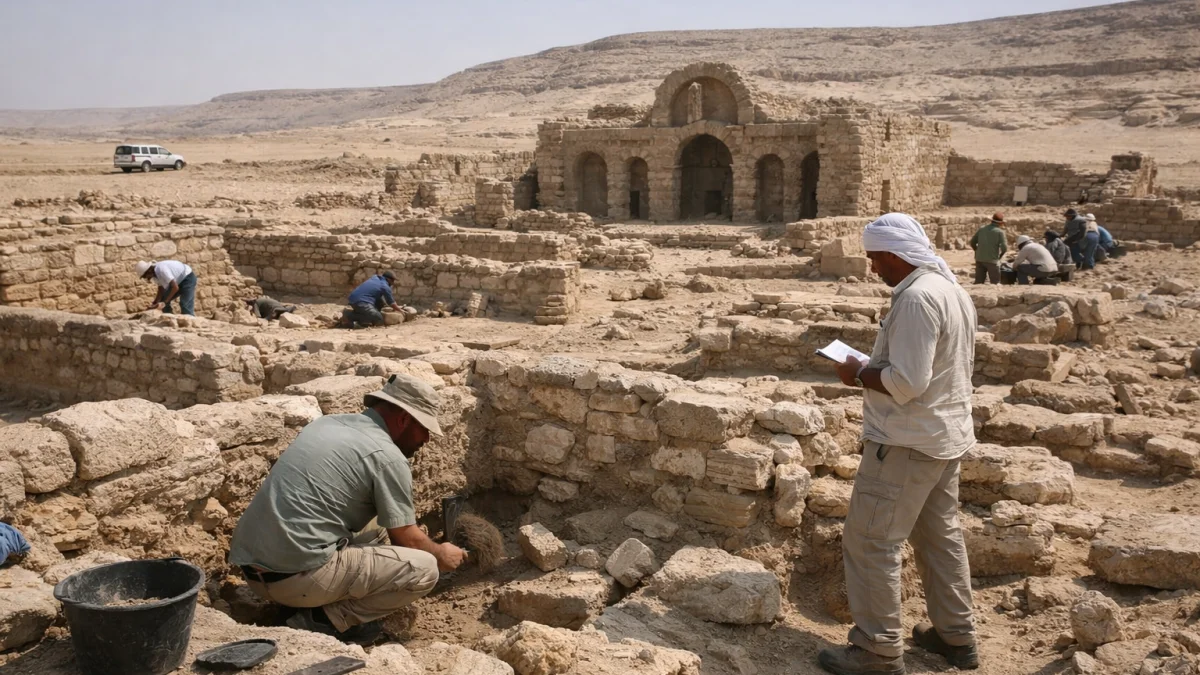
CAIRO—Egypt has uncovered a well-preserved Byzantine-era residential city in the Dakhla Oasis of the Western Desert, a discovery that archaeologists say offers rare insight into urban life, religious practices and economic activity during the fourth century, the Tourism and Antiquities Ministry announced.
The ministry said the settlement, located in the New Valley governorate, contains a planned street network with north-south roads intersected by east-west streets, creating public squares and organized residential quarters. The excavation also revealed a basilica church, fortified structures, watchtowers and houses with vaulted roofs, indicating an established urban community during the period when Egypt formed part of the Byzantine Empire.
Hisham el-Leithy, secretary-general of Egypt's Supreme Council of Antiquities, said the remains provide evidence of daily life, urban planning and commercial activity in the oasis during the fourth century. Archaeologists uncovered bread ovens, kitchens, stone grinding tools, bronze and gold coins, and more than 200 inscribed pottery fragments, or ostraca, documenting commercial transactions and aspects of everyday communication.
Among the notable discoveries was the residence of a church deacon identified in inscriptions as Tisous. According to the ministry, researchers believe the building may have served as a house church before construction of the larger basilica, offering new evidence of the development of Christian worship in the settlement.
Egyptian authorities announced the findings alongside a separate excavation at the Marina el-Alamein archaeological site near Alexandria, where archaeologists uncovered 18 additional tombs, increasing the total identified there to 48. The ministry said the site is believed to be the ancient Greco-Roman port city of Leukaspis, which flourished between the second and fourth centuries.
The Marina el-Alamein excavation yielded pottery vessels, lamps, amphorae, altars, limestone basins and a 2.5-meter granite sarcophagus containing skeletal remains under study, according to mission chief Eman Abdel-Khaliq. Archaeologists also recovered fragments of a plaster sphinx and found four gold pieces placed in the mouths of the deceased, a funerary practice associated with beliefs about the afterlife during the period.
The Dakhla Oasis site is included on UNESCO's Tentative List for World Heritage status. Egyptian officials said the discoveries contribute to understanding settlement patterns in the Western Desert while adding to the country's continuing archaeological research. The ministry said excavation and analysis of the newly uncovered structures and artifacts are continuing.