As notices of job cuts spread across technology companies in the first half of 2026, a different kind of announcement began appearing alongside them: invitations to enroll in short-term training courses, AI certification programs and career-transition services designed for workers whose jobs had disappeared as employers accelerated investment in artificial intelligence.
For many displaced employees, those offers have become the next step after months of uncertainty. They are updating résumés, learning new software tools and weighing whether the skills that built their previous careers remain valuable in a labor market being reshaped by automation.
The growing emphasis on retraining reflects a broader shift taking place across the technology industry and beyond. Companies continue to invest billions of dollars in AI infrastructure while reducing headcount in parts of their organizations, prompting governments, employers and nonprofit groups to expand programs aimed at helping workers move into emerging roles rather than leave the workforce altogether.
That transition has become increasingly visible as layoffs have reached companies once regarded as stable employers. Reports that Microsoft was preparing another round of job reductions in July, following earlier cuts this year, underscored how even firms leading the AI race continue to reshape their workforces while increasing spending on artificial intelligence. Company reports indicated the reductions would affect consulting, sales and other business functions as resources shifted toward AI priorities.
The pattern extends beyond a single company. Reuters has documented a succession of businesses announcing job reductions while citing automation, efficiency efforts and AI investment as central to restructuring plans. Economists at Goldman Sachs have warned that adoption of AI could contribute to rising unemployment in occupations most exposed to automation, although researchers also caution that technological change rarely affects every occupation in the same way or on the same timetable.
Against that backdrop, a coalition of technology companies, philanthropies and public officials launched RAISE US in late June, presenting it as an attempt to build a more coordinated response to workforce disruption. Led by former U.S. Commerce Secretary Gina Raimondo and former Indiana Governor Eric Holcomb, the nonprofit has attracted support from companies including Amazon, Microsoft, Anthropic and the OpenAI Foundation.
The initiative aims to raise $1 billion for programs that include short-term credentials, AI-assisted career coaching, retraining incentives and wage insurance for workers changing occupations. Pilot efforts are beginning in Arkansas, Connecticut, Maryland and Utah, where organizers say they will measure success by whether participants secure and retain employment rather than simply complete training courses.
The effort arrives as labor-market data point to a rapidly changing landscape. Challenger, Gray & Christmas reported that employers cited artificial intelligence as the reason for 87,714 announced job cuts through May, the highest total since the outplacement firm began tracking AI-related layoffs in 2023. The figures have intensified debate over how much displacement can be directly attributed to AI and how much reflects broader corporate restructuring, slower hiring and post-pandemic adjustments.
That distinction matters to workers trying to decide what comes next.
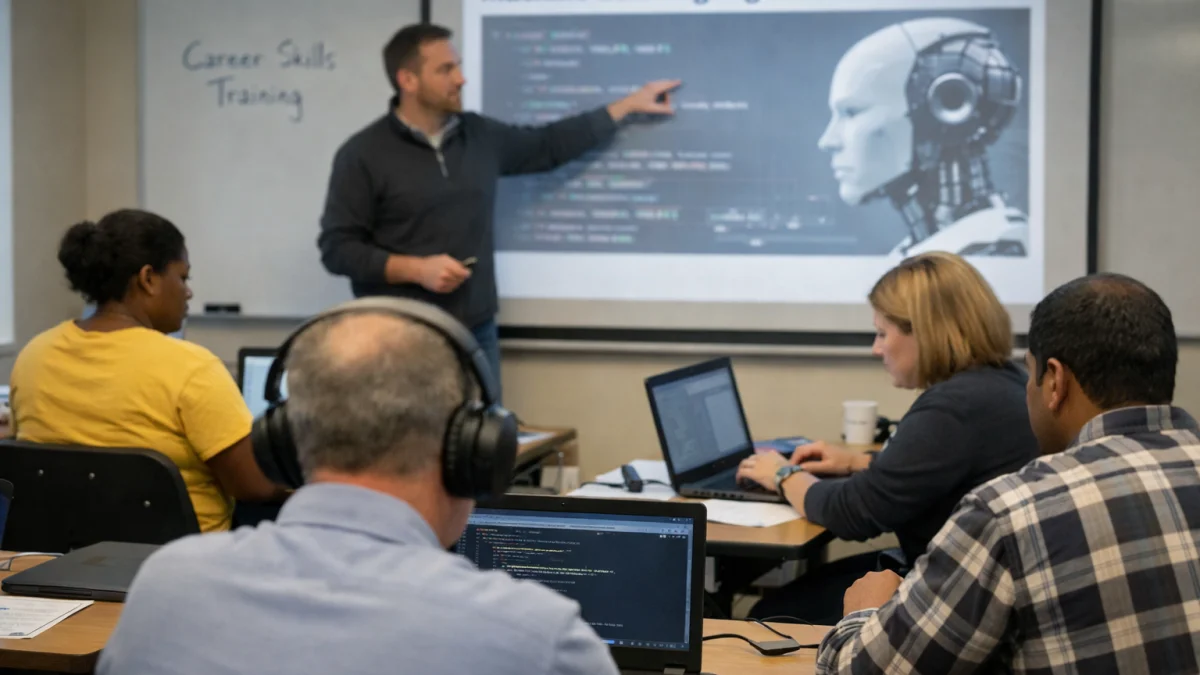
Career advisers involved in retraining programs increasingly encourage participants not simply to compete against AI systems but to learn how to work alongside them. Many courses emphasize prompt engineering, data literacy, cybersecurity, cloud computing and project management, arguing that employers continue to seek people capable of supervising, evaluating and integrating AI tools into business operations.
Employers participating in new initiatives have similarly framed retraining as an investment in redeployment rather than replacement. Organizers behind RAISE US say one objective is to help companies retain experienced employees by equipping them with new skills before automation eliminates existing roles.
Yet uncertainty remains. Some economists and industry analysts caution that AI's impact differs widely across occupations and that companies sometimes cite artificial intelligence alongside other business reasons for reducing staff. Analysts have warned against assuming every announced layoff represents direct technological substitution, noting that slower demand, cost-cutting and strategic reorganization continue to influence employment decisions.
Outside the United States, similar questions are emerging. Reuters reported in June that companies in China have quietly reduced staffing while expanding AI adoption, particularly in sectors such as advertising, technology and entertainment. At the same time, demand has increased for workers with AI-related expertise, illustrating how technological change is simultaneously eliminating some jobs while creating others that require different capabilities.
For workers entering retraining classrooms, however, the challenge is less about forecasting the future than navigating the present. Many are learning unfamiliar tools after years in specialized careers, hoping that experience accumulated before the AI boom can still provide an advantage when combined with new technical skills.
Whether today's retraining initiatives become lasting models will depend on outcomes measured over years rather than months. Organizers, employers and policymakers alike acknowledge that enrollment alone cannot determine success. The more difficult test will be whether workers displaced during the AI transition find stable employment in the economy that artificial intelligence is helping to create.
As investment in AI continues to accelerate, the success of that transition may be judged not only by advances in the technology itself but also by whether workers can build new careers alongside it instead of being left behind.