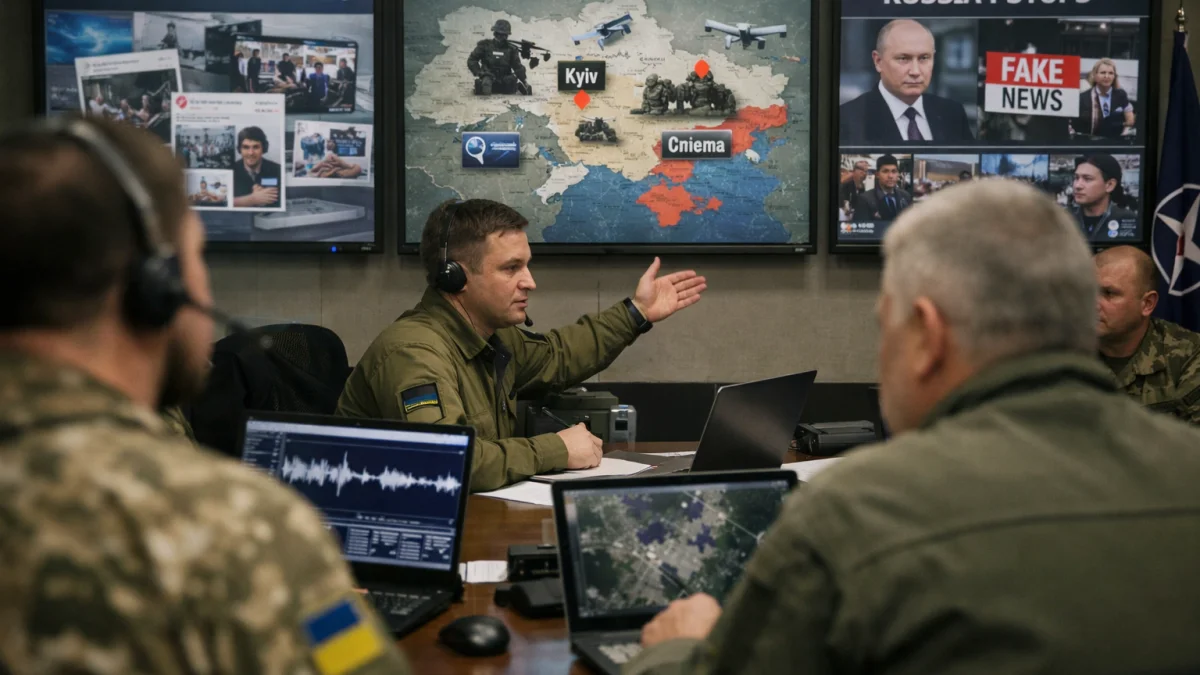
KYIV — Russia and Ukraine are increasingly integrating cognitive warfare into their broader military campaigns, with analysts and officials pointing to intensified efforts to shape public perception, influence political decision-making and undermine confidence in adversaries as the conflict enters another phase of technological competition.
Military assessments published in recent weeks by the Institute for the Study of War (ISW) and Critical Threats Project said the Kremlin has expanded information operations alongside battlefield activity, including what researchers described as exaggerated claims of territorial gains, manipulated imagery and messaging intended to influence both domestic and international audiences. The organizations said some material circulating online appeared to include AI-altered or AI-generated content designed to reinforce official Russian narratives, although individual pieces of content remain difficult to verify independently.
The assessments said Russian officials have also paired military announcements with diplomatic messaging that analysts argue seeks to portray Moscow as open to negotiations while casting Ukraine as unwilling to engage. Those conclusions represent the assessment of the research organizations and have not been independently verified by Reuters.
Ukraine has continued to emphasize strategic communications as part of its defense effort while expanding long-range drone and cyber capabilities that officials say are intended to disrupt Russian military logistics and infrastructure. President Volodymyr Zelenskyy recently announced the creation of a dedicated long-range command to coordinate deep-strike operations against targets inside Russia, describing the effort as part of a broader strategy to reduce Moscow's capacity to sustain the war.
European institutions have also warned that information manipulation remains a central element of the conflict. A joint report by the European External Action Service and Ukraine's Center for Countering Disinformation said Russia continues to conduct large-scale foreign information manipulation and interference campaigns aimed at weakening support for Ukraine domestically and abroad, including efforts linked to Kyiv's European Union membership aspirations.
Separately, European governments have accused Russia of cyber operations targeting critical infrastructure across the region, allegations Moscow has consistently denied. The latest discussions among EU and NATO officials have combined cyber defense, information resilience and conventional military support as part of a broader response to hybrid threats stemming from the war.
Researchers say advances in artificial intelligence, social media amplification and inexpensive digital production tools have accelerated the pace of influence operations by reducing the time required to generate persuasive text, images and video. While governments on both sides continue to accuse each other of spreading disinformation, independent verification of many online claims remains difficult, underscoring the growing role of cognitive and information operations alongside conventional combat.