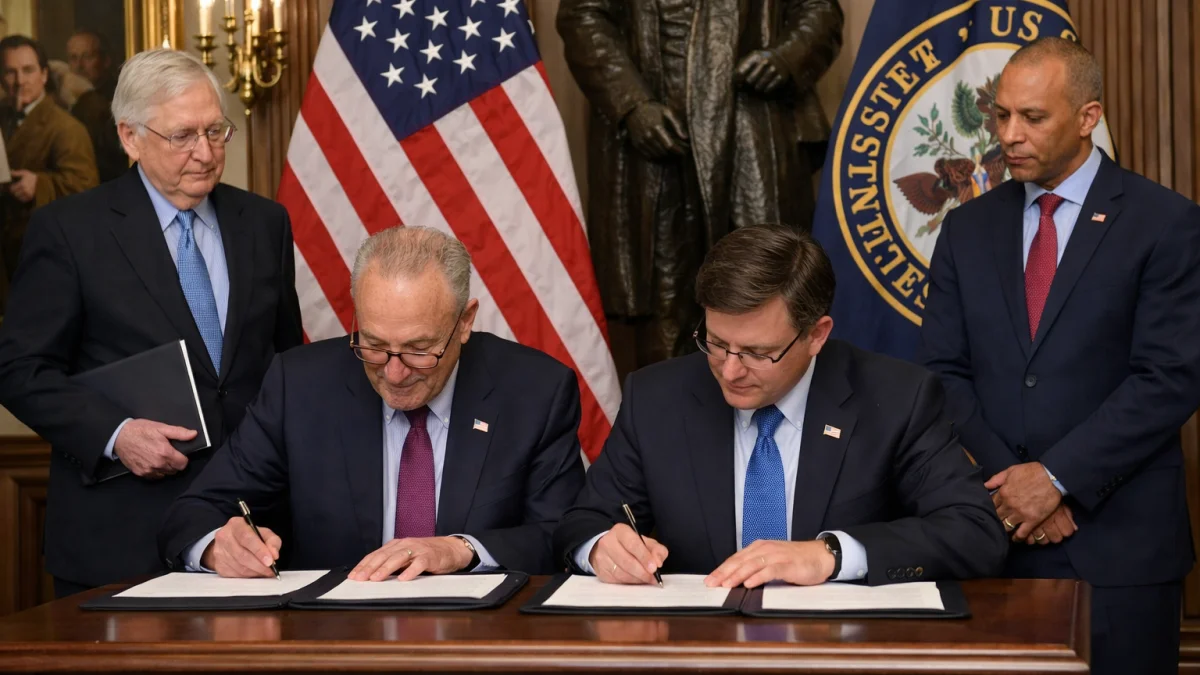
The 21st Century ROAD to Housing Act has become U.S. law without President Donald Trump's signature, marking an unusual constitutional outcome for one of the most significant bipartisan housing measures in decades. Rather than vetoing the legislation, Trump allowed the statutory review period to expire while Congress remained in session, enabling the bill to take effect automatically under Article I, Section 7 of the U.S. Constitution. The decision preserves a wide-ranging package intended to increase housing supply and improve affordability while highlighting the continuing intersection of policy-making and broader political disputes.
The law's enactment is significant for two reasons. First, it represents one of the few major bipartisan legislative achievements in a sharply polarized Congress, reflecting broad agreement that housing affordability has become a nationwide economic challenge affecting households, employers, and financial stability. Second, the circumstances of its enactment underscore that bipartisan consensus on a specific policy issue does not necessarily translate into executive endorsement when unrelated political priorities intervene. Trump stated that he withheld his signature to protest the Senate's failure to advance the SAVE America Act, an elections measure he has made a legislative priority, while declining to veto the housing bill outright.
The legislation addresses long-standing concerns about constrained housing supply, which economists, housing researchers, and industry groups have identified as a principal driver of elevated home prices and rents across much of the United States. By seeking to accelerate residential construction, streamline portions of federal permitting and environmental review, expand opportunities for manufactured housing, and limit large institutional ownership of certain single-family homes, lawmakers aim to ease structural barriers that have contributed to persistent affordability pressures.
Unlike short-term demand-side stimulus, the law focuses primarily on expanding supply. Many housing economists have argued that years of underbuilding relative to population growth have produced a substantial housing deficit. Although estimates differ across research organizations, policymakers from both parties have frequently cited a nationwide shortage numbering in the millions of homes. Supporters therefore characterize increasing construction as the most durable approach to moderating long-term housing costs.
The legislation's broad bipartisan support reflected that diagnosis. Congress approved the measure by overwhelming margins after negotiations incorporated proposals from both Republican and Democratic lawmakers. The package combines regulatory reforms favored by many Republicans with affordability and market-oversight provisions supported by Democrats, illustrating an effort to assemble a coalition around practical housing measures rather than comprehensive ideological reform.
From a business perspective, the law has implications across multiple sectors. Homebuilders may benefit from faster permitting processes and fewer regulatory delays for qualifying projects. Manufacturers of modular and manufactured housing could gain from provisions intended to expand deployment of lower-cost housing options. Real estate investors may face additional limits in certain segments of the single-family housing market, while lenders, developers, and local governments will closely monitor how implementing agencies interpret and apply the legislation's numerous provisions. Financial markets initially viewed parts of the legislation positively, although analysts generally cautioned that meaningful effects on housing affordability are likely to emerge gradually rather than immediately.
Even supporters acknowledge that the law is unlikely to produce rapid reductions in home prices or mortgage costs. Mortgage rates remain elevated by historical standards, and housing prices continue to reflect years of limited inventory. Economists generally emphasize that increasing housing supply requires years of planning, financing, permitting, and construction before significant additions reach the market. As a result, any measurable effects on affordability are expected to develop over an extended period rather than within months of enactment.
The legislation has also drawn criticism from multiple directions. Some housing advocates argue that it does not sufficiently address affordable rental housing, homelessness, or tenant protections, contending that additional public investment will still be required to meet the needs of lower-income households. Others question whether restrictions on institutional investors will materially influence prices, noting that investor purchases have already moderated in some markets and that local zoning policies remain among the largest constraints on housing production. These differing assessments reflect broader debates over the relative importance of federal policy, local land-use regulation, and market forces in addressing the housing shortage.
Politically, the episode illustrates both the possibilities and limits of bipartisan lawmaking. Congress succeeded in advancing legislation that attracted support across party lines, yet the president deliberately declined to associate himself with the measure because of an unrelated legislative dispute. By allowing the bill to become law instead of vetoing it, the administration avoided blocking widely supported housing reforms while signaling dissatisfaction with congressional action on election legislation.
The law is now in effect, shifting attention from legislative negotiations to implementation. Federal agencies must develop guidance for carrying out its provisions, while state and local governments, developers, lenders, and housing organizations will assess how quickly the reforms influence permitting, construction activity, and housing availability. Officials, industry participants, and economists will be monitoring implementation timelines, regulatory guidance, and housing market indicators to determine whether the legislation delivers measurable improvements in affordability and supply over the coming years.