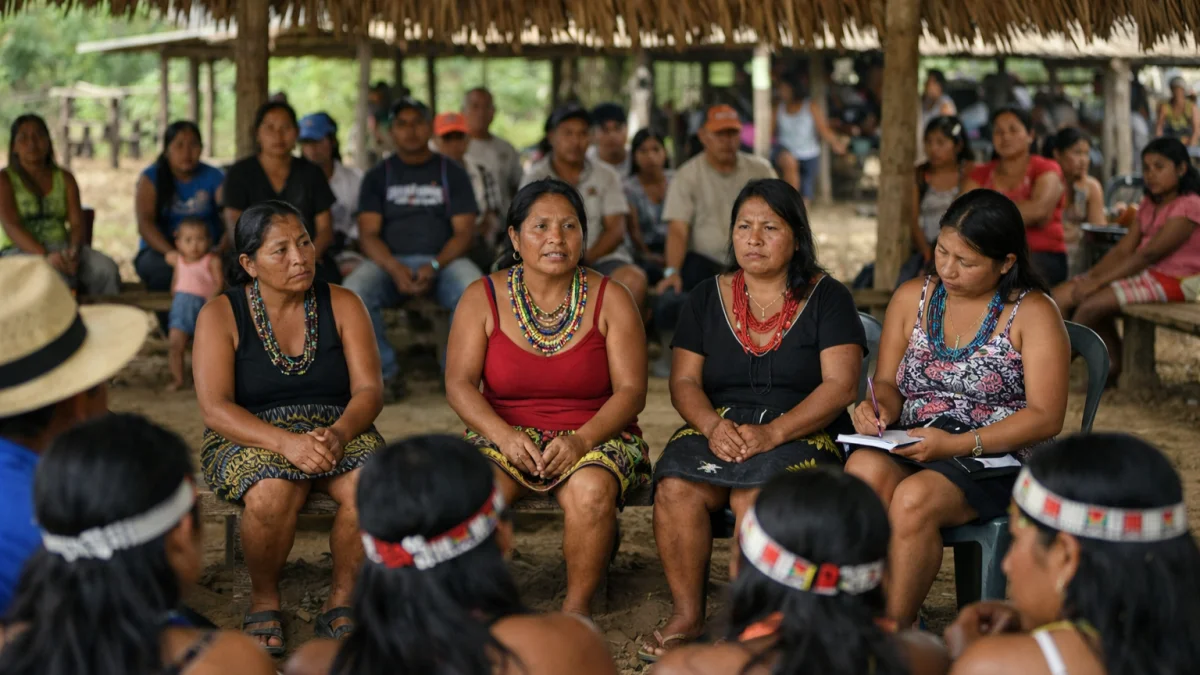
In the remote communities of Colombia’s Emberá people, the fight against female genital mutilation began not in government offices but in conversations among women who decided a practice long hidden behind silence could no longer remain unchallenged.
For years, Emberá women leaders, health workers and community advocates worked to bring attention to cases of female genital mutilation, known locally as ablación, a practice documented mainly among some Indigenous communities in Colombia. Their efforts helped drive a national debate that culminated in the Colombian Congress approving a law in 2026 aimed at preventing and eradicating the practice, making Colombia the first country in Latin America to pass such legislation.
The law was the result of a two-year legislative process, but the campaign behind it was built on a much longer struggle by Emberá women who argued that protecting girls required confronting a subject that had often been treated as untouchable.
The debate over female genital mutilation in Colombia has been complicated by secrecy, cultural sensitivity and the relationship between Indigenous autonomy and state responsibility. Activists and officials have emphasized that the goal is not simply punishment, but prevention, education, health care support and dialogue with Indigenous communities.
For Emberá women involved in the movement, the issue has been personal. Many have said the first step was breaking the silence around a practice that was often discussed only within families and communities.
One of the women who helped bring the issue into public discussion was Patricia Tobón Yagarí, an Emberá Indigenous lawyer who has described learning about the practice through her family history and later discovering that it continued in Colombia after believing it had disappeared from her community. In testimony shared with the United Nations Population Fund, she recalled that a newborn Emberá girl’s death in 2007 after complications linked to the procedure exposed the issue nationally.
The 2007 case revealed a hidden reality. According to UNFPA reporting, many people outside affected communities were unaware the practice existed in Colombia, while even some Emberá community members had limited knowledge of its continuation because of the secrecy surrounding it.
The Emberá are not a single community but a diverse Indigenous population spread across Colombia and neighboring countries. Within Colombia, female genital mutilation has been documented primarily among some Emberá groups, rather than as a practice shared by all Emberá people.
Community-led efforts to stop the practice have developed over years. UNFPA reported that some Emberá leaders had already worked with communities to establish agreements against the procedure and promote education-based approaches. These efforts focused on discussions about women’s rights, health consequences and alternatives that respected Indigenous participation.
The national campaign gained momentum as Emberá women worked alongside lawmakers, health professionals and civil society organizations. The proposed legislation moved through Congress after lawmakers argued Colombia needed clearer public policies for prevention, reporting and support for affected women and girls.
Carolina Giraldo, one of the lawmakers involved in the initiative, said the measure was intended to create government responsibility for addressing the issue through education and prevention rather than relying only on criminal penalties.
Supporters of the legislation also highlighted the difficulty of measuring the true scale of the practice. Official records have captured only reported cases, and experts have warned that underreporting remains a major challenge because many cases occur privately and are not brought to authorities.
According to reports citing Colombian health authorities, dozens of cases were recorded in recent years, though experts believe the actual number may be higher. The majority of identified cases involved girls at very young ages.
Health professionals have described the medical risks associated with female genital mutilation, including infections and long-term complications. The World Health Organization classifies the practice as a violation of the rights of girls and women and a procedure with no medical benefit.
But for Emberá advocates, the discussion has also been about who leads the solution. Many have rejected the idea that ending the practice requires outsiders imposing decisions on Indigenous communities. Instead, they have argued that women from within the communities must be central to the process.
That approach has shaped Colombia’s response. The new law emphasizes prevention, awareness campaigns, institutional coordination and support for survivors, while recognizing the need for culturally informed work with Indigenous authorities.
The passage of the law did not end the challenge immediately. Activists and officials still face the task of reaching communities, improving reporting systems and ensuring that girls at risk receive protection and care.
For the Emberá women who spent years pressing the issue into public view, the achievement represents a shift from silence toward recognition. Their campaign moved a private and painful subject into national debate, placing Indigenous women at the center of a conversation about health, rights and the future of their communities.