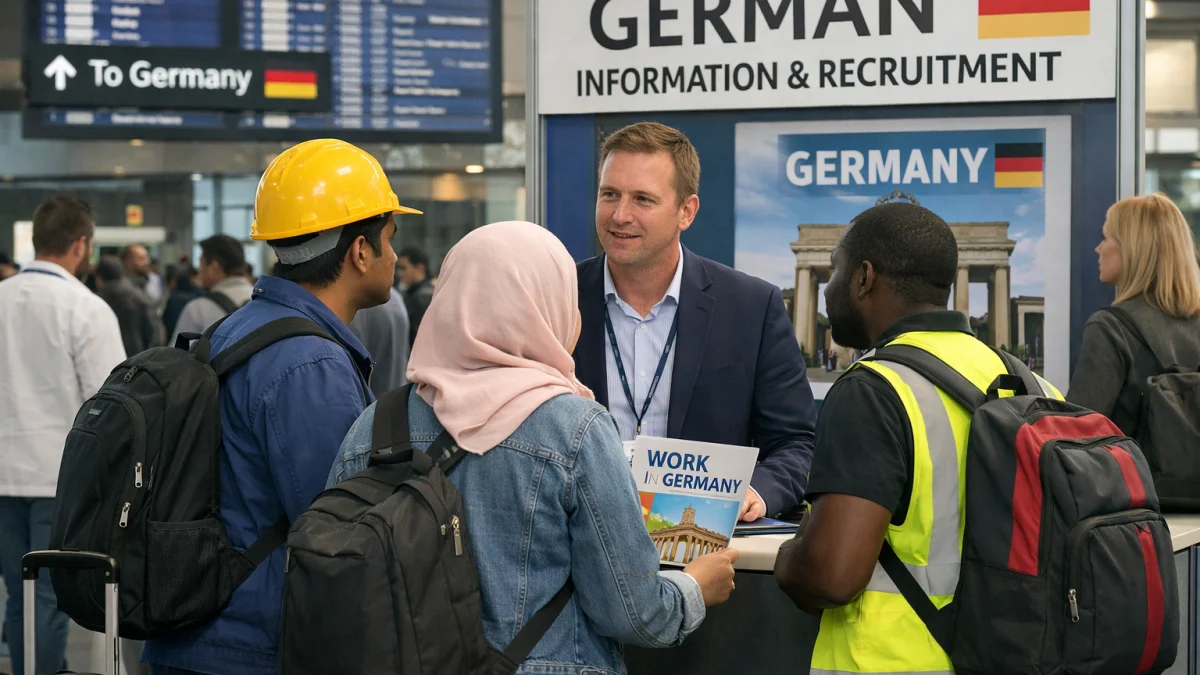
Each morning, new visa applications, qualification assessments and employment inquiries arrive at Germany's diplomatic missions and labor agencies from people hoping to build careers in Europe's largest economy. For many applicants, the paperwork represents more than a bureaucratic process. It is the first step toward a decision that could reshape their professional and personal lives.
Germany's government is actively encouraging that decision.
"We want skilled immigration to Germany, and we need skilled immigration to Germany. We need it really badly," Dr. Martin Bergfelder, the German Federal Foreign Office's Special Representative for Skilled Immigration, said during a recent briefing in Berlin, describing the country's growing demand for qualified workers from abroad.
His remarks reflect a challenge that has become central to Germany's economic future: an aging population, persistent labor shortages and mounting competition with other advanced economies for engineers, nurses, information technology specialists, craftspeople and other qualified professionals.
For prospective migrants, however, Germany's recruitment drive is only part of the story. The opportunity also requires weighing family ties, language barriers, professional recognition and the uncertainties of beginning again in a new country.
The country's campaign builds on years of immigration reform designed to make Germany more accessible to workers from outside the European Union. Under the Skilled Immigration Act, eligibility has expanded beyond university graduates to include many vocationally trained workers and people with substantial professional experience. Salary thresholds for several visa categories have been adjusted, qualification rules broadened and pathways such as the Opportunity Card created to help qualified applicants seek employment inside Germany.
The reforms respond to demographic realities that economists say cannot be ignored.
Germany has long relied on migration from other European countries to support its labor market. But declining birth rates and a rapidly aging workforce mean domestic labor supply alone is unlikely to meet future demand. Government projections and industry groups have repeatedly warned that shortages threaten economic growth across sectors ranging from healthcare and construction to manufacturing and digital technology.
Those pressures have encouraged Berlin to look farther afield.
Government initiatives increasingly target skilled workers from Asia, Africa and Latin America, while employers participate in overseas recruitment programs and job fairs. Germany has also supported efforts to simplify recruitment procedures through digital services and faster administrative processing.
The federal government's planned Work-and-Stay Agency aims to consolidate immigration procedures through a single online portal, reducing administrative complexity for both employers and applicants. Officials say the "one-stop" system is intended to shorten waiting times and improve transparency throughout the immigration process.
The wider European Union is pursuing similar objectives. The recently implemented Single Permit Directive simplifies work and residence applications, while the EU Talent Pool seeks to connect employers facing labor shortages with qualified non-EU candidates. European policymakers argue that these measures are increasingly necessary as demographic change reduces the continent's working-age population.
Yet attracting workers is only one part of the equation.
German officials and employers acknowledge that successful recruitment depends on more than visas. Foreign workers often face lengthy qualification recognition procedures, language requirements in regulated professions and the practical challenges of relocating families, finding housing and integrating into unfamiliar communities.
Recognizing those concerns, Germany has also begun emphasizing what officials describe as "fair recruitment."
Earlier this year, the federal government helped launch the WE-Fair alliance, bringing together public institutions and businesses to promote transparent recruitment practices, improve information about working conditions and support skills development both in Germany and in countries of origin. Officials say the initiative seeks to avoid exploitative recruitment while creating sustainable migration pathways.
Development Minister Reem Alabali Radovan said at the alliance's launch that Germany's aging workforce makes international recruitment increasingly important while stressing that cooperation with partner countries should strengthen opportunities rather than simply draw talent away.
The discussion also extends beyond Germany.
Countries including Kenya have expanded overseas labor programs as governments seek employment opportunities for young populations and higher remittance income. Officials present international migration as an economic opportunity, while critics argue that domestic job creation should remain the priority and warn about potential exploitation abroad.
For individual workers, those broader policy debates often translate into intensely personal decisions.
Accepting a position in Germany may promise higher wages, professional advancement and greater long-term stability. It can also require leaving behind extended families, adapting to a new language and navigating unfamiliar institutions.
Germany's recruitment effort therefore reflects more than labor market economics. It illustrates how demographic change is reshaping migration itself, with advanced economies competing not only through salaries but also through immigration policy, administrative efficiency and promises of long-term opportunity.
Whether those efforts ultimately succeed will depend not only on how many workers Germany can attract, but also on whether those who arrive choose to remain.
For applicants reviewing visa requirements, preparing language examinations or waiting for qualifications to be recognized, that decision begins long before boarding a flight. It starts with balancing ambition against uncertainty—a calculation shared by thousands of skilled professionals considering whether Germany's growing invitation offers not just a job, but a place to build the next chapter of their lives.