On fields once shaped by ploughs and planting, researchers are finding that nature can begin rebuilding itself when intensive agriculture stops. Plants return, microbial communities change and, in some landscapes, wildlife follows. But the recovery is neither uniform nor guaranteed, and scientists are increasingly asking a practical question: when should people intervene, and when should they step aside?
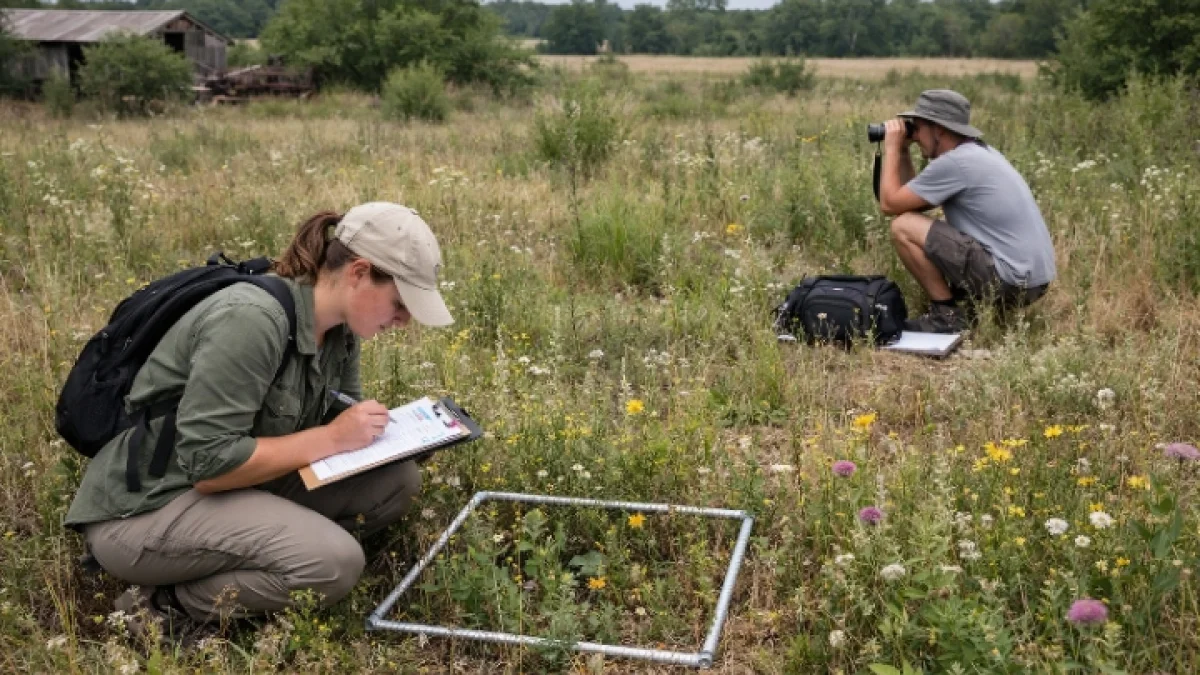
A study published in 2026 by researchers from the University of the Free State, the University of Fort Hare and Leliekloof Farm examined formerly cultivated fields in South Africa's Eastern Cape to measure how vegetation and soil microbial communities changed after farming ended. Using a sequence of fields abandoned at different times, the researchers found that plant and bacterial diversity had begun to resemble that of natural grassland. Yet the composition of those communities still differed between fields of different ages and from nearby natural habitats, suggesting that recovery is a process rather than a simple return to an earlier state.
The findings add to a growing body of research that is turning abandoned agricultural land into an object of scientific interest. As farming retreats from some marginal or economically difficult areas, fields that once produced crops can become testing grounds for understanding how ecosystems recover — and for deciding where conservation resources are most needed.
The opportunity is potentially large. A study published in Nature Communications estimated that 101 million hectares of cropland were abandoned globally between 1992 and 2020. The researchers found that, depending on where land was located and how it was allocated, abandoned cropland could offer opportunities for both renewed food production and climate mitigation through natural forest regrowth. Their modelling also underscored the importance of deciding carefully which lands should be restored and which might be better suited to other uses.
For ecologists, the appeal of natural recovery lies partly in what it can reveal about the resilience of ecosystems. Rather than beginning with a blueprint and rebuilding a landscape species by species, researchers can observe what happens when some of the pressures of intensive agriculture are removed.
That approach can be less costly than highly engineered restoration, but it comes with uncertainty. The 2026 Eastern Cape study found signs of recovery in both plant and microbial diversity, while cautioning that changing climate and rainfall patterns could prevent the communities from ever fully matching native conditions.
Other research has reached a similar conclusion from a different direction. A long-term analysis of grasslands and savannahs found that, even after decades following agricultural abandonment, biodiversity and ecosystem productivity could remain below those of nearby land that had never been ploughed. After 91 years, formerly cultivated fields in the study had recovered only about three-quarters of the plant diversity and half the productivity of remnant ecosystems. The researchers argued that active restoration could be necessary to accelerate recovery.
The contrast is important because "letting nature recover" does not mean the same thing everywhere. A field may contain seeds, microbes and other organisms capable of recolonising it. In another place, intensive cultivation may have altered the soil so profoundly, or surrounding habitats may be so fragmented, that key species cannot return without assistance.
Scientists are also finding that the speed of recovery varies sharply among ecosystems. A 2026 Nature commentary on research into tropical forests regrowing on former farmland reported that, after 30 years, recovering forests could regain about 90% of the wildlife abundance and biodiversity levels of neighbouring old-growth forests, while reaching about 75% of their species composition. The authors described the result as evidence of considerable resilience, while noting that recovery of species composition is not identical to a complete return to the original forest.
Technology is increasingly helping researchers determine where natural recovery is working and where it is falling short. High-throughput DNA sequencing, for example, allowed the Eastern Cape team to examine bacterial communities alongside visible vegetation. Such methods can reveal ecological changes that would be difficult to detect simply by counting plants in the field.
Remote sensing is expanding that capacity across much larger areas. Researchers have developed high-resolution mapping approaches that use aerial imagery and machine learning to identify features such as farmland, woodland and hedgerows. Such maps can help ecologists assess habitat connectivity and give policymakers more detailed information when planning restoration across agricultural landscapes.
Yet the science also carries a warning against treating abandonment as an automatic conservation solution. Land left unmanaged can accumulate vegetation that increases wildfire risk, while invasive species can spread and suppress native biodiversity. Researchers studying abandoned landscapes have therefore described them as both an opportunity and a potential threat, depending on local conditions and how the surrounding landscape is managed.
The debate is ultimately about more than fields. It is about how societies decide what land should produce, what land should protect and what land can be allowed to change on its own.
For researchers watching abandoned farmland, the return of biodiversity is therefore not a single event to be celebrated or measured once. It is a long experiment in ecological succession, with microbes, plants and animals responding at different speeds. The evidence emerging in 2026 suggests that nature can recover substantially when given room, but also that recovery has limits — and that the most effective restoration may depend on knowing when human intervention is necessary and when the better choice is simply to allow an ecosystem time to rebuild itself.