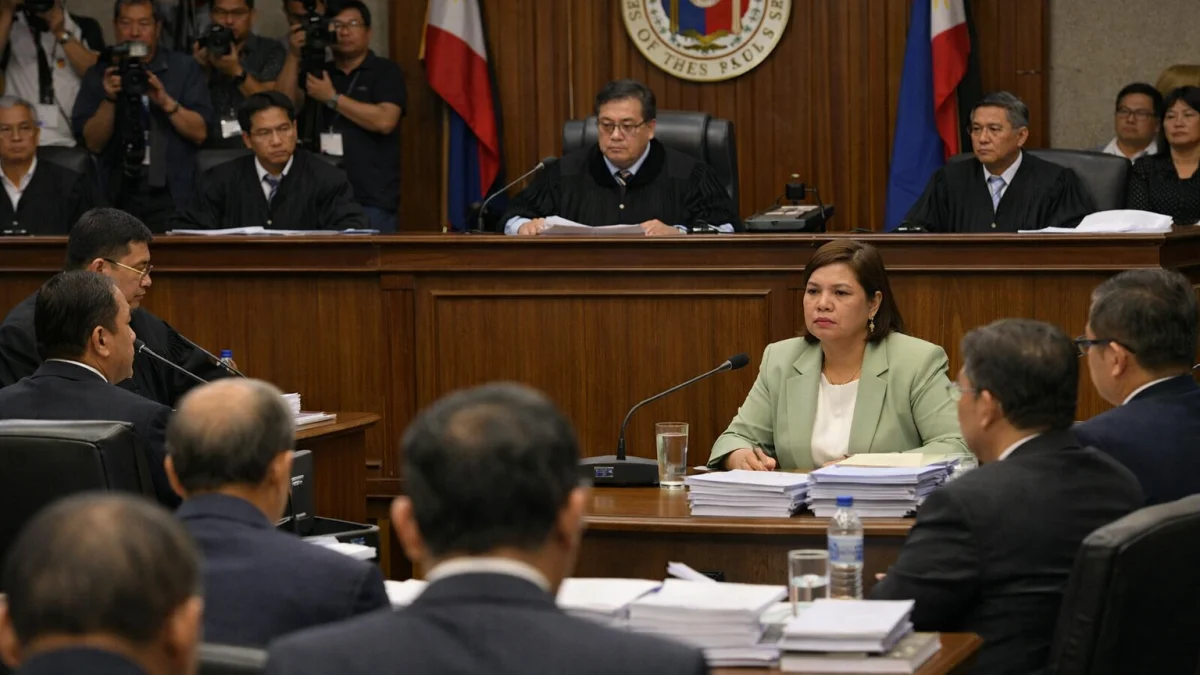
The opening of the Philippine Senate's impeachment trial of Vice President Sara Duterte marks one of the country's most consequential constitutional proceedings in decades, testing not only the political fortunes of one of the nation's most prominent leaders but also the resilience of democratic institutions designed to hold senior public officials accountable. The trial began on July 6 after months of procedural preparation, with prosecutors presenting the case as an exercise in constitutional accountability while Duterte's legal team argued that the proceedings are politically motivated.
The significance of the case extends beyond the allegations against Duterte. It represents a major examination of the Philippines' constitutional framework for balancing democratic mandates with legal accountability. As vice president and a leading figure in national politics, Duterte occupies an office directly elected by millions of voters. At the same time, the Constitution provides impeachment as the mechanism for addressing alleged serious misconduct by high-ranking officials. The trial therefore places the Senate at the center of an institutional test, requiring lawmakers serving as senator-judges to demonstrate both procedural fairness and constitutional independence.
The proceedings also unfold against the backdrop of a dramatic political realignment. President Ferdinand Marcos Jr. and Duterte entered office in 2022 as allies after a landslide electoral victory that united two of the country's most influential political families. That alliance has since fractured amid policy disagreements, competing political interests and escalating public confrontations. The impeachment trial reflects the depth of that rupture while highlighting how personal and political rivalries can intersect with constitutional processes.
House prosecutors accuse Duterte of multiple offenses, including alleged misuse of confidential public funds, unexplained wealth, bribery and corruption, as well as public threats directed at President Marcos, First Lady Liza Araneta-Marcos and other officials. Duterte has denied the allegations and maintains that the impeachment effort is intended to remove a political rival rather than establish legal responsibility. Her defense has also challenged aspects of the proceedings before the Supreme Court.
The Senate trial's design reflects the constitutional requirement that impeachment be conducted as a judicial rather than purely political exercise. According to the approved pre-trial order, prosecutors have been allocated substantially more trial days than the defense to present evidence, while both sides are expected to call dozens of witnesses over a process scheduled to extend for approximately 92 trial days. Conviction requires the support of two-thirds of the 24-member Senate, a threshold intended to ensure broad institutional consensus before removing an elected national official.
Whether the Senate can maintain public confidence throughout the proceedings may prove as important as the final verdict. Philippine politics has long featured intense competition among political families, and impeachment has frequently been viewed through a partisan lens. Previous impeachment efforts against senior officials have often stalled or failed before reaching conviction. No Philippine vice president has previously been removed through this constitutional mechanism, making the current proceedings historically significant regardless of their outcome.
The trial also carries substantial implications for the country's political future. Duterte has remained among the leading figures discussed as a potential presidential contender in the 2028 election. Conviction would permanently disqualify her from holding public office, fundamentally reshaping the electoral landscape. Acquittal, meanwhile, could strengthen her political standing by allowing supporters to argue that she successfully withstood an attempt to remove her from office. Because either outcome could influence future leadership, observers are closely scrutinizing whether the proceedings remain firmly grounded in evidence and constitutional procedure rather than political calculation.
Internationally, the impeachment is being watched as another indicator of institutional development in Southeast Asia's oldest constitutional democracy. Democratic systems are often evaluated not only by the conduct of elections but also by the credibility of mechanisms that investigate alleged misconduct by senior officials. A transparent process that respects due process, regardless of the verdict, would reinforce confidence in constitutional governance. Conversely, perceptions that legal standards have been subordinated to political considerations could deepen polarization and weaken trust in public institutions.
Security preparations surrounding the opening session underscored the trial's political sensitivity. Philippine authorities deployed thousands of police officers around the Senate while preparing for demonstrations by both supporters and critics of Duterte. Such measures reflected expectations that the proceedings would attract sustained public attention and highlighted the government's effort to ensure that constitutional processes continue without disruption.
For now, the confirmed facts remain limited to the formal commencement of the impeachment trial, the presentation of opening positions by both sides, and the Senate's implementation of procedures governing what is expected to be a lengthy evidentiary process. The ultimate outcome will depend on the evidence presented, legal arguments advanced by both parties and the constitutional judgment of senator-judges. Until those proceedings conclude, attention will remain focused on whether the Senate maintains procedural integrity, how the courts respond to related legal challenges, and whether the trial reinforces public confidence in the Philippines' democratic institutions and constitutional system of accountability.