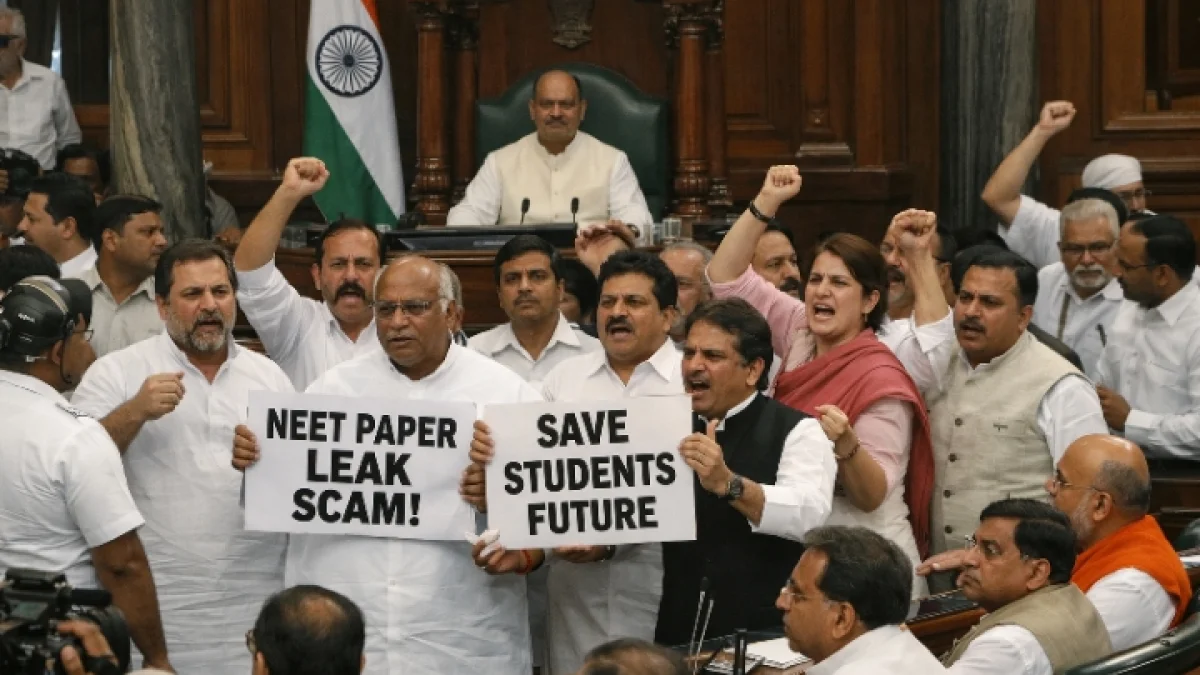
India's Parliament has been repeatedly disrupted as the opposition intensified demands for a debate on the alleged NEET-UG 2026 examination paper leak, turning what began as an education-sector controversy into one of the most significant political challenges confronting Prime Minister Narendra Modi's government during the current monsoon session. The government has agreed in principle to discuss the issue, but disagreements over the format, timing and political accountability have prevented normal legislative business from resuming.
The confrontation matters because it extends well beyond the integrity of a single national examination. NEET, India's nationwide medical entrance test, affects the educational and career prospects of millions of students each year. Allegations that the examination process was compromised have therefore raised broader questions about the credibility of public institutions responsible for conducting high-stakes competitive examinations, an issue that carries political consequences in a country where education and employment opportunities are closely linked.
The parliamentary impasse also reflects how examination integrity has evolved into a wider debate over governance and accountability. Opposition parties have sought to keep sustained pressure on the government by demanding the resignation of Education Minister Dharmendra Pradhan and insisting that Parliament prioritize the issue over scheduled legislative business. The government, while expressing willingness to debate the controversy, has resisted demands tied to ministerial accountability and has argued that discussions should proceed within agreed parliamentary procedures.
Prime Minister Modi's announcement that fast-track courts would be established to handle examination paper leak cases marked his first direct intervention since nationwide protests intensified. The proposal signaled an effort to reassure students and demonstrate that the government views examination fraud as a systemic criminal issue rather than an isolated administrative failure. However, opposition leaders and protest organizers argued that judicial mechanisms alone do not address questions of political responsibility, maintaining demands for ministerial accountability.
The controversy has expanded because it intersects with long-standing concerns about youth unemployment and competition for limited professional opportunities. Medical education remains among India's most sought-after career paths, making confidence in entrance examinations particularly important. For many families, years of preparation and substantial financial investment depend upon the perceived fairness of a single examination. Allegations of leaks therefore have consequences extending beyond individual candidates, affecting public trust in the broader examination system.
The government's response has combined criminal investigations, promises of institutional reforms and appeals for calm. Authorities have initiated investigations into the alleged leak network while engaging with protest representatives. At the same time, educational bodies have urged universities to counsel students and discourage prolonged participation in demonstrations that could disrupt their studies, illustrating official efforts to balance public order with academic continuity.
Politically, the dispute demonstrates the opposition's attempt to unite around an issue with broad public resonance rather than one defined primarily by ideological divisions. Unlike debates over economic or foreign policy, examination fairness directly affects families across regional, linguistic and political lines. By focusing parliamentary attention on the alleged leak, opposition parties seek to portray the issue as evidence of administrative shortcomings affecting ordinary citizens.
For the Modi government, the challenge is to contain political fallout while preserving confidence in national institutions. Accepting parliamentary discussion may reduce criticism that the government is avoiding scrutiny, but it also creates a forum for sustained examination of administrative decisions and the handling of the controversy. Conversely, continued parliamentary disruption risks delaying legislative business while reinforcing opposition claims that accountability has not been adequately addressed.
The episode also highlights recurring institutional challenges associated with conducting nationwide competitive examinations in a country of India's scale. Previous examination controversies have prompted reforms involving security protocols, digital monitoring and investigative oversight. The latest allegations have renewed debate over whether existing safeguards are sufficient to prevent organized criminal networks from compromising examinations that involve millions of candidates.
Another significant aspect is the convergence of parliamentary politics and street protests. Demonstrations led largely by students and youth organizations have increased pressure on policymakers, while clashes with police and heightened security measures have underscored the government's concern about maintaining public order. The interaction between public protest and parliamentary disruption has amplified the issue's political visibility beyond the education sector alone.
The immediate situation remains fluid. Parliament continues to face disruptions as opposition parties press for a fuller debate and accountability measures, while the government has pledged legal action against those responsible for examination fraud and proposed faster judicial processes. Investigations into the alleged paper leak continue, and officials are monitoring both the progress of those inquiries and whether parliamentary negotiations can restore normal legislative proceedings while addressing concerns over the integrity of India's examination system.