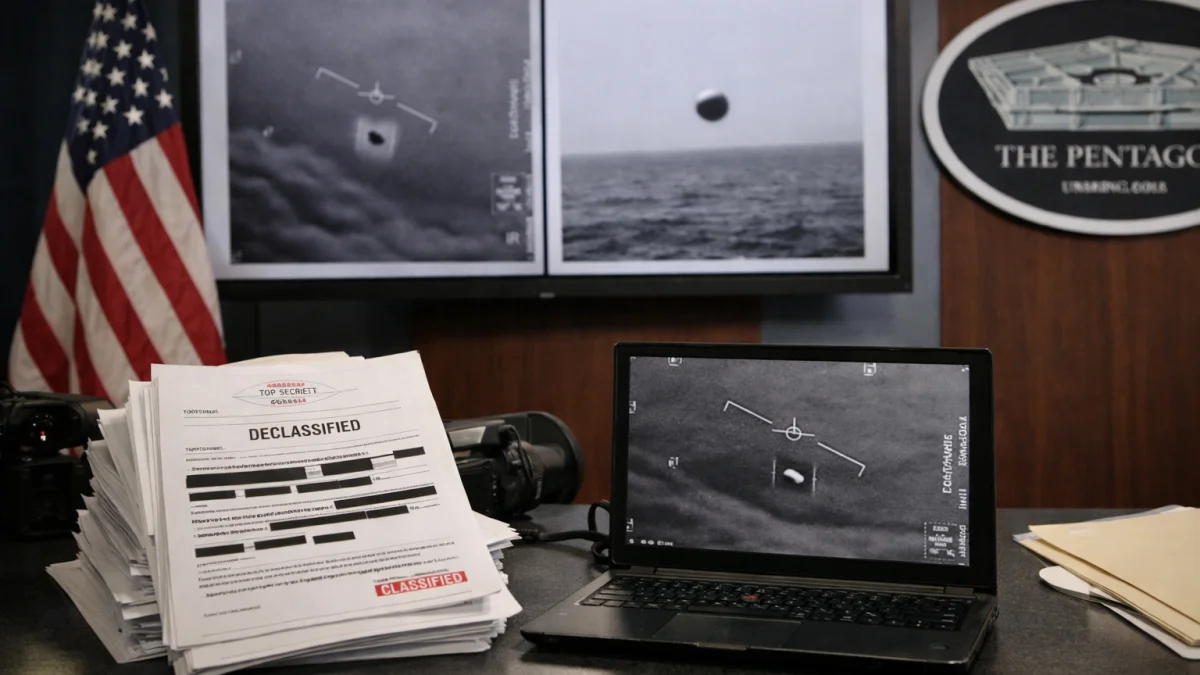
The Pentagon has released a fourth batch of declassified files and videos related to unidentified anomalous phenomena (UAP), continuing an unprecedented U.S. government transparency initiative that has steadily expanded public access to decades of military records, eyewitness accounts and sensor data. While the latest disclosures include previously unseen footage of unexplained aerial objects observed during military operations, officials have again stressed that the release should not be interpreted as evidence of extraterrestrial technology or alien life.
The significance of the latest release lies less in any single image or video than in the institutional shift it represents. For decades, U.S. military reporting on unidentified aerial incidents was fragmented, highly classified and often inaccessible outside government channels. Since May 2026, however, the Defense Department has adopted a structured process for publishing historical records under the Presidential Unsealing and Reporting System for UAP Encounters (PURSUE), responding to an executive order by President Donald Trump directing broader disclosure of government-held UAP material. Officials have described the effort as an exercise in transparency rather than an endorsement of extraordinary claims.
The newest release reportedly includes dozens of additional documents and videos, among them military footage showing unusual aerial objects tracked over operational areas. One widely discussed video depicts a six-pointed object recorded over the Yellow Sea, while other files describe orb-like or irregularly shaped objects observed by military personnel. In several cases, analysts have been unable to determine the origin of the objects based on available information alone. At the same time, some incidents have later been assessed as likely involving balloons, drones or other conventional explanations once additional data became available.
That distinction remains central to the Pentagon's approach. "Unidentified" does not imply extraterrestrial. Instead, it reflects the limits of available evidence at the time an incident is documented. The Defense Department's All-domain Anomaly Resolution Office (AARO), established to investigate such reports, has repeatedly concluded that most resolved cases involve ordinary objects, atmospheric effects, sensor limitations or human activity rather than unknown technology. Previous annual AARO assessments similarly found no verified evidence that investigated cases represented alien spacecraft or hidden foreign breakthrough capabilities, although a small number of reports remain unresolved because of insufficient data.
The continuing releases also reflect changing national security priorities. Military officials increasingly view unexplained aerial sightings through the broader lens of airspace security, intelligence collection and aviation safety rather than popular culture's longstanding association with UFOs. Unknown objects operating near military installations or training areas require investigation regardless of their eventual explanation because they may represent surveillance platforms, commercial drones, atmospheric phenomena or sensor anomalies affecting operational awareness. That security-focused framework has gradually replaced earlier public debates centered primarily on extraterrestrial possibilities.
The disclosures have generated substantial public interest. According to Pentagon officials, the government's UAP website has attracted exceptionally high traffic since its launch, illustrating sustained demand for official information on incidents that historically fueled speculation and conspiracy theories. By publishing original documents, photographs, audio recordings and videos, the Defense Department says it aims to allow independent researchers, journalists and the public to examine the same material available to government investigators while reducing misconceptions about what information remains classified.
Experts caution, however, that greater transparency does not necessarily produce definitive answers. Many videos were recorded under difficult operational conditions using infrared sensors or targeting systems optimized for military missions rather than scientific observation. Limited viewing angles, incomplete radar data, classified contextual information and short recording durations often constrain investigators' ability to reach firm conclusions. As a result, some cases remain officially unresolved without implying that extraordinary explanations are more likely than conventional ones.
The broader historical context also matters. Government interest in unidentified aerial reports is not new. The United States has conducted multiple official investigations dating back to the Cold War, including Project Sign, Project Grudge and Project Blue Book. More recently, congressional scrutiny, whistleblower allegations and bipartisan concern over military airspace incursions helped elevate UAP investigations from a niche subject to a recognized national security issue. The current disclosure program marks one of the largest sustained releases of historical UAP records by the U.S. government, although significant portions of military reporting remain classified because they contain sensitive operational information or intelligence sources and methods.
The latest release therefore represents another step in an evolving transparency effort rather than a definitive resolution of longstanding questions surrounding unidentified aerial phenomena. Officials continue to emphasize that the published material includes incidents with varying levels of evidentiary quality, many of which may ultimately receive conventional explanations as additional information becomes available. For now, the Pentagon says further batches of declassified records are planned, while AARO and other agencies continue evaluating unresolved cases under established national security and scientific review procedures.