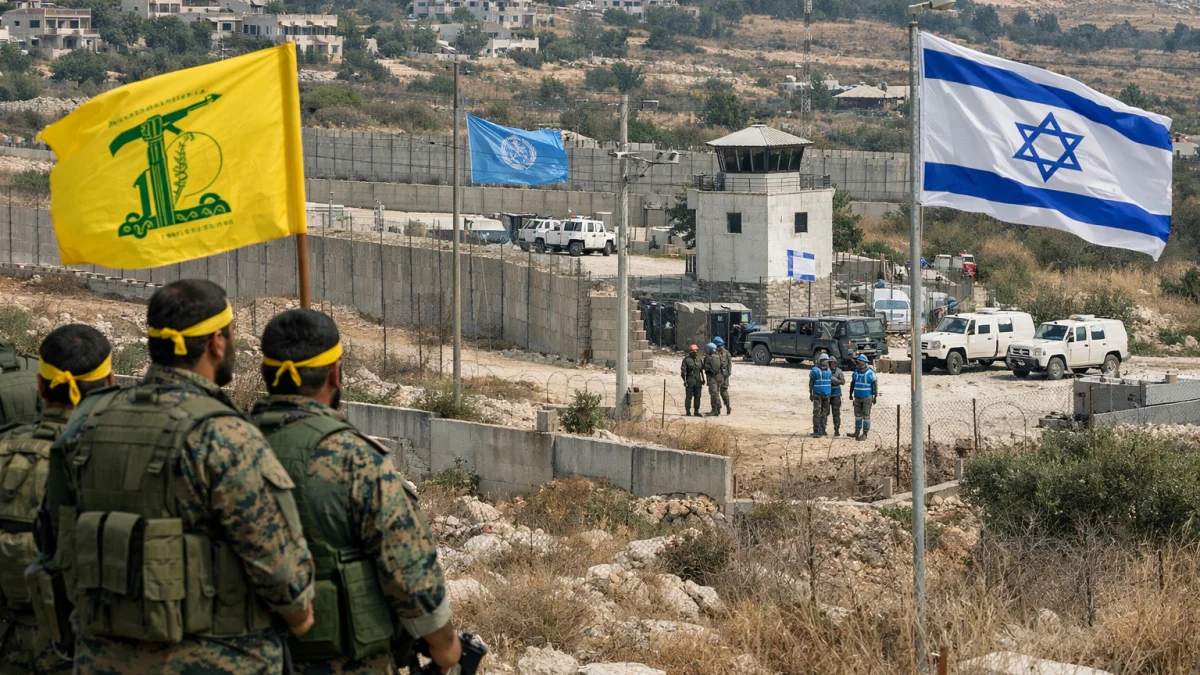
The Lebanon-Israel framework agreement signed with U.S. mediation has placed Hezbollah at the center of the most difficult question facing Lebanon’s fragile political system: whether the state can reassert control over armed power without triggering a new internal confrontation. The agreement, reached after months of renewed conflict, links an Israeli military withdrawal from southern Lebanon to the disarmament of Hezbollah and the transfer of security responsibility to the Lebanese Armed Forces (LAF).
The significance of the framework extends beyond the immediate Israeli-Lebanese front. It tests Lebanon’s ability to enforce the principle that only state institutions should control national security decisions, while exposing the limits of a government that has historically struggled to challenge Hezbollah’s independent military structure. The agreement creates a diplomatic pathway toward a longer-term settlement, but its implementation depends on resolving the central contradiction of Lebanese politics: Hezbollah is simultaneously a powerful political actor inside the state and an armed organization operating outside full government command.
Under the framework, Lebanon and Israel agreed on a process involving Lebanese military deployment in designated “pilot zones” in southern Lebanon, reconstruction efforts, and a U.S.-supported mechanism to oversee implementation. Israel has tied a full withdrawal to verification that Hezbollah’s military infrastructure has been dismantled and that the group no longer represents a security threat. The agreement also outlines future negotiations aimed at a broader peace and security arrangement between the two countries.
For Hezbollah, the framework represents a direct challenge to the group’s long-standing role as Lebanon’s main armed force outside the state. Hezbollah has rejected the agreement, arguing that it threatens Lebanese sovereignty and its position as a resistance movement against Israel. Parliament Speaker Nabih Berri, an ally of Hezbollah, has also criticized the deal and warned that it could deepen domestic divisions.
The dispute reflects a long-running issue in Lebanon. Following the 1975-1990 civil war, international agreements and United Nations resolutions called for the disarmament of militias and the expansion of state authority. However, Hezbollah retained its weapons, arguing that its arsenal was necessary to deter Israel, particularly after Israel’s withdrawal from southern Lebanon in 2000. The 2006 Israel-Hezbollah war further reinforced the group’s military identity, even as Lebanese governments repeatedly faced pressure to bring all weapons under state control.
The current framework differs from previous arrangements because it directly connects Hezbollah’s disarmament with Israeli withdrawal and reconstruction. Analysts have noted that this creates both a diplomatic opening and a major implementation challenge. The Lebanese state must demonstrate the capacity to deploy forces, maintain security, and manage reconstruction while avoiding a confrontation with a heavily armed domestic actor.
The Lebanese Armed Forces are expected to play a central role, but their ability to replace Hezbollah’s military presence remains a key uncertainty. The LAF is the country’s official security institution, yet Lebanon’s political system has traditionally relied on consensus among competing sectarian groups, making decisions involving Hezbollah particularly sensitive. Analysts have warned that without political agreement inside Lebanon and sustained international support, the framework could remain a diplomatic document rather than becoming an operational security arrangement.
The economic dimension is also significant. Lebanon has faced a severe financial crisis since 2019, and reconstruction needs have increased after years of conflict and instability. The framework includes international support for recovery efforts, but the flow of aid is likely to depend on whether Lebanon can demonstrate that state institutions, rather than armed groups, control implementation mechanisms.
Israel views the agreement primarily through a security lens, seeking to prevent a repeat of cross-border attacks and establish greater control over threats along its northern border. Lebanese officials supporting the framework have emphasized sovereignty, territorial integrity, and the return of displaced civilians. The United States has presented the agreement as a process intended to reduce conflict and strengthen Lebanese institutions, while European officials have called for compliance with the arrangement and support for Lebanon’s government.
The immediate test will be whether the parties can move from commitments on paper to verified actions on the ground. Key issues remain unresolved, including the pace of Israeli withdrawal, the scope of Hezbollah’s disarmament, the authority of Lebanese forces in affected areas, and the political response inside Lebanon. The framework has created a new diplomatic mechanism, but officials and observers are monitoring whether it can overcome the deeper political and security realities that have shaped Lebanon for decades.