The mural went up on a Friday in June, six colors deep against a Chinatown storefront on Grant Avenue — the face of a San Francisco-born cook who, in 1898, forced the United States Supreme Court to decide who counts as American. The new mural at 701 Grant Ave. depicts Wong Kim Ark, the man at the center of the landmark 1898 case that affirmed birthright citizenship for those born on U.S. soil. Four days later, his great-granddaughter was refreshing the Supreme Court's website, waiting to learn whether that legacy would survive a second trial, this one nearly 130 years after the first.
Sandra Wong had gone looking that morning for the ruling that would affect millions, telling AsAmNews she had never followed a Supreme Court case so closely before and wasn't sure how the process worked. She had hoped a decision would arrive the week before, in time to coincide with the mural's unveiling, but instead spent days trying not to dwell on the wait, telling herself there was nothing left to do but let the ruling come when it came.
The case, formally Trump v. Barbara, asked the justices to decide whether children born in the United States to parents who are undocumented or only temporarily present are entitled to citizenship under the Fourteenth Amendment — the same question, in different clothing, that Wong Kim Ark had carried to the court in 1898. That his descendants would still be arguing it in 2026 is itself a measure of how contested the doctrine of birthright citizenship, once treated as settled law, has again become.
Wong Kim Ark was born in San Francisco in 1873 to Chinese immigrant parents who ran a business in the city before eventually returning to China. In 1895 he traveled to visit family there, and on his return to the United States was told he was not a citizen and denied reentry. He challenged the denial, and the Supreme Court ruled in his favor by a vote of six to two, holding that the phrase "subject to the jurisdiction thereof" in the Fourteenth Amendment extended citizenship to nearly all children born on American soil, regardless of their parents' status. The ruling proved so durable that even amid the anti-Japanese hostility of World War II, children born to Japanese nationals held in American internment camps were still recognized as citizens by birth.
That durability was tested again after President Donald Trump, in the opening days of his second term, issued an executive order seeking to deny citizenship to children born to parents who were in the country illegally or temporarily. Legal challenges followed, and the administration eventually appealed to the Supreme Court, which agreed in December 2025 to hear the case; oral arguments took place on April 1, 2026, with Trump attending in person — the first sitting president ever to do so at the court.
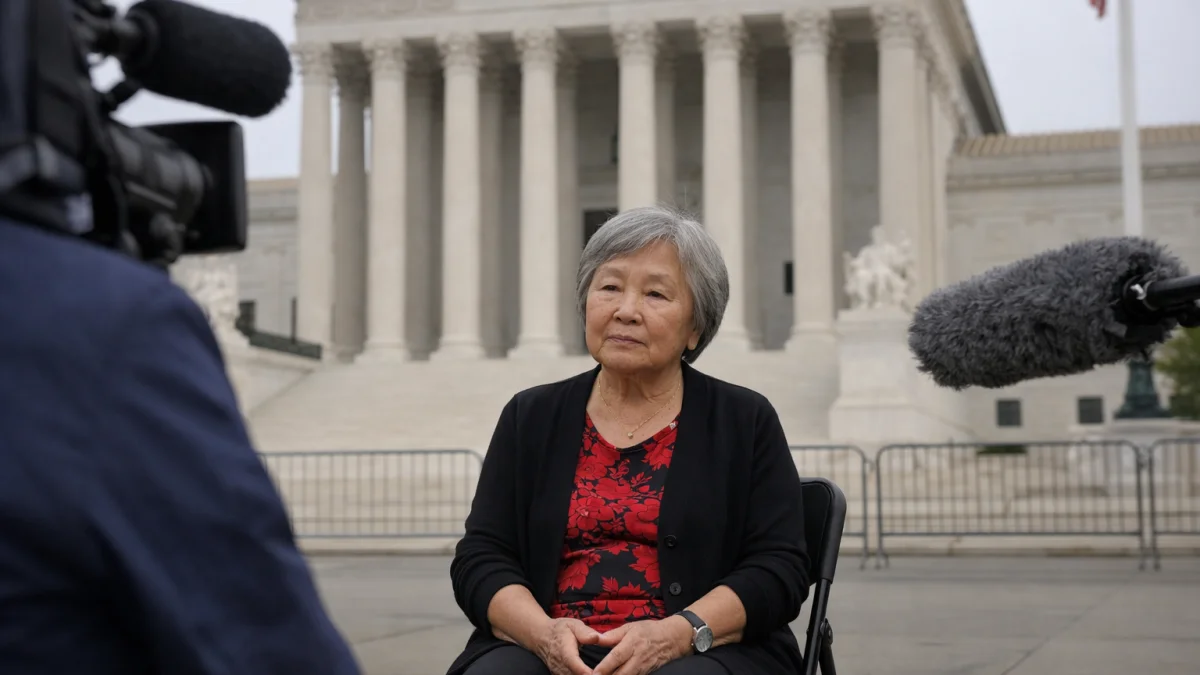
Norman Wong, Sandra's brother and Wong Kim Ark's other great-grandchild, was in the crowd outside the courthouse that day. He had traveled to Washington to rally and to tell people about his great-grandfather's story, later saying at the demonstration that the fight their ancestor waged was never only his own — that it belonged to Norman and to generations that would come after. Wong, 76, only learned in his fifties that Wong Kim Ark was his great-grandfather; his own father had rarely spoken of the family's history, until Chinese-language newspaper reporters, having found the name in old court records, came looking for an interview. Since Trump's order took effect, Wong has become an unlikely public face of the effort to defend birthright citizenship, giving speeches and interviews that began in January 2025.
On June 30, 2026, the court ruled, upholding the lower courts and rejecting the administration's arguments by a vote of six to three. Writing for the majority, Chief Justice John Roberts held that the settled understanding of the Fourteenth Amendment, ratified after the Civil War, makes anyone born in the United States a citizen, with only narrow exceptions. Justices Clarence Thomas, Samuel Alito and Neil Gorsuch dissented; in a dissent, Thomas argued the amendment was designed to secure rights for freed Black Americans and has instead been "repurposed for political projects" the Reconstruction Congress never intended. Trump responded on social media that the ruling was "too bad for our Country" but predicted Congress could "easily" undo it through legislation, while White House aide Stephen Miller called the decision "one of the most destructive and outrageous" in the court's history.
For Sandra Wong, the news did not arrive through the court's own language, which she found dense and difficult to parse on first read. She said she began receiving text messages from others almost as soon as the opinion posted, and those messages did more to explain what had happened than the ruling's text did on its own. In a statement to the New York Times, she said simply that being born in the country means belonging to it, adding that her great-grandfather never intended to become a symbol but stood up for what was right, and that it mattered. She told Newsweek she did not want to presume what Wong Kim Ark himself would have felt, but imagined he would have been relieved, given how many times immigration officials had questioned him and demanded paperwork just to reenter the country of his birth.
Norman Wong framed the outcome less as a family vindication than as a civic obligation. "I don't consider this stuff a personal victory," he said. "It's an obligation and a duty for every American to care about this because ultimately we're not fighting for the rights of Chinese or Japanese or whatever. We're fighting for rights for all Americans because these are fundamental rights."
California Attorney General Rob Bonta, who sat in the same row as Trump during April's oral arguments, said his office had since heard from hundreds of people — disproportionately Black, Latino, Asian American and Pacific Islander — worried their citizenship could be stripped over a parent's immigration status. Bonta said the ruling should let people "breathe a little easier," while cautioning that broader attacks on immigrants' legal standing had not ended.
Sandra Wong voiced a similar caution. Ahead of the country's 250th anniversary, she called the ruling a victory but said the fight had only gone "as far as it did" for now, not necessarily its full distance. On the Chinatown block where the mural now stands, the portrait of a man once turned away at the border remains fixed in place — a reminder, his descendants say, that the question he answered in 1898 did not stay answered on its own.