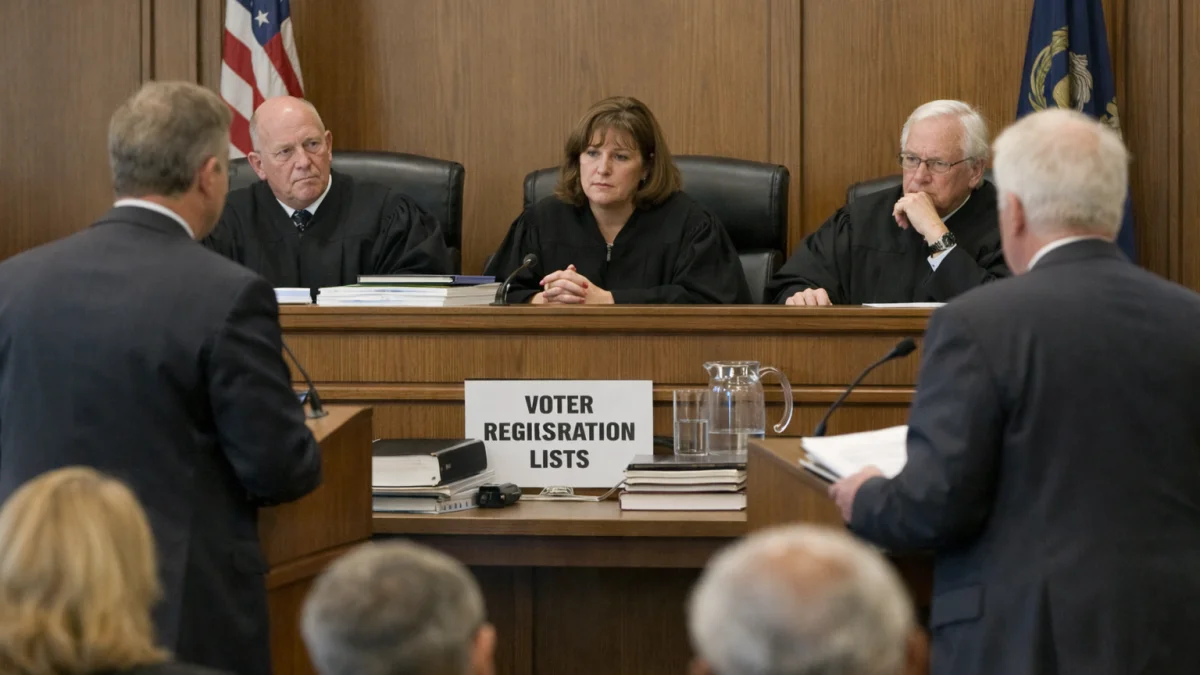
U.S. courts are increasingly at the center of a legal battle over the scope of federal protections against late voter-roll purges, with a Republican-backed effort to narrow those safeguards poised to test longstanding interpretations of federal election law ahead of the 2026 midterm elections.
The dispute has significance beyond Arizona, where the current litigation originated. At issue is how the National Voter Registration Act (NVRA) of 1993 should be interpreted, particularly its requirement that states complete systematic programs for removing ineligible voters at least 90 days before a federal election. The Supreme Court's decision to hear a Republican-led appeal challenging lower-court rulings that blocked portions of Arizona's voting law could determine how aggressively states may update voter rolls in future elections while balancing election administration against protections for eligible voters.
The Arizona case combines two closely watched questions: documentary proof-of-citizenship requirements for voter registration and the authority of election officials to remove suspected noncitizens from voter rolls. Arizona Republicans argue the measures are necessary to safeguard election integrity and ensure that only eligible citizens vote. The Trump administration has backed key elements of that position, continuing a broader national emphasis on identifying allegedly ineligible registrations.
Opponents, including voting-rights organizations and Democratic officials, contend that the disputed provisions conflict with the NVRA, which allows applicants registering for federal elections to attest to U.S. citizenship under penalty of perjury rather than providing documentary proof. Lower federal courts agreed with much of that reasoning, concluding that portions of Arizona's law were preempted by federal statute. The Supreme Court will now determine whether those rulings properly interpreted congressional protections.
The broader legal debate extends to the NVRA's so-called "quiet period," which prohibits systematic voter-list maintenance within 90 days of a federal election. Congress included the restriction to reduce the risk that eligible voters could be mistakenly removed shortly before Election Day without sufficient time to restore their registrations.
Republican officials increasingly argue that the prohibition should not prevent states from removing individuals believed to be noncitizens, particularly when new information becomes available. Some legal arguments distinguish between broad, systematic maintenance programs and individualized eligibility determinations, contending that the latter should remain permissible during the 90-day window. Voting-rights advocates respond that an expansive interpretation could substantially weaken one of the NVRA's principal safeguards against erroneous disenfranchisement.
Recent litigation illustrates how that disagreement has evolved. Before the 2024 election, the Supreme Court allowed Virginia to continue a voter-removal program during the quiet period through an emergency order that did not explain the Court's reasoning. Election-law scholars have since debated whether that action signals greater judicial willingness to permit certain voter-roll maintenance activities closer to elections than previously understood. Several ongoing lawsuits now explicitly test those boundaries.
The legal conflict also intersects with broader disputes over federal involvement in election administration. The Trump administration has sought access to state voter-registration data and has encouraged broader verification efforts intended to identify ineligible voters. Multiple federal courts, however, have rejected several Justice Department attempts to compel states to provide complete voter-registration lists, finding insufficient statutory authority or inadequate justification for the requests.
Separately, a federal judge recently blocked expanded use of the federal SAVE citizenship-verification system after concluding that modifications to the database raised privacy concerns and risked incorrectly identifying eligible citizens. Supporters of expanded verification maintain that such tools strengthen election security, while critics argue that database inaccuracies can produce false matches affecting lawful voters. Those disputes remain the subject of continuing litigation.
The political backdrop remains highly contested. Republican officials have consistently argued that stronger citizenship verification and more frequent voter-roll maintenance enhance public confidence in elections. Democratic lawmakers and voting-rights organizations counter that documented cases of noncitizen voting remain rare and that additional administrative hurdles disproportionately affect certain groups, including some minority, Native American, student and elderly voters who may face greater difficulty obtaining documentary proof of citizenship. Courts reviewing these claims have generally focused on statutory interpretation rather than broader political arguments.
Historically, the Supreme Court has played a central role in defining the balance between federal voting protections and state authority over election administration. Previous decisions have both expanded and narrowed aspects of the Voting Rights Act and other election laws, making the upcoming Arizona case part of a broader judicial reassessment of election regulation. Legal analysts note that any ruling clarifying the NVRA's quiet-period protections could influence election administration nationwide because most states operate under the statute's requirements.
For now, the existing lower-court rulings largely remain in effect while the Supreme Court prepares to hear arguments during its next term. Election officials, political parties and advocacy organizations are closely monitoring how the Court defines the limits of voter-roll maintenance under federal law. Until the justices issue a decision, uncertainty will remain over how broadly states may conduct voter-roll removals before federal elections and how courts will reconcile election-security objectives with statutory protections designed to prevent eligible voters from being mistakenly removed from the rolls.