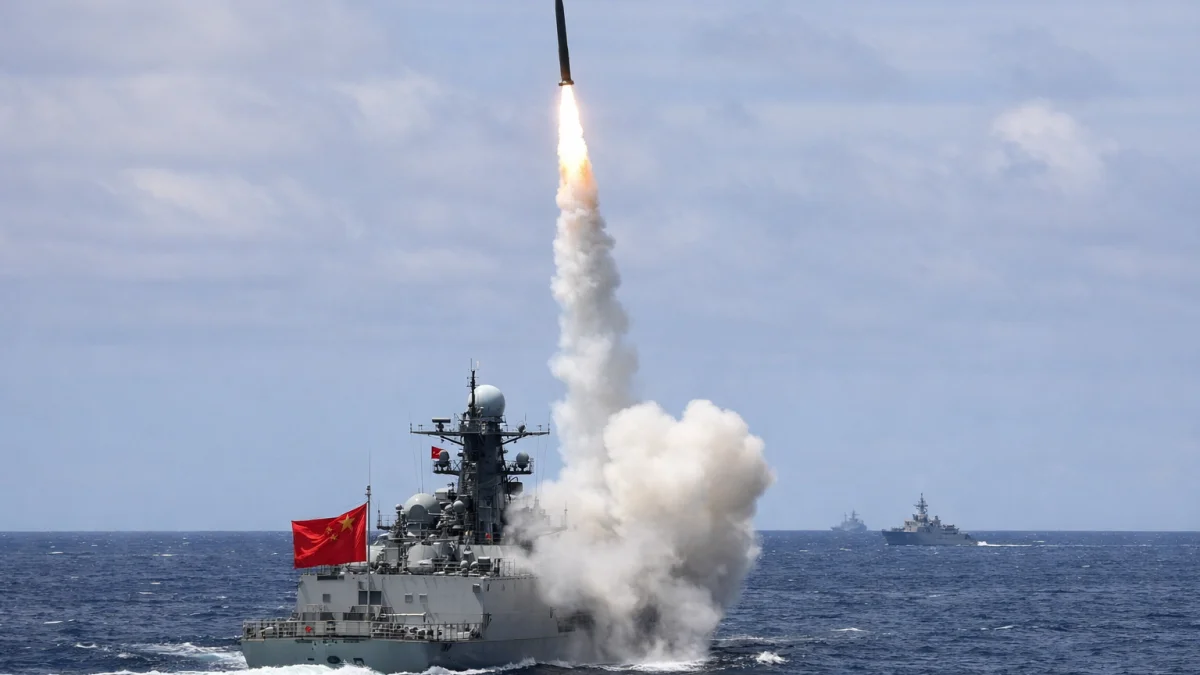
China's launch of a long-range ballistic missile from a nuclear-powered submarine into the South Pacific has renewed scrutiny of the country's evolving nuclear deterrent while prompting regional governments to question the implications for security and strategic stability. The missile, carrying a dummy warhead according to Chinese state media, was described by Beijing as part of routine annual military training and not directed at any specific country. Nevertheless, Australia, Japan and New Zealand publicly expressed concern, underscoring how military demonstrations increasingly carry diplomatic consequences beyond their stated operational purpose.
The test is significant because it extends beyond a demonstration of missile technology. Analysts view it as one of the clearest public signals to date that China is seeking to reinforce the credibility of its sea-based nuclear deterrent, an increasingly important component of its broader military modernization. Unlike land-based missile forces, ballistic missile submarines are intended to provide a survivable second-strike capability by remaining difficult to detect during a conflict. Demonstrating that such systems can successfully launch long-range missiles over operational distances strengthens perceptions of that capability, even when no live nuclear payload is involved.
China has characterized the launch as lawful and routine. State media reported that relevant countries received advance notification and that the missile landed in designated international waters. Chinese officials urged governments not to "over-interpret" the exercise, arguing that it complied with international law and standard military practice. Advance notification reflects an established risk-reduction measure intended to lower the chance of accidental escalation during missile testing.
Regional governments, however, emphasized that legality does not eliminate strategic concerns. Australian Foreign Minister Penny Wong described the launch as destabilizing, while New Zealand said the test was unwelcome, particularly because it occurred in the South Pacific, a region covered by the Treaty of Rarotonga establishing a South Pacific Nuclear Free Zone. Although the treaty does not prohibit missile overflights or tests by non-parties in international waters, officials argued that such activities risk undermining the region's longstanding commitment to limiting nuclear-related military activity. Japan also voiced concern from the perspective of regional security and said it would continue close monitoring.
The launch also reflects broader changes in China's military posture. For decades, Beijing maintained what many analysts described as a relatively modest nuclear force centered primarily on land-based missiles. Over the past several years, however, the United States and independent researchers have documented rapid expansion in China's nuclear infrastructure, including new missile silo fields, improvements to mobile missile forces and continued investment in ballistic missile submarines. The U.S. Department of Defense has projected that China's operational nuclear arsenal could exceed 1,000 warheads by 2030 if current trends continue, although Beijing has not confirmed such estimates.
A credible sea-based deterrent carries strategic implications beyond China's immediate neighborhood. Nuclear-powered ballistic missile submarines are designed to remain operational even if land-based forces are threatened, complicating an adversary's military planning. Demonstrating successful submarine-launched ballistic missile operations therefore contributes to deterrence by signaling that China's nuclear forces could remain capable of retaliation under a range of scenarios. Defense analysts note that such signaling is common among established nuclear powers, although the visibility of the test inevitably increases political attention.
The timing has also drawn attention. The missile launch occurred shortly after Australia signed a new defense agreement with Fiji aimed at strengthening regional security cooperation. While some observers suggested the coincidence may carry strategic messaging, officials and analysts cautioned against assuming a direct connection, noting that major missile tests typically require months of operational planning. Australian officials said they had been informed in advance by China but maintained that the exercise nonetheless heightened regional tensions.
The episode illustrates a broader challenge confronting the Indo-Pacific security environment. Military modernization by major powers increasingly intersects with diplomatic competition, alliance-building and regional confidence-building measures. Actions intended by one government as demonstrations of deterrence may be interpreted by neighboring states as evidence of growing military pressure, particularly in a region already marked by disputes over maritime claims, Taiwan, and expanding defense partnerships.
At present, the confirmed facts remain limited but consequential. China has acknowledged conducting the submarine-launched ballistic missile test with a dummy warhead and maintains it was a routine training activity conducted safely and in accordance with international practice. Australia, Japan and New Zealand have formally expressed concern, while analysts continue to assess what the launch indicates about the maturity of China's sea-based nuclear deterrent. Officials across the region are now monitoring whether the test remains an isolated demonstration or becomes part of a more regular pattern of strategic signaling in the Pacific.