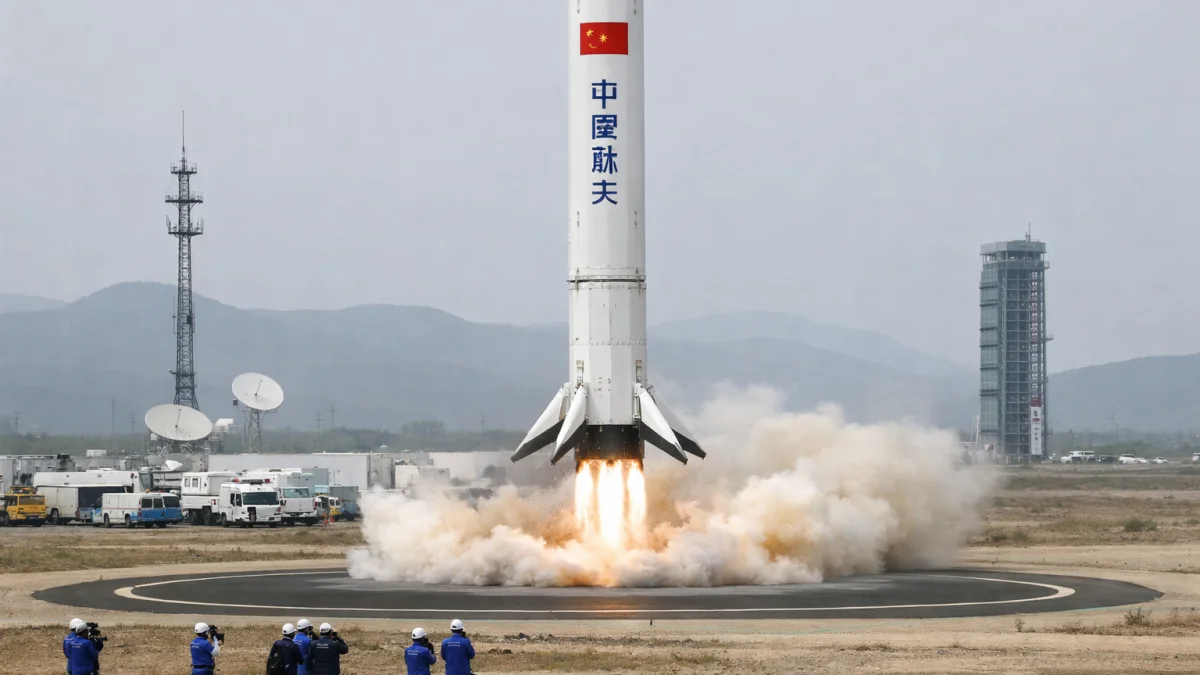
BEIJING — China has successfully completed its first controlled recovery of an orbital-class rocket booster, marking a significant milestone in the country's effort to develop reusable launch technology that could reduce spaceflight costs and support future commercial and lunar missions.
The achievement came during the maiden flight of the Long March-10B carrier rocket on July 10, when the launch vehicle lifted off from the Hainan commercial space launch site in southern China and placed its payload into its planned orbit, according to state broadcaster CCTV and the China Academy of Launch Vehicle Technology (CALT). About six minutes after stage separation, the rocket's first-stage booster returned under controlled flight and was recovered on an offshore platform using a net-based capture system.
Chinese state media described the operation as the country's first successful controlled recovery of a carrier rocket's first stage and said it represented a major advance in reusable launch technology. Officials also said the mission marked the world's first recovery of an orbital-class launch vehicle using a net-capture system at sea.
Unlike SpaceX's Falcon 9 system, which lands boosters vertically on landing legs, China's recovery method relies on a large net mounted on a seaborne platform. Chinese engineers say the approach reduces the weight required for landing hardware, allowing the rocket to carry more payload while adapting to varying offshore recovery conditions.
The Long March-10B, developed by CALT, is designed to carry at least 16 metric tons into low-Earth orbit. The rocket forms part of China's broader strategy to expand commercial launch capacity, deploy large satellite constellations and support future human lunar exploration missions planned before the end of the decade, according to Chinese authorities.
Industry analysts said the successful recovery narrows the technological gap with the United States in reusable launch systems, although China has yet to demonstrate routine booster reuse comparable to SpaceX's operational program. Previous Chinese attempts by government and private-sector developers to recover orbital-class boosters had not achieved a successful controlled recovery.
Chinese officials said the recovered booster is expected to undergo further evaluation, with another Long March-10B mission planned later this year as engineers continue testing the vehicle's reusability.