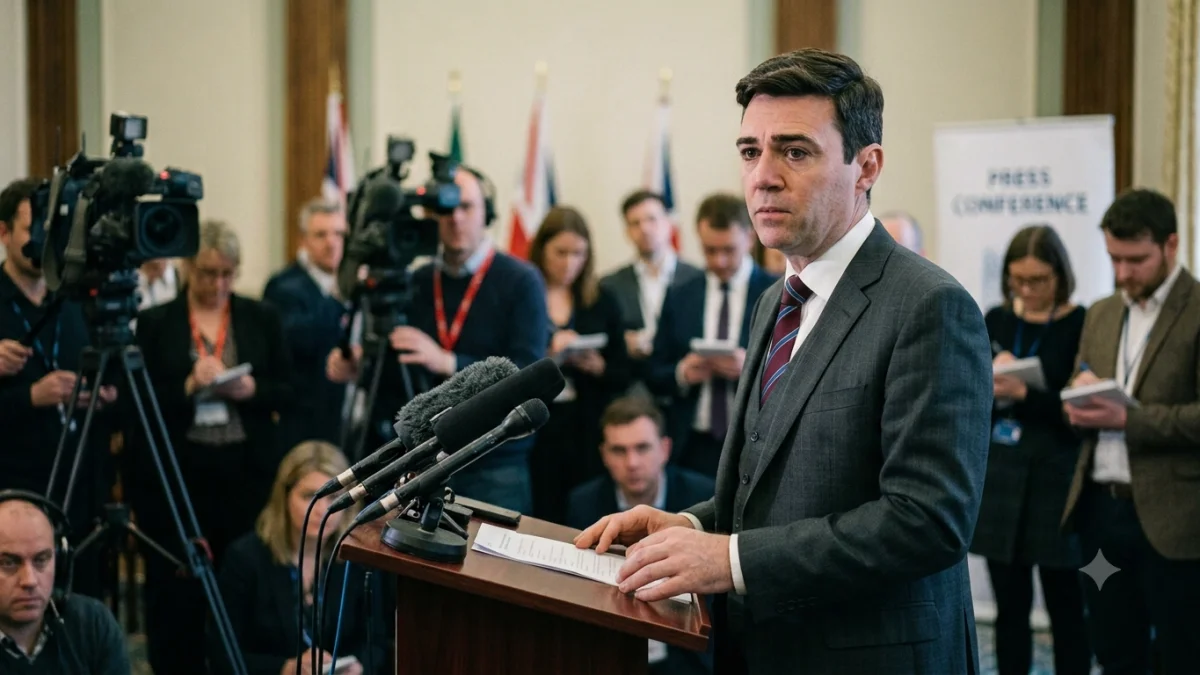
Andy Burnham's appointment as Britain's prime minister without a general election marks a significant leadership change for the governing Labour Party while underscoring the constitutional flexibility of the United Kingdom's parliamentary system. The former mayor of Greater Manchester assumed office after winning the Labour leadership unopposed following Keir Starmer's resignation, allowing the governing party to replace its leader—and therefore the head of government—without returning to voters because Labour continues to command a majority in the House of Commons.
The transition is politically significant because it attempts to reset a government that has struggled to maintain public support despite securing a strong parliamentary mandate at the previous general election. Burnham inherits office at a time when opinion polls have reflected growing pressure on Labour from opposition parties, particularly Reform UK, while economic concerns, pressure on public services and questions over living standards continue to dominate domestic politics. His elevation therefore represents not merely a change of leadership but an effort by Labour to restore political momentum without risking an early national election.
Although some political opponents have argued that a leader taking office without a fresh public vote lacks a renewed electoral mandate, constitutional experts note that Britain's parliamentary system is designed around confidence in the House of Commons rather than the direct election of a prime minister. Voters elect Members of Parliament, and the monarch appoints as prime minister the individual judged capable of commanding the confidence of the Commons. Similar leadership transitions occurred when Theresa May succeeded David Cameron in 2016, Boris Johnson replaced May in 2019, Liz Truss succeeded Johnson in 2022, and Rishi Sunak replaced Truss later that year, all without immediate general elections.
Even so, Burnham's accession differs in several respects. He returned to Parliament only weeks before becoming Labour leader after years serving as Greater Manchester mayor, making his path to Downing Street unusually rapid. His political identity has been shaped less by Westminster than by local government, where he became associated with greater devolution, regional investment and public transport reform. Supporters argue that experience could strengthen efforts to decentralize decision-making beyond London, while critics question whether local executive leadership readily translates into managing national government and foreign policy.
Burnham has attempted to frame his premiership around political stability after a decade marked by repeated changes of leadership. Britain has now had seven prime ministers in roughly 10 years, a level of turnover that economists and political analysts have frequently linked to uncertainty over long-term policymaking and investor confidence. In his first statements after taking office, Burnham emphasized restoring trust, reducing living costs, tackling homelessness, reforming social care and pursuing a longer-term strategy for economic renewal while maintaining support for Ukraine and close relations with international allies.
The economic dimension of the transition may ultimately prove as important as the political symbolism. Markets and businesses have closely monitored Burnham's choice of senior ministers, particularly the chancellor responsible for fiscal policy, given Britain's constrained public finances. Burnham has pledged fiscal discipline while avoiding increases in the main personal taxes, a combination that analysts say will require difficult spending choices or alternative revenue measures if economic growth remains subdued. Questions also remain over how his government will finance expanded housing, infrastructure and social care commitments alongside higher defence spending.
Institutionally, Burnham has also indicated an interest in reshaping how the centre of government operates. Reports suggest he intends to strengthen policy coordination within Downing Street and place greater emphasis on performance monitoring across departments, while giving renewed prominence to regional government through closer engagement with metro mayors. If implemented, such administrative reforms could alter the balance between the Prime Minister's Office, the Treasury and other departments, although their effectiveness will depend on cabinet cohesion and parliamentary support.
Politically, Burnham faces the dual challenge of governing while simultaneously convincing voters that Labour has changed course without abandoning its core agenda. His leadership avoids the disruption of a general election but leaves the government responsible for delivering results under the mandate won in the previous election. Whether voters ultimately view the leadership change as a substantive reset or simply a change of personnel will likely depend on measurable improvements in economic performance, public services and political stability rather than the transition itself.
For now, the confirmed position is that Burnham has lawfully assumed office after securing Labour's leadership and the confidence of the governing parliamentary majority. The immediate focus of official attention has shifted to cabinet appointments, fiscal policy, the government's legislative priorities and the implementation of its promised reform programme. Those developments, together with Parliament's response and future public opinion, will provide the clearest evidence of whether the leadership transition succeeds in achieving the stability Burnham has identified as his central objective.