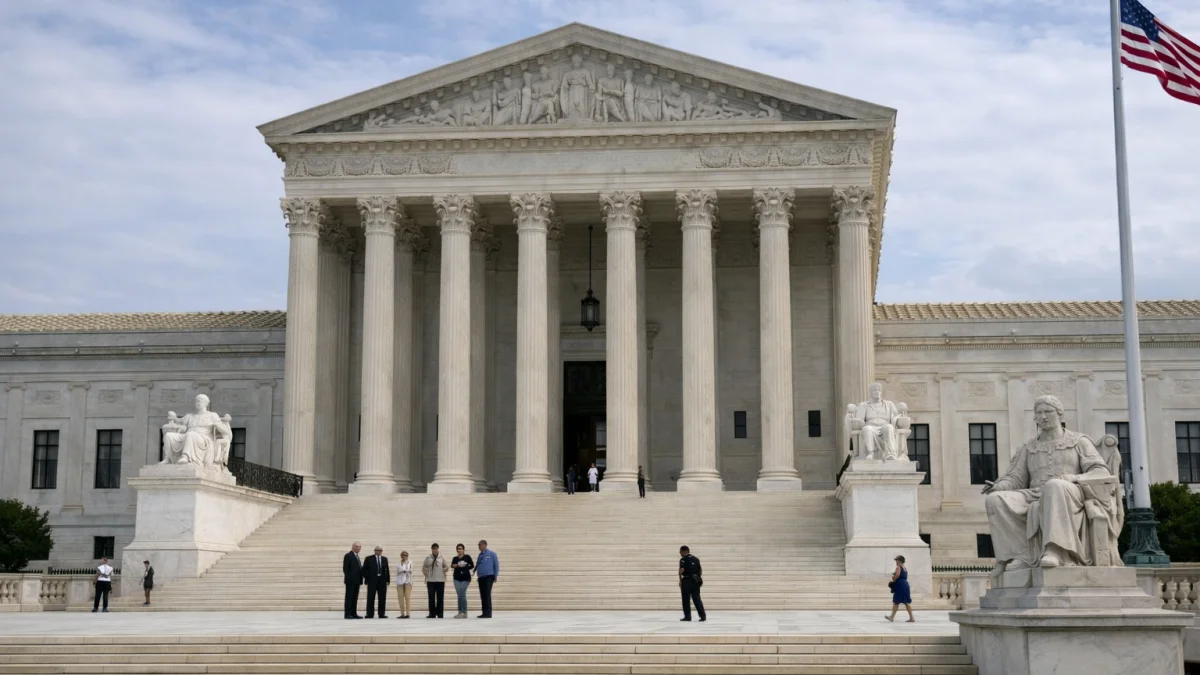
The U.S. Supreme Court has fundamentally altered the balance of authority between the presidency and the federal administrative state by ruling that the president may remove leaders of independent executive agencies without the statutory protections that had insulated many of them for decades. In a 6-3 decision in Trump v. Slaughter, the Court upheld President Donald Trump's dismissal of Federal Trade Commission Commissioner Rebecca Slaughter and overruled the 1935 precedent established in Humphrey's Executor v. United States, which had long permitted Congress to shield certain agency officials from removal except for specified causes.
The ruling is significant not only because it resolves a dispute over one commissioner, but because it redefines the constitutional relationship between Congress and the executive branch. For nearly a century, Humphrey's Executor formed a cornerstone of the legal framework supporting independent regulatory commissions. By discarding that precedent, the Court has expanded presidential authority over agencies that regulate financial markets, consumer protection, labor relations, competition policy, communications, and other areas where Congress had sought to reduce direct political influence.
Chief Justice John Roberts, writing for the majority, concluded that officials exercising executive power must remain accountable to the president under Article II of the Constitution. The Court reasoned that statutory restrictions preventing the president from removing such officials interfere with the executive's constitutional responsibility to ensure that federal law is faithfully executed. The majority characterized modern regulatory agencies, including the Federal Trade Commission, as exercising core executive functions through investigations, enforcement actions, rulemaking, and litigation, making presidential supervision constitutionally necessary.
The decision represents one of the Court's most consequential endorsements of the "unitary executive" theory, a constitutional interpretation holding that executive power ultimately resides in the president. While earlier Supreme Court decisions had gradually expanded presidential authority over executive officials, Trump v. Slaughter marks a sharper departure by expressly overturning one of the Court's most enduring precedents governing administrative independence. Legal scholars across the ideological spectrum have described the ruling as a defining moment in the evolution of separation-of-powers doctrine, even as they differ over its constitutional merits.
The practical implications extend well beyond the FTC. Approximately two dozen multimember agencies were created with fixed terms and "for-cause" removal protections designed to promote continuity across administrations. Although the statutory missions and regulatory authorities of those agencies remain unchanged, leadership turnover could now become more closely aligned with presidential priorities. That shift may allow future administrations to implement policy changes more rapidly by replacing commissioners whose regulatory philosophies differ from those of the White House.
Supporters of the ruling argue that the decision restores democratic accountability by ensuring that executive officials answer to an elected president rather than operating with substantial insulation from political oversight. They contend that voters can more effectively evaluate presidential performance when executive agencies reflect presidential policy choices, rather than pursuing agendas established by officials protected from removal. The Trump administration welcomed the ruling as a reaffirmation of constitutional executive authority.
Critics, including the Court's three dissenting justices, argue that the decision weakens institutional safeguards that Congress deliberately created to reduce political influence over regulatory enforcement. They contend that independent agencies have historically been designed to provide expertise, continuity, and stability in areas where long-term regulatory consistency is viewed as economically or institutionally important. Some legal experts have warned that easier removal of commissioners could increase policy volatility as successive administrations reshape agency leadership more frequently.
Notably, the Court stopped short of extending the same principle to every federal institution. In a separate decision involving Federal Reserve Governor Lisa Cook, the justices declined to permit her removal, preserving at least for now the central bank's institutional independence. That outcome suggests the Court continues to recognize constitutional or statutory distinctions among agencies, particularly where longstanding historical practice and monetary policy considerations are involved. As a result, while Trump v. Slaughter substantially expands presidential authority, it does not eliminate all limits on executive removal power.
The ruling also reflects a broader trajectory in recent Supreme Court jurisprudence concerning administrative governance. Alongside decisions limiting judicial deference to agency interpretations of federal law and scrutinizing congressional delegations of regulatory authority, the latest decision reinforces the Court's willingness to reshape the constitutional foundations of the modern administrative state. Together, these decisions signal increased judicial attention to structural questions concerning the distribution of governmental power rather than solely the substance of federal regulation.
For now, the immediate legal effect is clear: presidents possess substantially greater authority to remove leaders of many independent executive agencies than they have at any point in nearly a century. The longer-term consequences will depend on how future administrations exercise that authority, how Congress responds through legislation, and how lower courts apply the Supreme Court's reasoning to other agencies with differing statutory structures. Those issues are likely to generate further litigation as courts, policymakers, and regulated industries assess the practical reach of one of the most consequential executive-power rulings in decades.