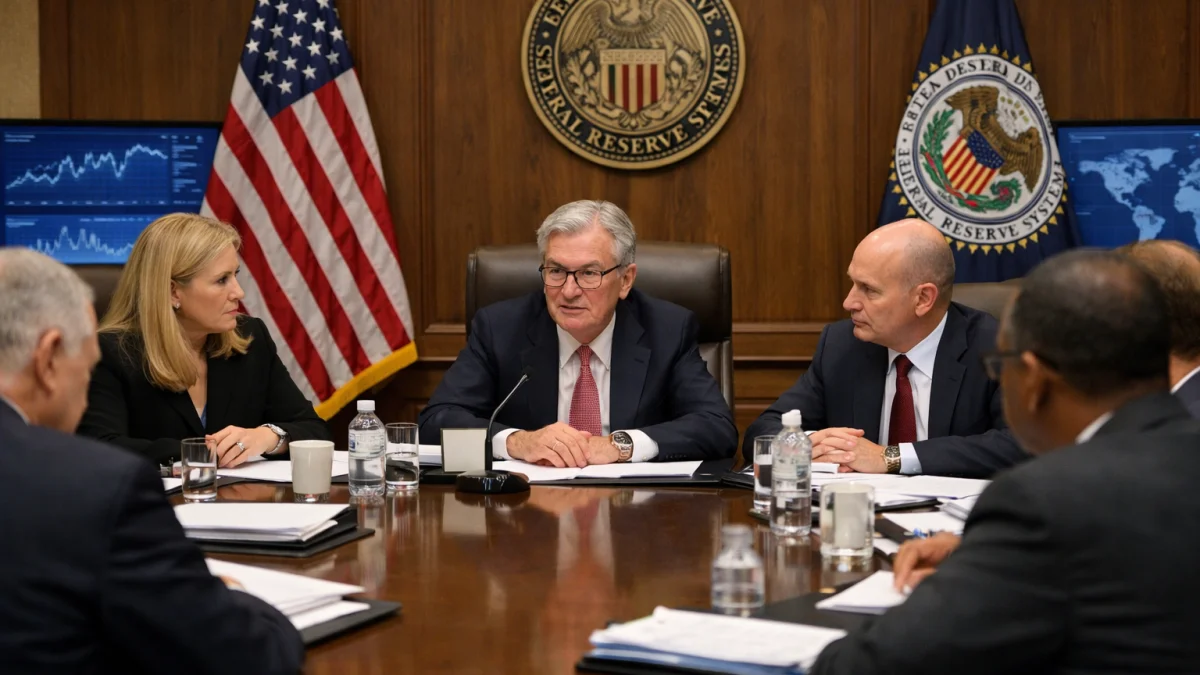
WASHINGTON — Federal Reserve officials are continuing to emphasize a data-dependent approach to monetary policy as they weigh the future path of U.S. interest rates against a backdrop of persistent inflation and heightened global uncertainty, according to recent official statements and public remarks delivered after the central bank's June policy meeting.
The discussion follows the Federal Open Market Committee's decision on June 17 to leave its benchmark federal funds rate unchanged at a target range of 3.50% to 3.75%, while reaffirming its commitment to restoring inflation to its 2% objective. The central bank said economic activity had continued to expand at a solid pace despite elevated uncertainty, citing in part the effects of conflict in the Middle East and continuing inflationary pressures.
In its policy statement, the FOMC said, "Inflation remains elevated relative to the Committee's 2 percent goal," adding that it would continue to monitor incoming information, the evolving outlook and the balance of risks before adjusting monetary policy. The statement also noted that job gains had kept pace with labor force growth while the unemployment rate had changed little.
Federal Reserve officials have reinforced that message in speeches during June. Governor Christopher J. Waller, speaking at a conference in Washington on June 22, addressed the international role of the U.S. dollar, while other policymakers continued public engagements on financial regulation and the economic outlook. The Federal Reserve has not indicated any predetermined timetable for future rate changes, according to its published schedule of speeches and official communications.
Attention has also focused on the Federal Reserve's communication strategy under Chair Kevin Warsh. Recent public reporting indicates Warsh has sought to reduce reliance on forward guidance, arguing that financial markets should respond primarily to economic data rather than detailed policy signaling from the central bank. Analysts have said the approach could leave investors placing greater weight on incoming economic indicators and individual policymakers' remarks.
Economists remain divided over the likely direction of interest rates later this year. A Reuters survey published on June 26 found that most economists expected the Federal Reserve to leave rates unchanged through the remainder of 2026, although policymakers' updated projections released after the June meeting showed differing views within the committee about whether additional tightening might eventually be warranted.
The Federal Reserve has not announced any change to its policy stance since the June 17 meeting. Officials are expected to continue assessing incoming economic data, inflation trends and global developments ahead of the central bank's next scheduled policy decisions.