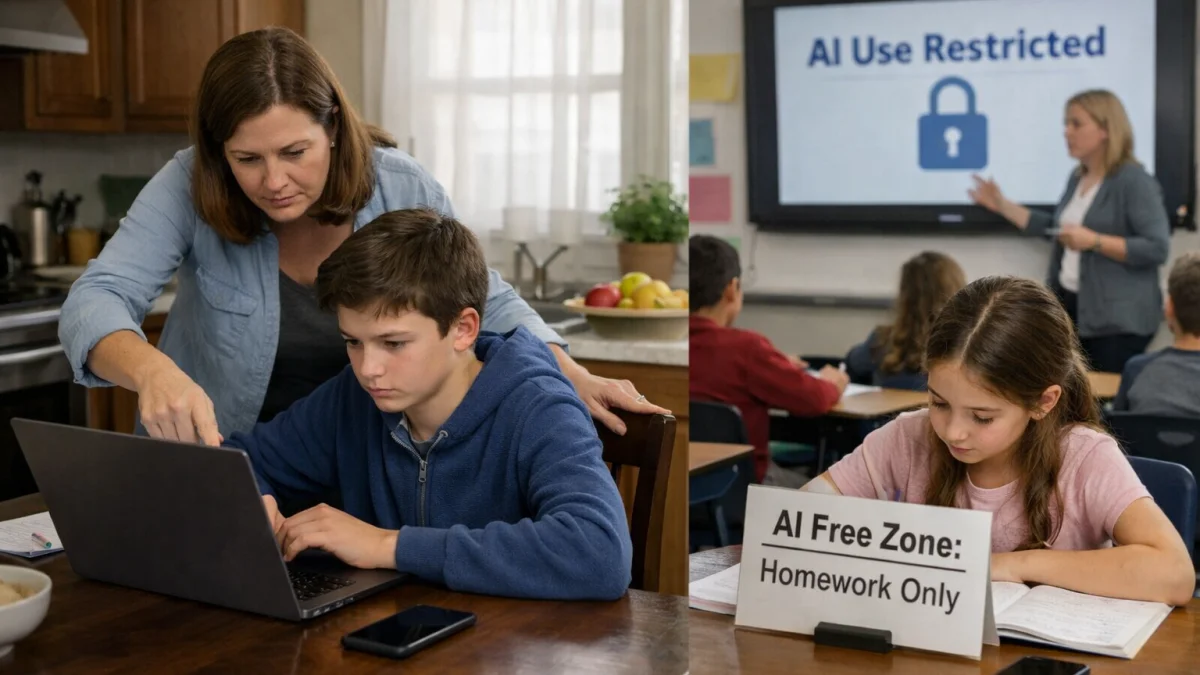
When Norway's schools reopen after the summer break, many of the country's youngest pupils will enter classrooms where generative artificial intelligence tools are largely off limits. Under new government rules, children in elementary school will generally not use AI in class, while older students will be introduced to the technology gradually and under teacher supervision. The policy reflects a growing belief among policymakers that children should first master foundational skills before relying on AI.
The decision is one of the clearest signs of how governments, schools and families are redefining the relationship between children and rapidly advancing technology. Across several countries, educators are trying to balance AI's promise as a personalized learning tool with concerns that students may become overly dependent on systems that can write essays, solve mathematics problems or imitate human conversation with remarkable fluency.
The debate reaches far beyond classrooms. It has become a question about childhood, trust and the responsibilities of adults navigating a technology that is evolving faster than many institutions can respond.
Parents increasingly find themselves making decisions that previous generations never faced. Many are weighing whether AI should become a homework companion, a private tutor or a tool reserved for older children. Teachers, meanwhile, are adapting lesson plans, assessment methods and classroom expectations while governments race to establish rules that keep pace with technological change.
Those efforts have accelerated during 2026.
At a government-level global dialogue on AI governance in Geneva earlier this month, United Nations Secretary-General António Guterres warned that artificial intelligence was advancing faster than regulatory systems could keep up. He called for internationally coordinated safeguards, particularly to protect children from manipulation, harmful content and other emerging risks. "Innovation needs guardrails," Guterres told delegates while urging governments and technology companies to prioritize child safety as AI systems become more powerful.
The concerns extend beyond online safety. Education experts increasingly argue that children need AI literacy, but that literacy should include understanding the technology's limitations, ethical questions and potential risks rather than simply learning how to use new software.
A preliminary report released by the U.N.'s Independent International Scientific Panel on Artificial Intelligence argues that AI literacy should be adapted to different ages and cultural contexts and should complement, rather than replace, developer responsibility and government safeguards. The report says current AI education remains limited in many parts of the world despite growing interest from schools and employers.
Governments are responding in different ways.
Norway has adopted one of the most restrictive approaches for younger children, pairing limits on classroom AI with earlier policies restricting smartphone use and encouraging greater reliance on printed books. Officials say the measures are intended to strengthen foundational learning after declining educational performance. Older students, however, will still learn how to use AI responsibly before entering higher education or the workforce.
Elsewhere, policymakers have focused more heavily on oversight than outright restrictions.
In Australia, the federal government recently outlined an AI policy that Prime Minister Anthony Albanese described as providing strong safeguards, including protections for creative works. The announcement formed part of a broader national discussion involving technology companies, educators and creative industries over how AI should be governed while allowing innovation to continue.
In the United States, lawmakers from both major political parties have proposed legislation addressing children's interactions with AI chatbots. One bipartisan proposal would require companies offering AI chatbots to provide family accounts that allow parents to monitor children's conversations and set time limits, reflecting concerns about online safety while acknowledging AI's educational potential. Senator Ted Cruz said AI could benefit children's education if accompanied by appropriate safeguards.
For teachers, the policy shifts often require practical adjustments rather than philosophical debates.
Assignments once completed at home increasingly need redesigning to distinguish between students' own work and material produced by AI systems. Some schools have expanded in-class writing or oral assessments, while others are teaching students how to disclose AI assistance appropriately. Education researchers have also found that successful adoption depends not only on technology itself but on teacher confidence, institutional support and trust that AI tools genuinely improve learning without increasing workload or creating new ethical concerns.
Families face similar uncertainties outside school hours.
Some parents embrace AI as an always-available tutor capable of explaining difficult concepts in multiple ways. Others worry that children may lose opportunities to develop critical thinking, writing or problem-solving skills independently. Those differing experiences help explain why governments have struggled to design policies that satisfy both advocates of innovation and those calling for stronger limits.
The discussion has broadened beyond education into wider questions of governance.
Bank of England Governor Andrew Bailey recently argued that international cooperation will be essential because AI risks cross national borders. At the same event, DeepMind co-founder Demis Hassabis supported the idea of stronger international oversight for advanced AI systems, highlighting concerns shared by policymakers and researchers that no country can manage the technology's risks alone.
That recognition increasingly shapes conversations in classrooms as much as in government meeting rooms.
Teachers are introducing students not only to the possibilities of AI but also to questions about reliability, privacy and responsible use. Parents are learning alongside their children as new tools become part of everyday life. Governments, meanwhile, continue refining policies that attempt to encourage innovation while preserving childhood development and public trust.
As schools prepare for another academic year, the lesson extending beyond any single classroom is that artificial intelligence is no longer simply an emerging technology. It has become part of the daily decisions families, educators and policymakers must make together as they determine how the next generation will learn, question and grow in an AI-enabled world.