Passengers boarding a long-haul flight often share one quiet hope before the cabin doors close: that nobody will claim the middle seat beside them. United Airlines is preparing to turn that familiar wish into a product passengers can buy.
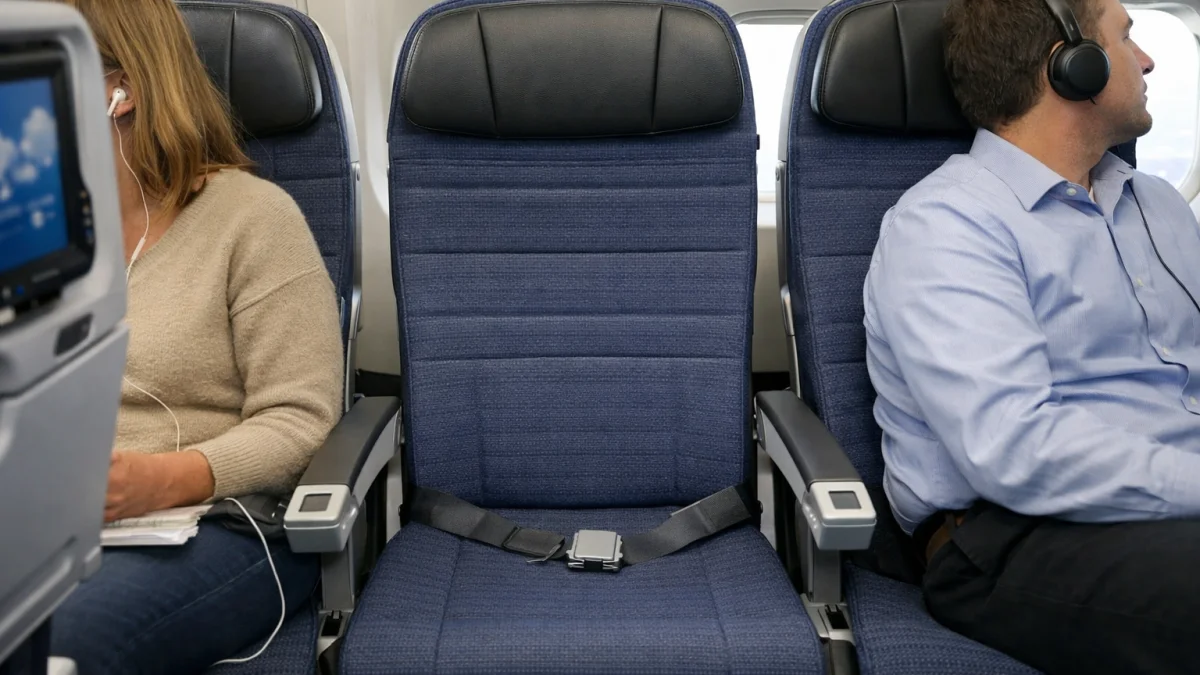
The Chicago-based carrier said this week that its new Airbus A321XLR aircraft will include a dedicated Economy Plus row where the middle seat is no longer available for a traveler. Instead, the space will be permanently converted into a shared table stretching between the window and aisle seats, giving the two passengers extra elbow room and a place for drinks or small personal items. The airline plans to begin selling the option later this year, with the aircraft entering domestic service in the fall before operating international routes in early 2027.
The announcement reflects a broader shift in commercial aviation, where airlines increasingly package comfort itself as a premium product. Rather than adding an entirely new cabin, United is offering travelers the opportunity to pay for something many have long valued informally: personal space.
For passengers facing transatlantic journeys on narrow-body aircraft, the appeal is easy to understand. The Airbus A321XLR enables airlines to fly thinner long-haul routes with a single-aisle aircraft, opening new destinations but also extending the amount of time travelers spend in a more confined cabin than on traditional wide-body jets. Extra room around the shoulders can become nearly as valuable as extra legroom during flights lasting several hours.
United said every one of the 50 A321XLRs it has on order will include one special Economy Plus row featuring two repurposed middle seats. Those seats will remain physically installed but will be fitted with a fixed table covered in a soft leather-like material and equipped with cup holders instead of serving as passenger seating. The airline has not yet disclosed pricing and said additional details will be released closer to launch.
Andrew Nocella, United's executive vice president and chief commercial officer, described the initiative as part of a broader effort to expand customer choice throughout the aircraft.
"We're investing nose-to-tail across our fleet and giving customers choice and value in every cabin," Nocella said in the company's announcement.
The new seating concept arrives only weeks after United unveiled another premium-economy experiment, "Relax Row," which will allow selected economy seats on Boeing 787 and 777 aircraft to convert into couch-like sleeping surfaces beginning in 2027. Together, the initiatives illustrate how airlines are increasingly seeking revenue not only through premium cabins such as business class, but also through incremental upgrades inside economy itself.
Industry analysts have long observed that ancillary revenue—from seat selection, baggage fees and other optional purchases—has become an increasingly important source of airline earnings. The empty-middle-seat product extends that strategy by monetizing a feature passengers previously received only by chance.
The concept also draws inspiration from Europe, where several airlines have long sold short-haul business-class tickets by blocking the middle seat rather than installing wider seats. United's adaptation differs by making the middle position a permanent shared table instead of simply leaving it vacant.
Not everyone is convinced travelers will embrace the additional charge.
Katy Nastro, a travel expert and spokesperson for the travel service Going, questioned whether passengers would see sufficient value in paying for something that occasionally happens naturally when flights are lightly booked.
"You can look at the seat map for free and see if there is a seat that doesn't have anybody sitting in the middle," Nastro told The Washington Post. "I feel like this is yet another way the airlines are looking to nickel-and-dime people."
Others view the initiative as recognition that comfort itself has become increasingly scarce as airlines maximize aircraft utilization and passengers continue returning to the skies after the pandemic recovery. Full flights have reduced the odds of naturally finding an empty adjacent seat, making guaranteed space more attractive for travelers willing to pay.
United's A321XLRs will also introduce several other premium features, including Polaris business-class suites with privacy doors and direct aisle access, upgraded entertainment systems with 4K OLED screens and Bluetooth connectivity, larger overhead bins and an onboard snack bar. The empty-middle-seat option fits into that broader redesign aimed at differentiating the airline across multiple price points rather than focusing solely on the front of the aircraft.
For frequent travelers, the announcement highlights how airlines increasingly view the cabin as a collection of customizable experiences instead of fixed classes of service. Window and aisle passengers in the special Economy Plus row will occupy the same general cabin as other economy travelers, yet receive a noticeably different experience through additional space rather than dramatically different service.
Whether passengers ultimately decide the upgrade is worth the premium will depend in part on pricing, something United has yet to reveal. But the company's decision underscores a larger reality of modern air travel: in an era when almost every square inch of an aircraft can carry commercial value, even the absence of a passenger can become something an airline is prepared to sell.