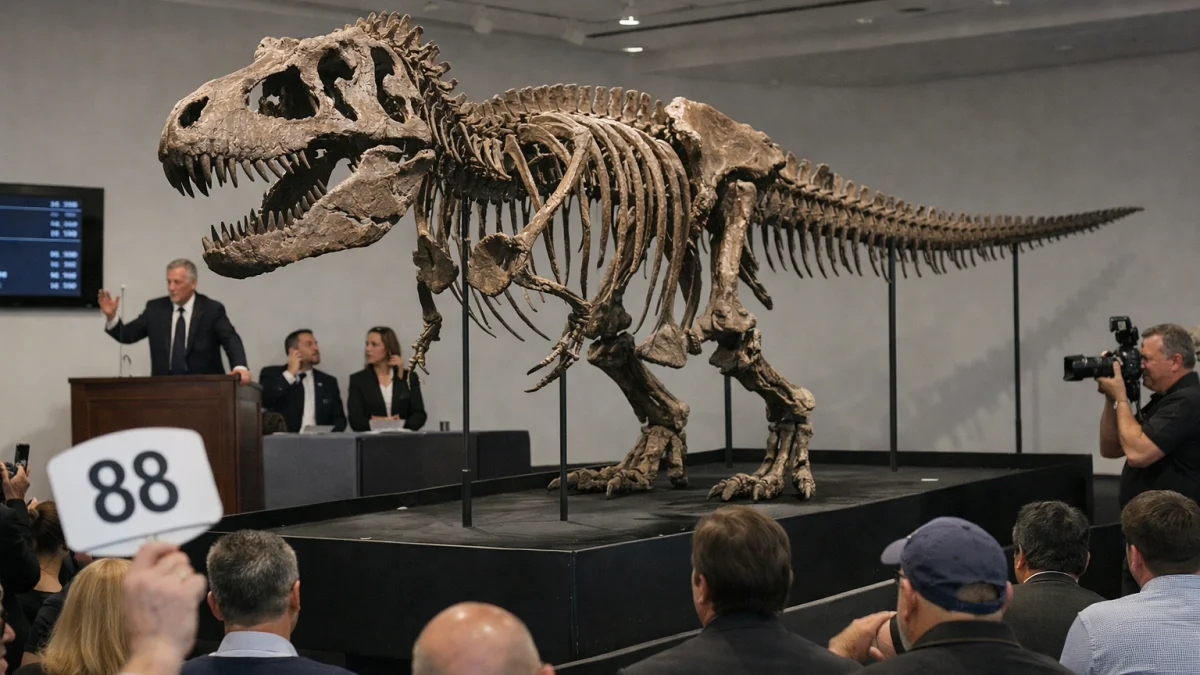
NEW YORK—A Tyrannosaurus rex fossil nicknamed “Gus” sold for a record $50.1 million at a Sotheby’s auction in New York on Tuesday, setting a new benchmark for dinosaur fossils sold at auction and renewing debate over the ownership of scientifically significant specimens.
The 67-million-year-old fossil, one of the largest and most complete T. rex specimens ever discovered, was purchased by an anonymous bidder participating by telephone after about 10 minutes of bidding against six other contenders, according to Sotheby’s. The auction house had estimated the fossil would sell for between $20 million and $30 million.
Known as “Gus” after the late South Dakota ranch owner Gary “Gus” Licking, on whose property the remains were discovered in 2021, the mounted skeleton stands about 12.5 feet (3.8 meters) tall and stretches roughly 38 feet (11.6 meters) long. Sotheby’s said the specimen consists of 183 fossil bones and includes an exceptionally well-preserved skull along with several rare skeletal elements.
The sale surpassed the previous auction record for a dinosaur fossil, set in 2024 when the stegosaurus known as “Apex” sold for nearly $45 million. It also exceeded the nearly $32 million paid for the T. rex specimen “Stan” in 2020.
Following the auction, Cassandra Hatton, Sotheby’s vice chair, described Gus as “an exceptional find” that had been excavated, documented and prepared to a high scientific standard, according to the auction house.
The record-breaking sale also prompted concern among paleontologists, who have argued that fossils of major scientific importance should remain accessible for research and public education. The Society of Vertebrate Paleontology urged the new owner to place the specimen in an accredited museum or otherwise ensure public access for scientific study.
Researchers have said that while private ownership of fossils discovered on private land is legal in the United States, sales at increasingly high prices can make it difficult for museums and public institutions to compete with wealthy private collectors. Some scientists warn that limited access to rare specimens could constrain future research, although the identity of the buyer and plans for the fossil have not been disclosed.
As of July 15, Sotheby’s had not identified the purchaser, and no announcement had been made regarding whether Gus would be placed on public display or made available to researchers.