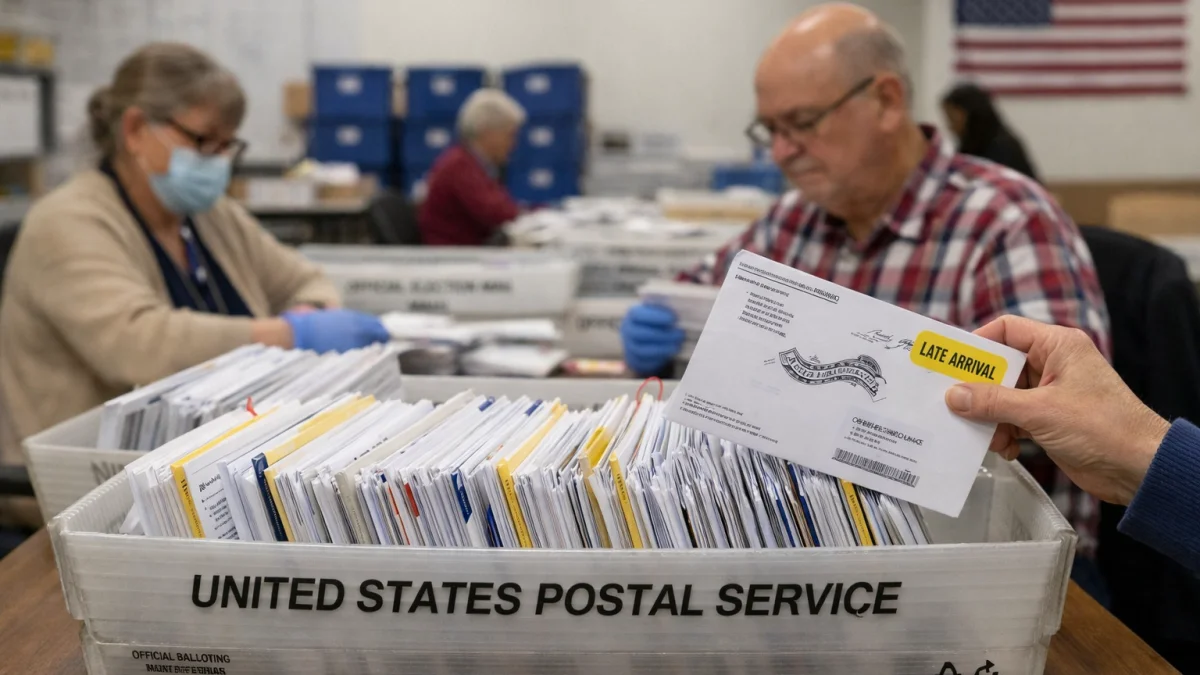
WASHINGTON — The U.S. Supreme Court ruled on Monday that states may continue counting mail ballots that arrive after Election Day if they were postmarked by Election Day, rejecting a Republican-backed challenge that sought to invalidate grace periods used in numerous states ahead of the 2026 midterm elections.
In a 5-4 decision, the court upheld a Mississippi law allowing absentee ballots postmarked on or before Election Day to be counted if they are received within five business days. Justice Amy Coney Barrett wrote the majority opinion, joined by Chief Justice John Roberts and Justices Sonia Sotomayor, Elena Kagan and Ketanji Brown Jackson.
The ruling reverses a decision by the 5th U.S. Circuit Court of Appeals, which had concluded that federal election statutes requiring a uniform Election Day barred states from counting ballots received after that date, even if they had been mailed on time. The Supreme Court held that the federal statutes establish when ballots must be cast, not when election officials must receive them.
The case, brought by Mississippi Secretary of State Michael Watson after the Republican National Committee and other plaintiffs challenged the state's law, was closely watched because similar ballot-receipt deadlines are used in multiple states and the District of Columbia. Election officials had warned that striking down those laws could have required significant procedural changes only months before congressional elections.
The Republican challengers argued that federal law requires all ballots to be received by Election Day and that post-election receipt deadlines undermine the statutory election date. Mississippi defended its law, maintaining that ballots cast by Election Day satisfy federal requirements and that states retain authority over election administration unless Congress clearly provides otherwise.
The dispute formed part of a broader legal campaign supported by former President Donald Trump and Republican allies challenging mail voting practices adopted or expanded in many jurisdictions. Trump has repeatedly criticized mail voting, while election officials and previous court proceedings have found no evidence of widespread fraud sufficient to alter national election outcomes.
The decision leaves in place existing grace periods for qualifying absentee ballots in states that permit them and provides legal certainty for election administrators preparing for the 2026 midterm elections.