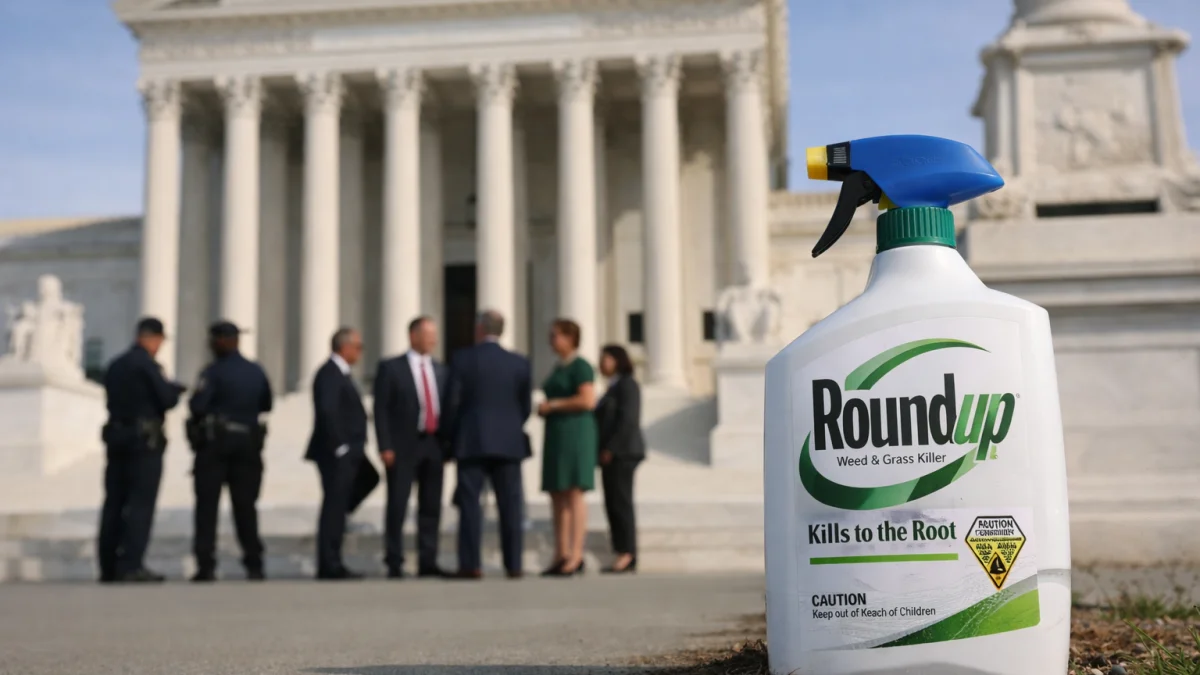
WASHINGTON — The U.S. Supreme Court on Thursday ruled in favor of Bayer’s Roundup weedkiller, blocking thousands of lawsuits that alleged the company failed to warn consumers that the product could cause cancer. The 7-2 decision limited state-law claims against the maker of the herbicide, finding that federal pesticide labeling rules override those lawsuits.
The case involved a lawsuit brought by John Durnell, a Missouri resident who said his exposure to Roundup contributed to his diagnosis of non-Hodgkin lymphoma. A jury had awarded him $1.25 million, but the Supreme Court overturned that outcome, ruling that federal law prevented the state claim because the U.S. Environmental Protection Agency had approved Roundup’s label without requiring a cancer warning.
Justice Brett Kavanaugh wrote the majority opinion, concluding that the Federal Insecticide, Fungicide and Rodenticide Act (FIFRA) establishes a national standard for pesticide labeling and prevents states from imposing different warning requirements. Justices Ketanji Brown Jackson and Neil Gorsuch dissented, arguing that the decision improperly restricted state authority over consumer protection claims.
The ruling addresses one of the largest waves of product liability litigation in the United States. Thousands of plaintiffs have sued Bayer, which acquired Monsanto, the original maker of Roundup, in 2018, claiming that glyphosate, the herbicide’s active ingredient, caused their cancers and that the company should have provided stronger warnings. Bayer has denied that Roundup causes cancer and has maintained that glyphosate is safe when used as directed.
Bayer said the ruling provides greater legal certainty for the company and the agricultural sector. The company has also pursued a proposed multibillion-dollar settlement to resolve remaining Roundup-related claims, though the Supreme Court decision changes the landscape for many pending cases.
Environmental and public health advocates criticized the ruling, arguing that it reduces avenues for consumers to seek damages through state courts. They have pointed to continuing debate over glyphosate’s health effects, including differing assessments from scientific and regulatory bodies. The EPA has maintained its position that glyphosate does not require a cancer warning on Roundup labels, while the International Agency for Research on Cancer has classified glyphosate as “probably carcinogenic” based on its own review.
The decision does not determine whether Roundup causes cancer; instead, it resolves whether state failure-to-warn lawsuits can proceed when federal regulators have approved the product’s labeling. The ruling is expected to guide the handling of remaining Roundup litigation in courts across the country.