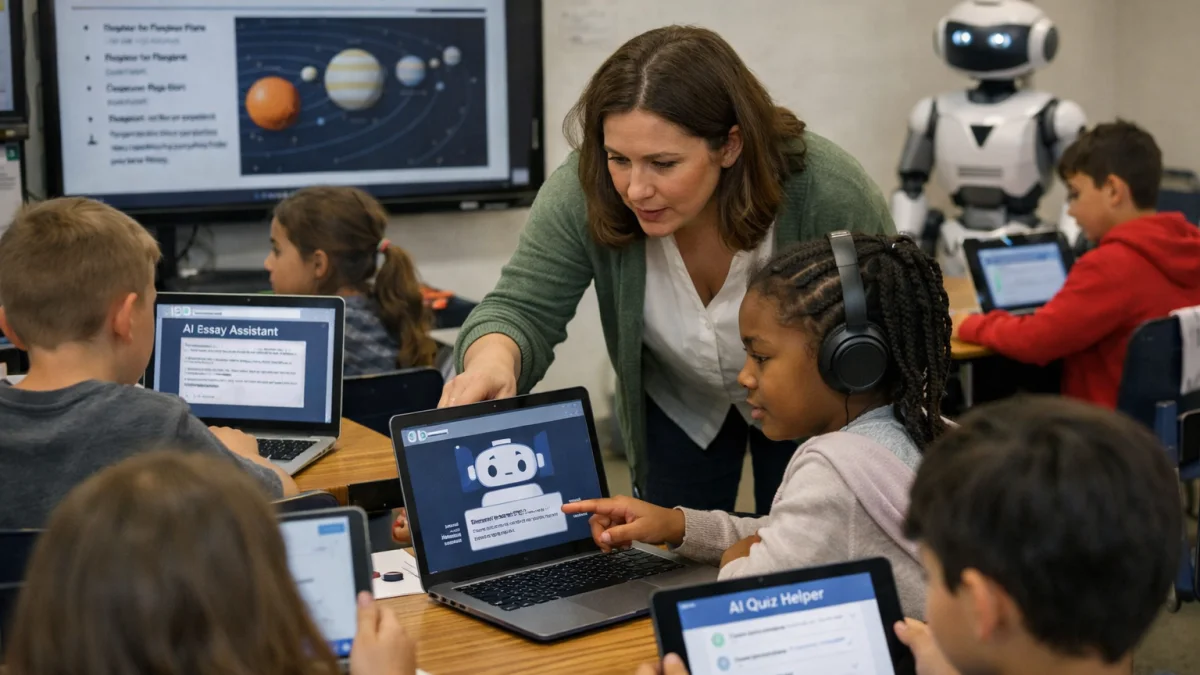
When students arrive at school each morning, many now enter classrooms where artificial intelligence is becoming as familiar as laptops, online textbooks and digital whiteboards. Teachers may use AI to draft lesson plans or create quizzes. Students increasingly turn to AI-powered assistants to explain difficult concepts, summarize readings or organize assignments. At home, parents are learning that conversations about homework often include a new question: when is AI helping a child learn, and when is it doing the work instead?
Those everyday decisions are emerging as one of education's defining challenges. As governments, school systems and technology companies accelerate the adoption of generative AI, teachers and families are adapting routines that were shaped long before conversational AI entered classrooms. The debate has expanded beyond concerns about plagiarism to broader questions about critical thinking, digital literacy, privacy and the changing relationship between students and technology.
The pace of change has left many educators balancing opportunity with caution. The OECD's Digital Education Outlook 2026 says generative AI can support learning when used with clear teaching principles but warns that better performance on assignments does not necessarily translate into deeper learning. The report also found that 37% of lower secondary teachers reported using AI in their work in 2024, while 72% believed it could undermine academic integrity if students presented AI-generated work as their own.
For many teachers, AI's most immediate value lies outside the classroom spotlight. Administrative work that once consumed evenings—drafting lesson plans, generating practice questions or adapting materials for different learning levels—can often be completed more quickly with AI assistance. Education researchers increasingly describe these tools as potential teaching assistants rather than replacements for professional judgment.
That distinction has become central to policy discussions. UNESCO has argued that AI should strengthen, rather than diminish, human agency in education. Its guidance and competency frameworks encourage schools to help students understand how AI systems work, recognize their limitations and use them responsibly while preserving teachers' essential role in guiding learning.
The conversation increasingly extends into family life.
Parents who once monitored screen time are now asking different questions: whether homework reflects a child's own understanding, how personal information is handled by AI services, and what digital skills children will need in future workplaces. Rather than banning the technology outright, many families are trying to establish household rules that distinguish using AI as a study aid from relying on it to complete assignments.
Those discussions mirror debates taking place in schools. Some educators encourage students to disclose when AI has assisted their work, while others redesign assessments to include more classroom writing, oral presentations or collaborative activities that make individual understanding easier to evaluate. UNESCO's education experts have noted that many teachers are placing greater emphasis on in-class learning and spoken communication as AI-generated written work becomes more common.
Education researchers also argue that AI literacy is becoming a foundational skill rather than a specialized subject. In June, the OECD and the European Commission introduced an AI Literacy Framework intended to help schools teach students not only how to use AI but also how to evaluate its outputs, understand its limitations and consider its ethical implications. The framework describes AI literacy as a combination of knowledge, practical skills and attitudes that will become increasingly important across civic life and future employment.
Preparing teachers remains one of the largest challenges.
The AI Literacy Framework notes that teachers are expected to guide students through rapidly evolving technologies while many educators are still developing their own understanding. According to OECD findings cited in the framework, roughly three-quarters of teachers report lacking sufficient knowledge and skills to teach effectively with AI, even as public expectations continue to rise.
That gap has prompted governments, universities and education organizations to expand professional development focused on responsible AI use. Training increasingly emphasizes verifying AI-generated information, protecting student privacy, recognizing bias in automated systems and designing assignments that encourage original thinking rather than simple text generation.
Researchers caution that access remains uneven. Schools with reliable internet connections, modern devices and dedicated training opportunities may be better positioned to integrate AI effectively than under-resourced communities. OECD researchers have highlighted equitable infrastructure and sustained professional learning as essential if AI is to support learning rather than widen existing educational inequalities.
Even as technology advances rapidly, education specialists increasingly describe the future of classrooms in human terms rather than technological ones.
The OECD's reports argue that teachers' professional judgment, trusted relationships with students and pedagogical expertise become more—not less—important as AI becomes commonplace. UNESCO likewise frames AI as a tool that should complement education while preserving learners' capacity for independent thought and informed decision-making.
For families and teachers, those principles increasingly shape ordinary moments: reviewing homework together after dinner, discussing whether an AI-generated answer seems credible, or deciding when technology should be set aside so students can wrestle with a difficult problem on their own. As AI becomes another familiar presence in classrooms, the daily work of education continues to revolve around people—teachers guiding students, parents supporting learning at home, and children developing the judgment to know when artificial intelligence can assist them and when genuine understanding still depends on their own thinking.