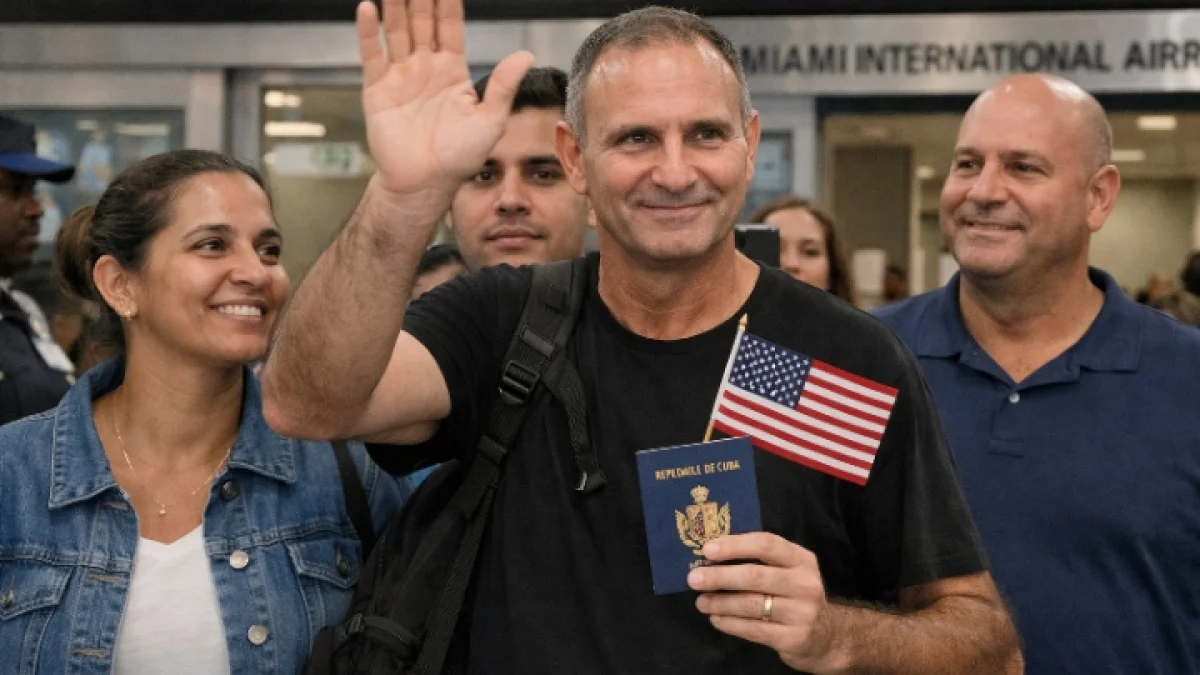
Five years after he entered a Cuban prison as one of the country's most prominent dissident artists, Luis Manuel Otero Alcántara has begun a new life in the United States, arriving under humanitarian parole after a journey that supporters say marks both an end and a beginning.
His arrival closes a chapter that started with Cuba's largest anti-government demonstrations in decades on July 11, 2021, when thousands of people took to the streets to protest economic hardship, shortages and restrictions on civil liberties. Otero Alcántara, co-founder of the San Isidro Movement, became one of the most recognizable faces associated with those events after years of using performance art and public protest to challenge state censorship and restrictions on expression.
Now 38, Otero Alcántara enters exile after completing a five-year prison sentence imposed on charges that included desecration of national symbols, contempt and public disorder. Cuban authorities have consistently maintained that those imprisoned after the 2021 protests were prosecuted for criminal offenses rather than for their political views, rejecting international criticism that characterized many detainees as political prisoners.
His departure illustrates the complicated choices confronting some of Cuba's best-known government critics. According to statements published by his family and supporters, Otero Alcántara had repeatedly refused earlier proposals that would have allowed him to leave Cuba in exchange for his release. Supporters later said that continued restrictions on his freedom led him to accept exile as the only realistic path to continue his work as an artist and activist.
The journey itself followed days of uncertainty.
After Otero Alcántara completed his prison sentence, rights advocates said they were unable to determine his whereabouts. The legal organization Cubalex filed a habeas corpus petition seeking information, arguing that authorities should clarify his status after he was transferred from Guanajay prison shortly before his scheduled release. His supporters expressed concern publicly until confirmation emerged that he had received humanitarian parole to travel to the United States with assistance from the U.S. Embassy in Havana.
The U.S. Embassy confirmed that it had worked to facilitate his travel, while U.S. Secretary of State Marco Rubio later announced that Otero Alcántara had arrived safely in the United States. Rubio described the artist as someone imprisoned for expressing himself through his art and advocating basic freedoms.
For supporters gathered in Miami, the arrival represented more than the release of a single prisoner. Associated Press reported that Cuban flags bearing the slogan "Patria y Vida" welcomed Otero Alcántara at the airport, reflecting the enduring symbolism of the protest anthem that became closely linked with the 2021 demonstrations and the wider movement for political change on the island.
That symbolism has long extended beyond galleries and performances. The San Isidro Movement, which Otero Alcántara helped establish, emerged as a coalition of artists, musicians and intellectuals challenging censorship and demanding greater artistic freedom. International recognition followed. Time magazine included him among its 100 most influential people in 2021, while organizations including Amnesty International identified him as a prisoner of conscience, a characterization rejected by the Cuban government.
His case has unfolded against a broader backdrop of political imprisonment and prisoner releases in Cuba.
Earlier this year, Cuban authorities announced a large-scale amnesty affecting thousands of inmates. The United States and human rights organizations said they were watching closely to determine whether people they considered political prisoners would benefit. Additional releases announced later in the year prompted renewed debate over the government's handling of political dissent, although uncertainty remained over how many dissidents would ultimately be freed.
For many advocates, Otero Alcántara's release also serves as a reminder of those who remain behind bars. Among the most frequently cited is rapper Maykel Castillo Pérez, known as "Osorbo," another prominent figure associated with the "Patria y Vida" movement, who continues serving an eight-year sentence. His imprisonment, like Otero Alcántara's, has remained a recurring source of tension between Washington and Havana.
Exile has become a recurring outcome for several high-profile Cuban dissidents. While relocation offers safety and greater freedom of movement, it also means continuing advocacy from outside the country where their work first gained meaning. For artists and activists whose message has been rooted in everyday Cuban life, that transition can reshape both audience and purpose.
Otero Alcántara has indicated that his first destination after arriving in the United States would be the Shrine of Our Lady of Charity, Cuba's patron saint. According to supporters, he traveled carrying a damaged statue of the Virgin Mary that had accompanied him through years of imprisonment, an object they described as representing endurance rather than triumph.
His arrival does not resolve the debates surrounding Cuba's treatment of dissent, nor does it settle competing narratives over the country's political prisoners. Instead, it opens a new chapter in a story that has unfolded through courtrooms, prisons, diplomatic negotiations and artistic expression. After five years in confinement, Otero Alcántara now faces the challenge of rebuilding his life far from Havana while his supporters continue to call attention to others they say remain imprisoned on the island.