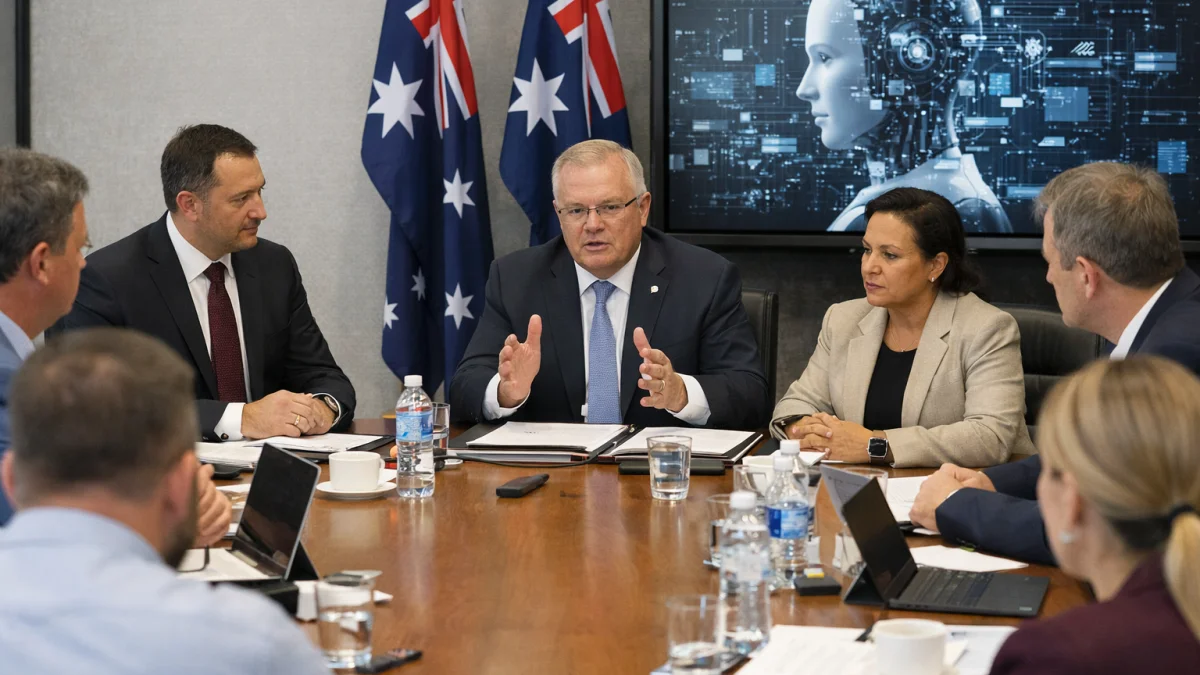
Australia's decision to introduce mandatory national standards for artificial intelligence infrastructure marks a significant shift in how governments are approaching AI governance. Rather than focusing solely on algorithms or online services, Canberra is moving to regulate the physical infrastructure that powers AI systems, including data centres, energy consumption, water use and copyright protections. The initiative, announced by Prime Minister Anthony Albanese alongside the creation of a new Office of AI within the Department of the Prime Minister and Cabinet, represents one of the most comprehensive attempts by a national government to integrate technology policy with energy, environmental and industrial strategy.
The announcement is significant because it broadens the scope of AI regulation beyond safety and transparency requirements that have dominated policy debates internationally. Instead, Australia is framing AI as a form of critical national infrastructure whose economic benefits depend on secure energy supplies, sustainable resource use and coordinated government oversight. Officials argue that clearer national rules will reduce regulatory fragmentation, improve investor certainty and ensure AI development aligns with broader national interests.
A central feature of the proposed framework is the regulation of large-scale data centres, which have become essential to training and operating advanced AI models. Under the government's proposal, future facilities would be legally required to secure or underwrite new electricity generation, pay the full costs of connecting to the electricity grid, reduce demand during periods of grid stress and minimise water consumption. Developers would also be expected to contribute to any additional water infrastructure their operations require, while governments would coordinate where major facilities are built in consultation with states, territories and local communities.
Those measures reflect growing concern internationally over the resource demands of AI infrastructure. The rapid expansion of generative AI has sharply increased demand for electricity-intensive computing facilities, prompting governments and utilities worldwide to assess whether existing power systems can accommodate future growth. Australia, which is simultaneously pursuing an energy transition and expanding its digital economy, has sought to avoid situations in which AI investment increases electricity prices or places additional pressure on public infrastructure. Officials say requiring developers to finance new capacity directly is intended to prevent households and businesses from bearing those costs.
The establishment of the Office of AI also signals a move toward more centralized governance. Australia previously relied on existing privacy, consumer protection and competition laws alongside voluntary AI ethics principles. The new office is intended to coordinate policy development across government agencies and oversee legislation establishing Australian AI standards, replacing what ministers describe as a fragmented regulatory approach.
The framework extends beyond infrastructure. The government has also committed to stronger copyright protections, stating that Australian books, music, journalism and other creative works should not be used to train AI systems without the rights holder's control or permission. That position places Australia within a broader international debate over how AI developers should obtain training data while balancing innovation with intellectual property rights. Similar disputes are unfolding in several jurisdictions, including the United States and Europe, where publishers, artists and technology companies continue to contest the legal boundaries of AI training.
Australia's approach differs in emphasis from several other major regulatory models. The European Union has concentrated primarily on risk-based regulation of AI systems through the AI Act, while the United States has generally relied more heavily on executive actions, agency guidance and sector-specific oversight than comprehensive federal legislation. Australia's proposal combines elements of technology regulation with infrastructure planning, environmental policy, industrial development and copyright law, illustrating how governments are increasingly treating AI deployment as a whole-of-government policy issue rather than solely a digital economy matter.
Industry reaction has been broadly supportive of providing greater regulatory certainty, although business groups have cautioned against overly burdensome requirements that could discourage investment. Technology companies have generally welcomed clearer approval processes, while unions have continued to raise concerns about AI's implications for employment and workplace protections. Environmental organizations and some community groups have argued that stricter oversight remains necessary because of the projected growth in electricity and water demand associated with hyperscale data centres, with some advocating temporary limits on new developments until mandatory standards are enacted.
The proposed framework also reflects a broader geopolitical trend in which countries are seeking greater control over AI capabilities regarded as strategically important. As AI systems become increasingly dependent on large-scale computing infrastructure, governments are placing greater emphasis on domestic resilience, energy security, supply chains and sovereign technological capability. Australia's decision to integrate infrastructure planning with AI governance demonstrates how competition over AI is expanding beyond software development into questions of physical capacity, environmental sustainability and national economic planning.
For now, the government's proposals remain subject to legislative development and consultation with state and territory governments before mandatory standards take effect. Officials are monitoring the drafting of legislation, implementation of the new Office of AI and negotiations over national standards for data centres, energy, water use and copyright. The effectiveness of Australia's approach will ultimately depend on how those rules are translated into enforceable regulation while maintaining investment certainty and addressing the infrastructure demands created by rapidly expanding AI technologies.