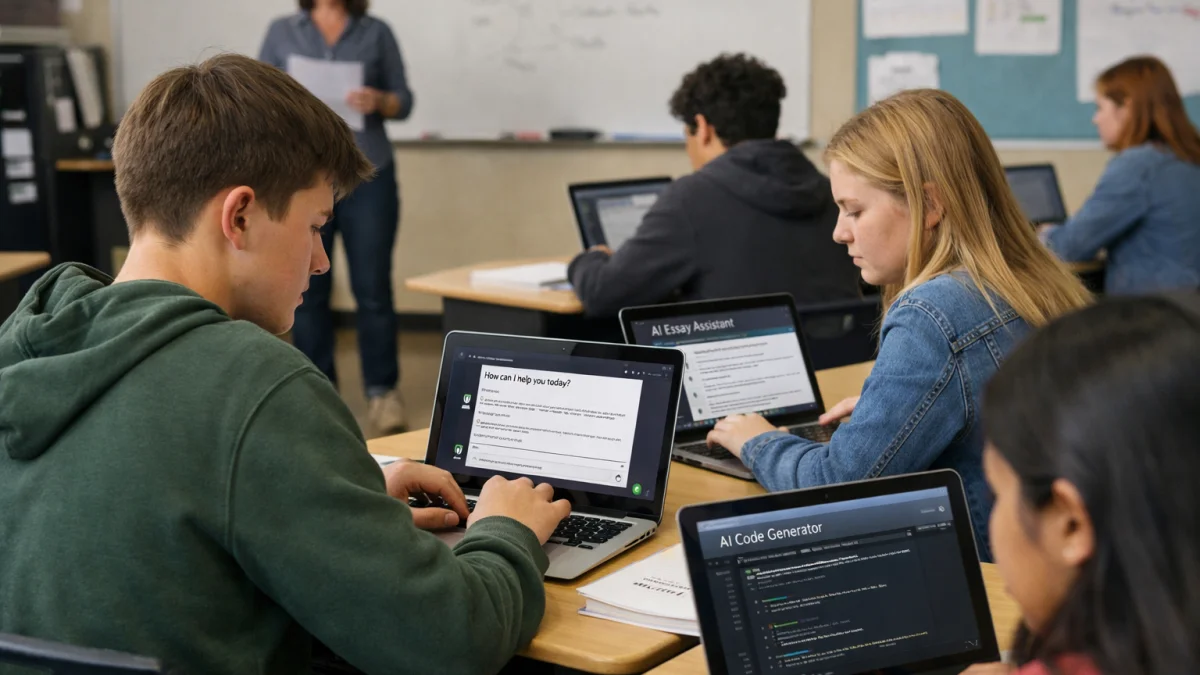
When English teacher Sarah Kline asks her students to write in class, the laptops stay closed. Pens move across paper instead. The assignment is not a rejection of technology but an attempt to preserve something she says has become harder to measure: whether the words belong to the student or to an artificial intelligence chatbot.
Scenes like this are becoming increasingly familiar in schools around the world as educators confront one of the fastest shifts in classroom technology in decades. Students have embraced generative AI tools for brainstorming, summarizing readings, solving mathematics problems and drafting essays. School leaders, meanwhile, are racing to establish rules that distinguish legitimate academic support from work that bypasses learning altogether.
The challenge extends well beyond concerns about cheating. Administrators, teachers, parents and policymakers are grappling with a broader question: how should schools prepare students for workplaces where AI is becoming routine while still ensuring they develop the critical thinking, writing and analytical skills education is meant to cultivate?
Recent surveys suggest the technology is already deeply embedded in student life. According to the College Board, cited in reporting published by Fortune and The Conversation, an estimated 84% of U.S. high school students surveyed said they had used generative AI for schoolwork during 2025. Yet only about three in 10 schools reported having formal policies governing its use.
That gap between student behavior and institutional guidance has produced sharply different responses.
Some schools are redesigning assessments rather than trying to eliminate AI altogether. Others are expanding oral examinations, requiring students to explain how they reached their conclusions, or asking them to disclose when AI assisted with research or drafting. Several districts have discouraged teachers from relying on AI-detection software, arguing that such systems remain unreliable and can falsely accuse students of misconduct.
In higher education, some institutions have gone even further. The University of Chicago Law School announced that first-year students will not be allowed to use phones or laptops in required classes, part of a broader strategy to strengthen independent reasoning before students begin incorporating AI into their legal training. Dean Adam Chilton said the goal was not to reject AI permanently but to ensure students first master foundational skills without technological assistance.
Elsewhere, governments are taking contrasting approaches.
Norway said it would impose a near ban on generative AI in elementary schools while restricting its use among older students, arguing that younger children risk skipping essential stages of learning. Prime Minister Jonas Gahr Stoere said reading, writing and mathematics must remain the central priorities of schooling.
Other countries are moving in the opposite direction. Reporting from Australia and Asia shows schools increasingly incorporating AI literacy into classrooms, with policymakers and educators arguing that students need to understand how to use the technology responsibly because it is already becoming part of everyday work and study.
The uneven pace of adoption means students often encounter different expectations from one classroom to another.
Education Week reported that AI policies vary widely across states, districts and even individual teachers, creating inconsistent experiences for students. Some educators encourage AI for brainstorming or feedback while prohibiting it during final assessments. Others forbid its use almost entirely.
Research suggests that inconsistency itself may become part of the problem.
A Thomson Reuters Institute survey of more than 1,800 law students found that nearly half said AI policies differed from professor to professor, while almost one-third believed their schools were not adequately preparing them with AI skills needed for future careers. At the same time, large majorities viewed AI literacy as professionally important while recognizing the risks of overreliance.
Those findings mirror concerns expressed by many educators, who increasingly describe AI not simply as another digital tool but as a force requiring schools to rethink assessment itself.
Traditional homework assignments completed outside the classroom have become more difficult to evaluate because AI systems can generate polished responses within seconds. In response, many teachers are returning to handwritten work, classroom discussions, oral presentations and project-based assessments that reveal how students think rather than simply what they submit.
The debate also reflects changing ideas about academic integrity.
For years, schools focused largely on plagiarism by comparing student work with published sources. Generative AI introduces a different challenge: text may be original in the sense that it has not been copied from another student or website, yet still may not represent the student's own reasoning.
Educators increasingly say transparency may matter more than prohibition. Some schools now require students to acknowledge when AI contributed to brainstorming, editing or research, much as they would cite outside assistance from other sources. Others encourage students to evaluate AI-generated responses critically rather than accepting them at face value.
Experts caution that schools cannot assume technology alone will solve the problem. AI-detection software has faced criticism over false positives, while newer AI systems continue evolving faster than many institutional policies.
For teachers, the transition often involves balancing competing responsibilities. They are expected to uphold academic standards while also preparing students for workplaces where AI proficiency is becoming increasingly valuable.
Students, meanwhile, are learning that responsible AI use involves judgment as much as technical skill. Knowing when to rely on a chatbot—and when to rely on one's own thinking—has become part of the education itself.
As classrooms prepare for another academic year, many schools remain in the midst of that adjustment. Policies continue to evolve, assignments are being redesigned, and teachers are experimenting with new ways to measure learning.
The rules are still being written. But one lesson has already emerged: the arrival of generative AI has transformed education from a debate about technology into a broader conversation about what schools ultimately expect students to know, to understand and to accomplish on their own.