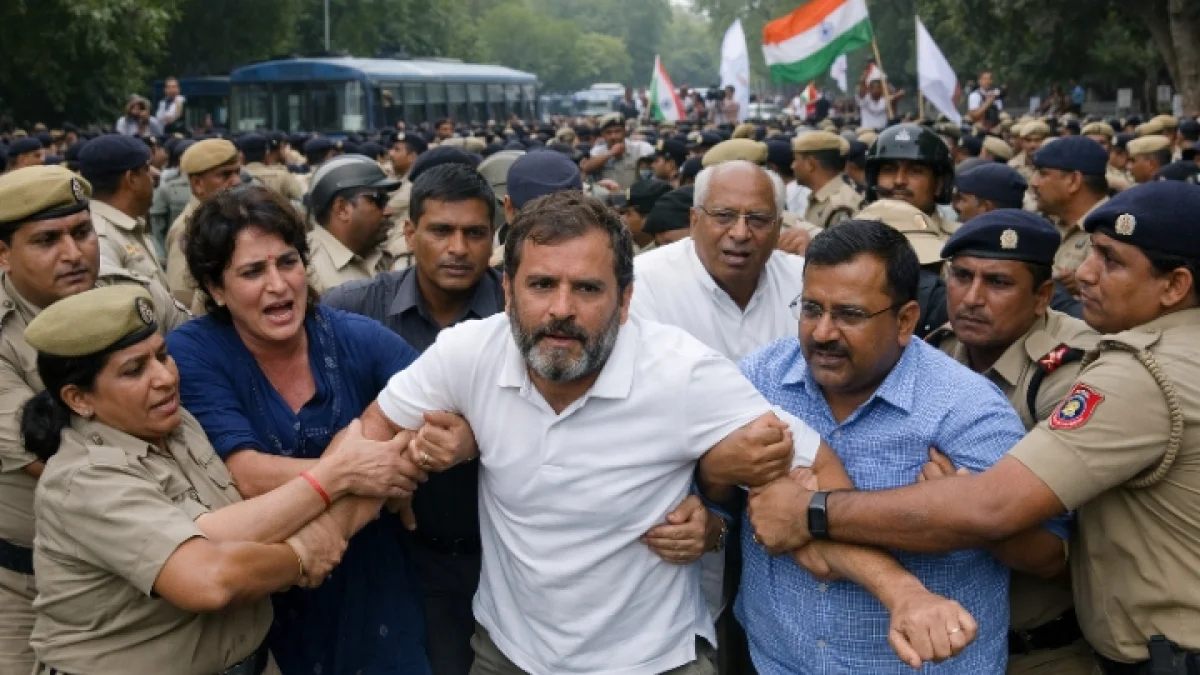
India’s political confrontation over alleged examination irregularities intensified on Tuesday after police detained opposition leaders including Congress leader Rahul Gandhi, his sister Priyanka Gandhi Vadra and Samajwadi Party chief Akhilesh Yadav following a sit-in near Prime Minister Narendra Modi’s official residence in New Delhi. The action came a day after police confronted student protesters marching toward Parliament, turning a dispute over competitive examinations into a broader political clash over accountability, policing and the right to protest. The detained leaders were later released.
The significance lies in the way the issue has moved beyond the education system and into the center of India’s national political contest. The opposition is using anger over alleged examination leaks and irregularities, particularly surrounding the National Eligibility cum Entrance Test, or NEET, to challenge the government on an issue that directly affects millions of young Indians seeking access to higher education. The government, meanwhile, faces the dual task of addressing concerns over examination integrity while defending public-order measures taken against demonstrations. That combination has raised the political stakes as Parliament is in session and opposition parties seek to keep the issue from being treated as a narrowly administrative dispute.
The immediate trigger was the police response to student demonstrations, according to reporting from multiple Indian media outlets. Opposition leaders said students had been subjected to excessive force and demanded accountability from the government, with Congress pressing for the resignation of Education Minister Dharmendra Pradhan. The government has rejected the opposition's characterization of its response and has emphasized efforts to address examination-related wrongdoing, including investigations and reforms. The two sides therefore differ not only over responsibility for the crisis but also over whether the episode represents a failure of governance or an attempt by the opposition to capitalize on public anger.
The decision to protest near Modi’s residence added a separate dimension. The prime minister’s official address on Lok Kalyan Marg is in a highly secured area, making an unscheduled opposition sit-in there an unusually direct challenge to the government. Indian media reported that senior officials, including Minister of State in the Prime Minister’s Office Jitendra Singh, attempted to persuade the protesters to leave before police moved to clear the demonstration. The authorities’ position is that security and public-order considerations constrained the protest, while opposition leaders argue that the detention of elected representatives illustrates the government’s unwillingness to engage with dissent.
The confrontation also illustrates the changing character of the protest movement. Reuters reported that the youth-led “Cockroach Janta Party” movement emerged from online satire but rapidly became a vehicle for demonstrations over the NEET controversy and wider concerns about educational opportunity and youth employment. The movement’s growth has given opposition parties an opportunity to align themselves with a constituency that is politically significant but not necessarily tied to established party structures. That may broaden the issue’s reach, although the extent to which the movement can sustain momentum independently of opposition parties remains unclear.
For the government, the political challenge is therefore broader than managing demonstrations. Examination controversies have repeatedly generated public concern in India because entrance tests can determine access to scarce professional education and shape the prospects of millions of young people. Allegations of leaks or manipulation can undermine confidence not only in individual examinations but in the wider merit-based system on which families and students depend. The government has sought to demonstrate that misconduct is being investigated and that reforms are possible, but continued protests suggest that those assurances have not resolved the political dispute.
For the opposition, the episode offers both an opportunity and a risk. The detention of prominent leaders can sharpen attention on the student issue and reinforce arguments about democratic freedoms. But moving the protest to a high-security location near the prime minister’s residence also allows the government to portray the opposition’s tactics as provocative or disruptive. The effectiveness of the opposition’s strategy will depend in part on whether it can maintain focus on examination integrity and student concerns rather than allow the confrontation to become primarily a dispute over protest tactics.
The immediate confirmed situation is that several senior opposition leaders were briefly detained after protesting near Modi’s residence and were subsequently released, while demonstrations linked to examination grievances have continued. The government and opposition remain divided over the handling of student protests, the adequacy of reforms and political accountability. Further developments will depend on the government’s response to demands for action on examination integrity, the handling of continuing demonstrations and whether Parliament provides a forum for substantive debate rather than further confrontation.