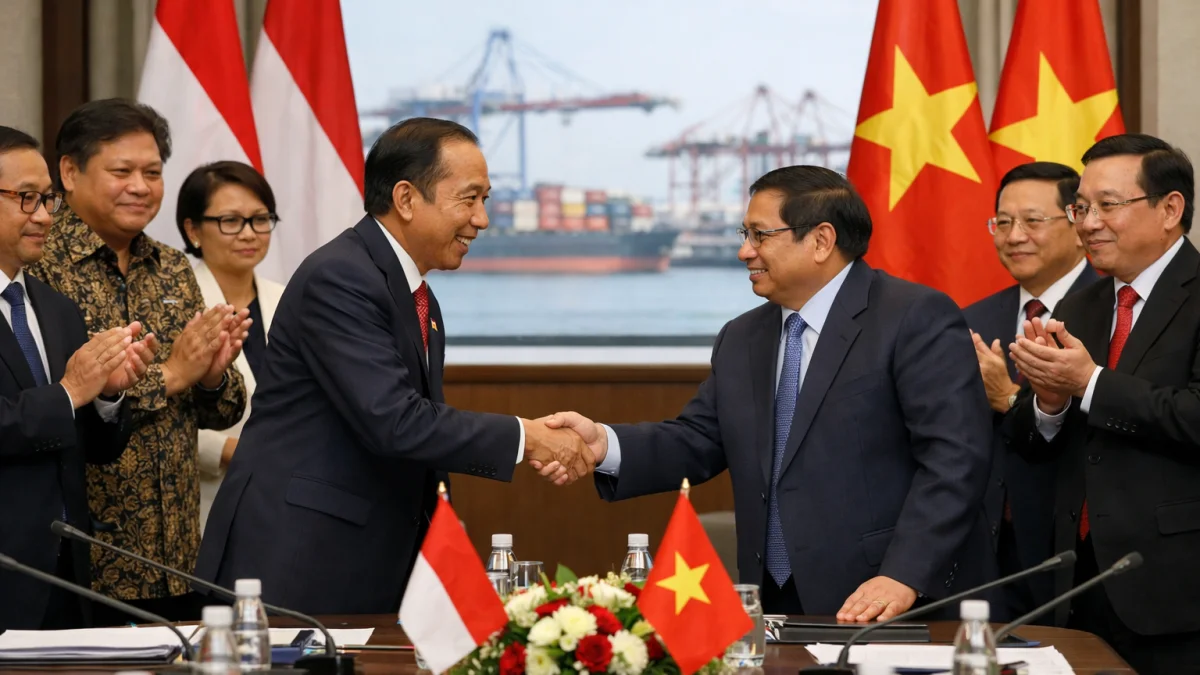
Indonesia and Vietnam have agreed on a new five-year action plan designed to deepen their comprehensive strategic partnership, setting a target of raising bilateral trade to US$18 billion by 2028 while expanding cooperation in investment, science and technology, agricultural innovation, the digital economy and electric-vehicle battery supply chains. The agreement, signed during the sixth Joint Commission for Bilateral Cooperation in Jakarta, reflects a broader effort by both Southeast Asian economies to strengthen regional production networks as companies continue to diversify manufacturing and sourcing strategies.
The significance of the agreement extends beyond higher trade volumes. Indonesia and Vietnam have emerged as two of Southeast Asia's fastest-growing manufacturing and investment destinations, competing for foreign capital while increasingly recognizing that complementary industrial strengths can improve regional resilience. Their decision to frame the relationship as one of partnership rather than direct competition signals an attempt to position ASEAN more effectively within evolving global supply chains that have been reshaped by geopolitical tensions, trade policy changes and corporate diversification away from excessive dependence on any single production base.
Foreign Minister Sugiono said the two countries intended to leverage their complementary economic strengths to promote shared prosperity, while Vietnamese Foreign Minister Le Hoai Trung emphasized that broader cooperation would contribute to regional stability alongside economic development. The 2026-2030 action plan follows the establishment of the Indonesia-Vietnam Comprehensive Strategic Partnership in 2025, providing a framework for translating political commitments into sector-specific cooperation.
Economic logic underpins the initiative. Indonesia offers Southeast Asia's largest domestic market, abundant reserves of critical minerals including nickel, and an expanding downstream industrial strategy. Vietnam has developed into one of the region's leading export-oriented manufacturing hubs, supported by extensive participation in global trade agreements and established electronics and industrial supply chains. Closer coordination between the two economies could strengthen regional value chains in sectors ranging from agriculture to advanced manufacturing rather than forcing multinational companies to choose between them.
Electric-vehicle battery supply chains illustrate this approach. Indonesia has sought to build an integrated battery ecosystem around its nickel resources, while Vietnam has expanded manufacturing capabilities in electronics, automotive components and technology industries. Greater cooperation in research, investment and industrial development could support ASEAN's ambition to capture more value from clean-energy manufacturing while reducing vulnerabilities associated with fragmented production networks.
The agreement also arrives during a period of heightened competition for investment across Asia. Governments throughout the region are seeking to attract multinational manufacturers reassessing production strategies in response to geopolitical uncertainty, changing tariff regimes and supply-chain risk management. Rather than presenting bilateral cooperation as inconsistent with competition for investment, Indonesia and Vietnam appear to be emphasizing that integrated regional supply chains can themselves become a competitive advantage.
That approach aligns with broader regional economic trends. ASEAN governments have increasingly promoted supply-chain resilience through stronger intra-regional links, while simultaneously pursuing wider market access through multilateral trade arrangements. Indonesia is continuing its accession process for the Comprehensive and Progressive Agreement for Trans-Pacific Partnership (CPTPP), viewing broader trade integration as part of its strategy to strengthen competitiveness and attract investment.
For businesses, the action plan may provide greater policy predictability in several sectors identified by both governments. Agriculture, science and technology, education, digital cooperation and investment promotion all feature prominently in the framework. While many of the commitments remain strategic rather than legally binding, they establish priorities that government agencies can translate into regulatory cooperation, investment facilitation and business partnerships over the coming years.
The trade target itself represents both ambition and a measurable benchmark. Officials from both governments have committed to increasing bilateral trade to US$18 billion by 2028 through expanded commercial cooperation. Achieving that objective will depend not only on stronger political relations but also on private-sector investment, logistics connectivity, regulatory coordination and sustained economic growth in both countries.
The initiative also reflects a broader diplomatic pattern in Indonesia's economic policy. Jakarta has recently pursued multiple economic partnerships while advancing negotiations and trade relationships with a range of international partners. This diversified approach seeks to expand export opportunities, attract investment and strengthen Indonesia's role within regional and global supply chains without relying excessively on any single market.
Historical experience suggests that implementation will be as important as headline commitments. Previous ASEAN cooperation initiatives have often depended on sustained administrative coordination, infrastructure development and private-sector participation to produce measurable commercial outcomes. Analysts generally note that stronger institutional mechanisms, regulatory alignment and investment certainty are necessary if strategic partnerships are to generate lasting increases in trade and industrial cooperation.
At present, the confirmed development is the adoption of the 2026-2030 action plan and the shared objective of increasing bilateral trade to US$18 billion by 2028 while expanding cooperation across priority economic sectors. The next indicators being monitored include implementation of sector-specific initiatives, progress in investment projects, growth in bilateral trade flows and the extent to which the new framework strengthens Indonesia's and Vietnam's positions within increasingly competitive regional supply chains.