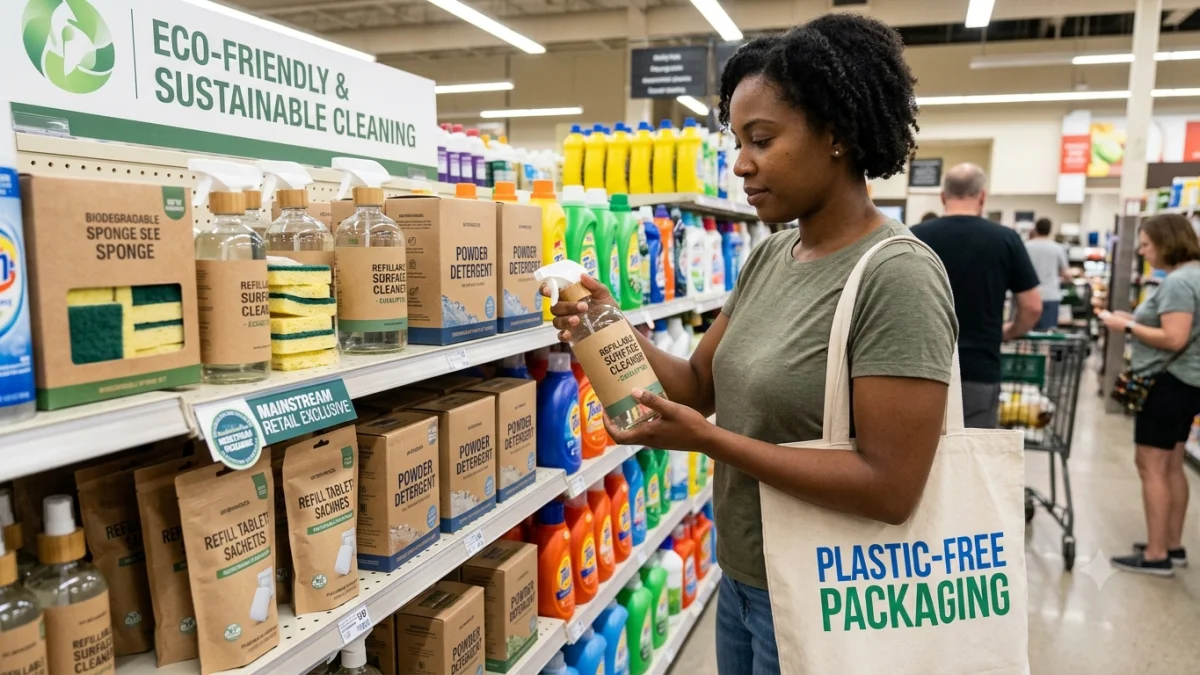
For years, shoppers looking for plastic-free household cleaners often had to seek them out online or in specialty stores, comparing refill systems and ingredient lists before placing an order. Today, that search increasingly begins in a more familiar setting: the cleaning aisle of a large supermarket or discount retailer, where refill tablets, reusable bottles and paper-based packaging now sit alongside conventional sprays and detergents.
The shift reflects more than a merchandising decision. It marks an important stage in the evolution of a category that has spent years trying to convince consumers that reducing plastic waste does not require sacrificing convenience or cleaning performance. As plastic-free brands move into mainstream retail, they are also adapting to the realities of selling to shoppers making quick purchasing decisions rather than carefully researching products online.
For companies such as Blueland, that transition has required redesigning packaging, simplifying product messaging and broadening product assortments. Sarah Paiji Yoo, the company's co-founder and chief executive, told Modern Retail that many customers encountering the brand in stores have never heard of it before, making shelf visibility as important as environmental credentials. The company's packaging now places greater emphasis on explaining that its products deliver a "100% plastic-free" cleaning experience while remaining effective for everyday household use.
The challenge illustrates how sustainability businesses often evolve as they leave their niche origins behind.
Early customers were typically willing to learn how refill tablets worked, keep reusable bottles and order replenishments online. Mass-market shoppers, however, often decide within seconds whether to place an unfamiliar product into their shopping carts. Retail shelves reward clarity, recognizable branding and straightforward instructions as much as environmental innovation.
Retailers have noticed those changing expectations. Target, for example, has expanded its assortment of environmentally focused cleaning products, adding brands that emphasize refill systems, lower-plastic packaging and formulations marketed as safer alternatives. Company representatives have said consumers are increasingly looking for products that combine cleaning performance with reduced environmental impact.
The expansion comes as public concern over plastic waste and microplastics has become more prominent. Rather than asking shoppers to eliminate cleaning products altogether, many emerging brands encourage them to reuse durable containers while purchasing compact refills packaged in recyclable or compostable materials.
That approach also changes the economics of transportation and storage. Tablets, powders and concentrates weigh less than bottles filled largely with water, reducing shipping volumes while allowing retailers to stock more units in the same shelf space. Industry executives increasingly describe those operational advantages alongside environmental benefits.
Yet mainstream success has not come simply from appealing to environmentally conscious consumers.
Many brands now frame their products around convenience, household safety and cleaning performance before emphasizing sustainability. The strategy reflects years of consumer research suggesting that environmental benefits alone rarely sustain repeat purchases if products fail to match conventional alternatives on effectiveness or price.
Blueland's experience illustrates that learning process. According to company executives, some early refill concepts proved less successful in physical retail because they required consumers to understand preparation steps before using them. More familiar categories, including dishwasher tablets, laundry detergents and hand soap refills, have generated stronger demand.
The broader cleaning industry has also begun responding.
Large consumer goods manufacturers have expanded refill options, concentrated formulations and lower-plastic packaging across several product categories. Competition from younger companies has encouraged established brands to rethink packaging design and product formats as consumer expectations continue to evolve.
Researchers studying household recycling habits have found that consumers often support reducing plastic waste but encounter practical barriers at home, including limited storage space, uncertainty about recycling rules and frustration with bulky containers. Those findings help explain why refill systems are increasingly designed to simplify daily routines rather than depend solely on consumers' environmental motivations.
For shoppers, the most visible change may be that sustainable cleaning products no longer occupy a separate corner of the marketplace.
Instead, they increasingly compete directly with established household names on the same shelves, forcing consumers to compare price, convenience, ingredients and packaging in real time. That competition also requires environmentally focused brands to communicate their value quickly to customers who may never have considered changing their cleaning habits.
Industry observers say that broader retail availability represents an important milestone because accessibility has long limited adoption. Products that once required online subscriptions or specialty retailers are becoming routine purchases during weekly grocery trips, lowering the effort required for consumers who want to reduce single-use plastic in their homes.
The transition remains a work in progress. Refill systems continue to compete against inexpensive conventional products, while brands must persuade retailers that environmentally focused offerings deserve valuable shelf space. Packaging, pricing and consumer education all remain critical factors in determining whether the category can continue expanding beyond its environmentally committed customer base.
Still, the growing presence of refillable sprays, dissolvable tablets and reusable bottles in mainstream stores signals that plastic-free cleaning has entered a different phase. What began as a niche proposition marketed largely through digital channels is increasingly becoming an ordinary retail choice, one made not only by shoppers seeking to reduce waste but also by those simply looking for another effective product while walking down the cleaning aisle.