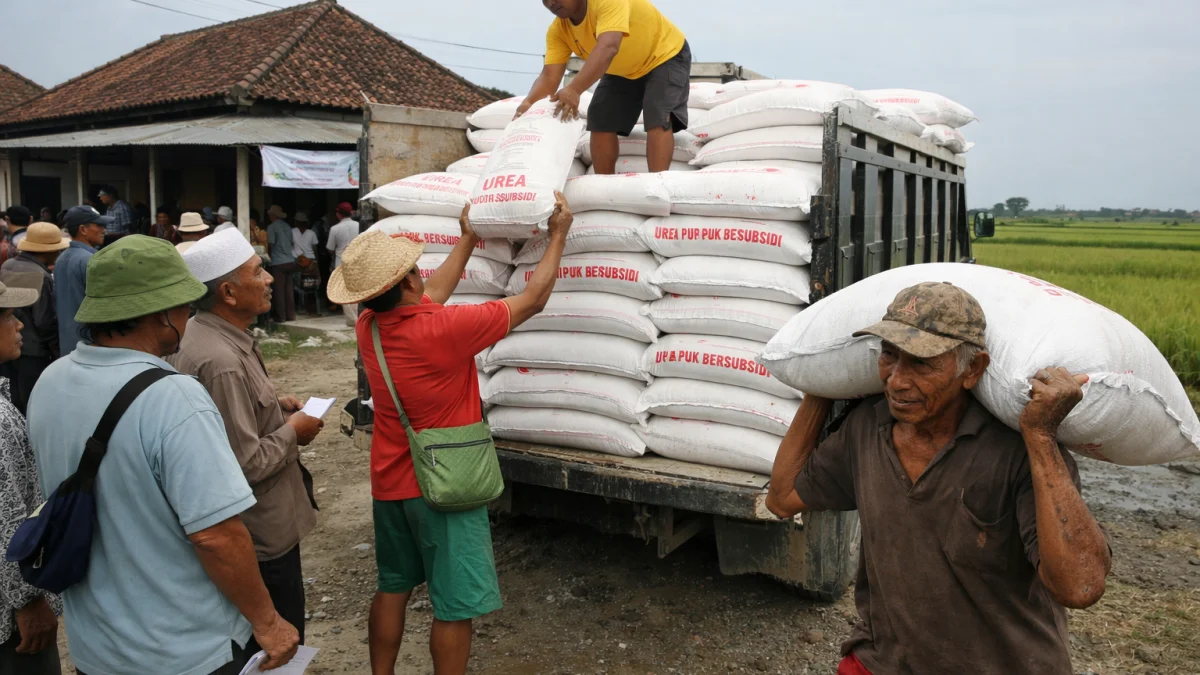
The planting calendar shapes life in many of Indonesia’s farming communities, where timing can determine whether a harvest is profitable or disappointing. For rice growers preparing fields ahead of a new planting season, one question often carries as much weight as the weather forecast: whether subsidized fertilizer will be available when it is needed, rather than after the crops are already in the ground.
That concern has long reflected one of Indonesian agriculture’s recurring challenges. Fertilizer subsidies have helped support millions of smallholder farmers, but distribution delays and complex administrative procedures have frequently disrupted seasonal schedules. In 2026, the government says it is trying to change that equation by simplifying the distribution system and accelerating deliveries before planting begins.
The effort highlights a simple reality of farming: even modest delays in agricultural inputs can have consequences that last through an entire growing season. Unlike many industrial supply chains, agriculture operates on biological timelines that cannot easily be postponed. Missing the ideal planting window may expose crops to different rainfall patterns, increase pest risks or reduce yields.
Speaking in Pontianak in early June, Coordinating Minister for Food Affairs Zulkifli Hasan said the government had overhauled regulations to ensure subsidized fertilizer reached farmers ahead of planting.
“Fertilizer must be available before the planting season. That is why we changed all regulations,” Hasan said, explaining that previous distribution procedures required multiple administrative approvals before supplies reached farmers. Under the revised system, registered farmers can redeem subsidized fertilizer directly through state-owned PT Pupuk Indonesia based on annual government allocations.
The policy forms part of a broader government strategy to strengthen food security while increasing domestic agricultural production. Authorities have also maintained a 20% reduction in the highest retail price of subsidized fertilizer introduced in late 2025, a measure officials say is intended to reduce financial pressure on farmers despite global economic uncertainty and currency weakness.
By late June, the government reported distributing 4.77 million tonnes of subsidized fertilizer, equivalent to 48.5% of the year's allocation of 9.84 million tonnes. Hasan said coordination among ministries and agencies would continue to improve to ensure fertilizer reached intended recipients and supported higher agricultural productivity.
Behind those national figures lies a highly seasonal agricultural economy spread across thousands of islands, where planting schedules differ by region and rainfall patterns. Farmers may grow rice several times a year in irrigated areas, while others rely on a single rainy-season crop. Fertilizer demand therefore arrives in concentrated periods rather than evenly throughout the year.
Government officials argue that making fertilizer available from the beginning of each calendar year allows farmers greater flexibility to prepare for their own planting schedules instead of waiting for administrative approvals.
The importance of timing has become even more pronounced as climate variability complicates traditional farming calendars.
Indonesia's weather agency warned on July 3 that farmers should adjust agricultural activities because of expected extreme dry weather during 2026. The agency urged producers to adapt cultivation practices to reduce risks associated with prolonged dry conditions, underscoring how weather uncertainty can compound existing logistical challenges.
For many farmers, decisions about fertilizer application cannot be separated from decisions about rainfall, irrigation and planting dates. Fertilizer delivered after crops have already passed key growth stages offers less benefit, while uncertainty over supplies can encourage farmers to delay planting altogether or reduce cultivated acreage.
Recognizing those pressures, the government has increasingly linked fertilizer policy with broader agricultural reforms. Officials have described deregulation alongside agricultural modernization as central pillars of Indonesia's effort to strengthen food production and move toward greater food self-sufficiency.
Agriculture Minister Andi Amran Sulaiman said earlier this year that simplified regulations had helped accelerate fertilizer distribution directly to farmers.
“In the past, when farmers were ready to plant, the fertilizer had not arrived. Now, the distribution is direct, fast, and on target,” Sulaiman said in February.
The reforms also come as fertilizer markets remain vulnerable to international disruptions. Global fertilizer prices have experienced periodic volatility in recent years because of geopolitical tensions, energy costs and supply-chain pressures, increasing the importance of reliable domestic distribution systems for countries seeking to stabilize food production.
Indonesia's approach has focused on combining subsidy support with administrative reform rather than relying solely on increased spending. Presidential Regulation No. 13 of 2025, cited by government officials, aims to improve transparency, industrial efficiency, sustainable supply and faster delivery of subsidized fertilizer.
The distribution campaign is also supported by physical logistics. Fertilizer must move from manufacturing facilities through warehouses and transport networks before reaching retailers serving farming communities across the archipelago. Government photographs released in June showed workers loading subsidized fertilizer for shipment from warehouse facilities as authorities sought to accelerate deliveries during the planting period.
Whether the reforms ultimately translate into higher productivity will become clearer only after successive planting and harvest cycles. Agricultural policies are often measured over seasons rather than weeks, as yields reflect a combination of weather, input availability, water supplies and market conditions.
For farmers preparing their fields, however, the government's message remains focused on timing rather than volume alone. Officials continue to stress that fertilizer should arrive before planting begins, recognizing that in agriculture, the value of an input depends not only on how much is delivered, but also on when it reaches the people who need it.