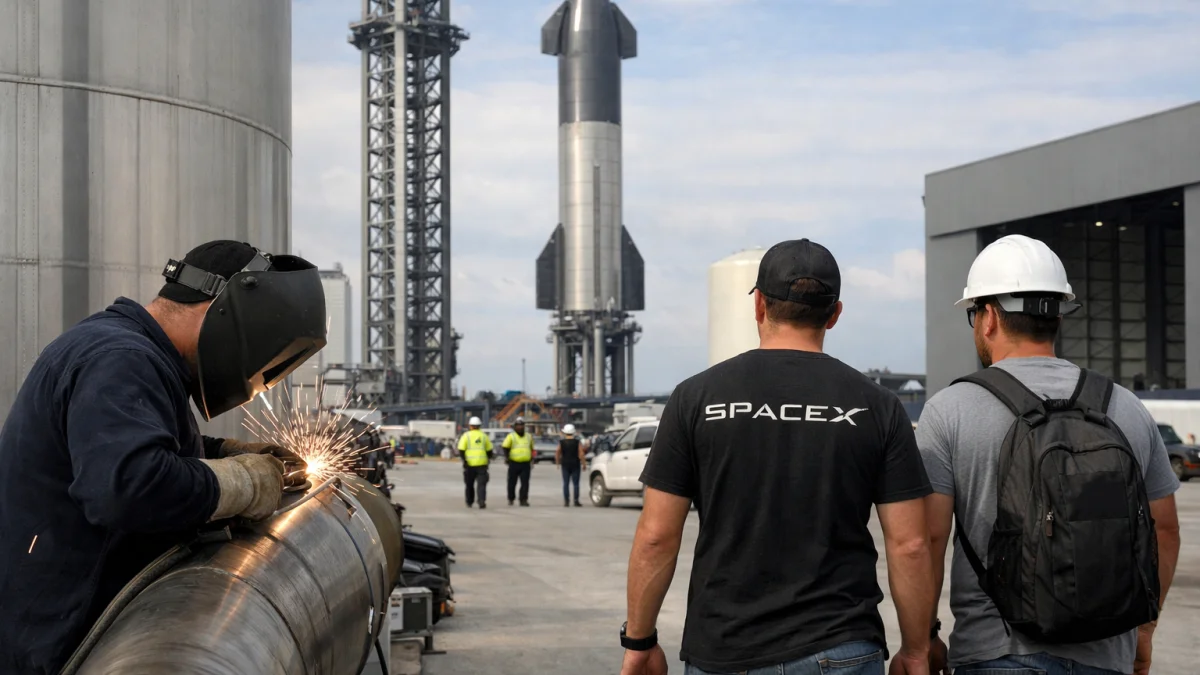
At the SpaceX factories where rockets move from metal sheets and engine parts into flight-ready machines, the value of a worker’s contribution has increasingly been measured not only in wages but also in ownership.
For years, employees across the company — from engineers and technicians to manufacturing workers — held equity in a private company whose shares were difficult to trade. After SpaceX’s public market debut in 2026, that paper ownership became a visible source of wealth, turning thousands of current and former employees into some of the newest participants in one of the largest employee wealth-creation events in the aerospace industry.
The story of SpaceX’s workers reflects a broader shift in Silicon Valley and aerospace: companies increasingly use stock ownership to recruit and retain talent, allowing employees to share in the value they help build. In SpaceX’s case, the strategy meant that some workers who spent years building rockets on factory floors gained stakes that became worth millions as the company’s valuation soared.
For manufacturing employees, the transformation was especially notable. A welder or technician working on spacecraft hardware traditionally would not expect a direct financial connection to the company’s market value. But SpaceX’s compensation structure included equity opportunities across a wider range of roles than is common in many aerospace companies, according to reports examining the company’s employee ownership.
Among those highlighted in coverage of the windfall was Juan Hernandez, described by reports as a former SpaceX welder who worked on rocket components. An analysis cited by media reports estimated that his holdings could be worth around $1 million based on SpaceX’s share price after its market debut.
The gains, however, did not come overnight in the way headlines sometimes suggest. Employees who benefited typically accumulated equity over years while SpaceX remained private. The public listing changed how those shares were valued and traded, but the ownership represented a long-term bet on the company’s growth rather than an instant reward for a single day’s work.
That growth has been built over more than two decades. Founded in 2002 by Elon Musk, SpaceX began with the goal of reducing the cost of spaceflight and developing reusable rockets. The company’s Falcon rocket program, cargo missions, and Starlink satellite business helped transform it into one of the world’s most valuable space companies. Its rise created opportunities not only for investors but also for employees who received equity during the company’s private years.
The scale of the employee wealth effect drew attention because it extended beyond executives and early investors. Estimates cited by industry analysts and media reports suggested that more than 4,000 current and former employees could hold stock worth at least $1 million, with several hundred potentially holding stakes valued above $100 million.
For aerospace workers, the outcome highlights the changing relationship between labor and ownership in high-growth industries. Traditional manufacturing jobs have generally provided income through salaries, overtime, and benefits. Technology companies, however, have increasingly offered equity as a way to align employees with company performance. When those companies succeed, the rewards can extend far beyond the executive level.
The model also carries risks. Stock-based compensation depends on company performance and market conditions. A private company’s shares can be difficult to sell, and a high valuation does not automatically translate into immediate cash. Public market prices can also rise and fall, affecting the value of employee holdings. SpaceX’s own stock experienced volatility after its debut, showing that even successful companies remain subject to investor expectations and market forces.
The employee gains also placed SpaceX in contrast with other aerospace companies where workers may receive different forms of compensation but less direct exposure to company equity. Analysts and observers have pointed to employee ownership as one factor that helped SpaceX attract and keep workers in a highly competitive industry.
For many SpaceX employees, the significance of the moment was tied to years spent working on a difficult and uncertain mission: building rockets that could return to Earth, launching satellites, and expanding commercial space operations. The financial outcome became a reminder that the company’s rise was not built only by founders and investors, but also by the workforce that assembled the hardware and kept the launches moving.
As SpaceX entered a new phase as a public company, the people who helped build its rockets found themselves connected to its future in a new way — not only as employees, but as owners.