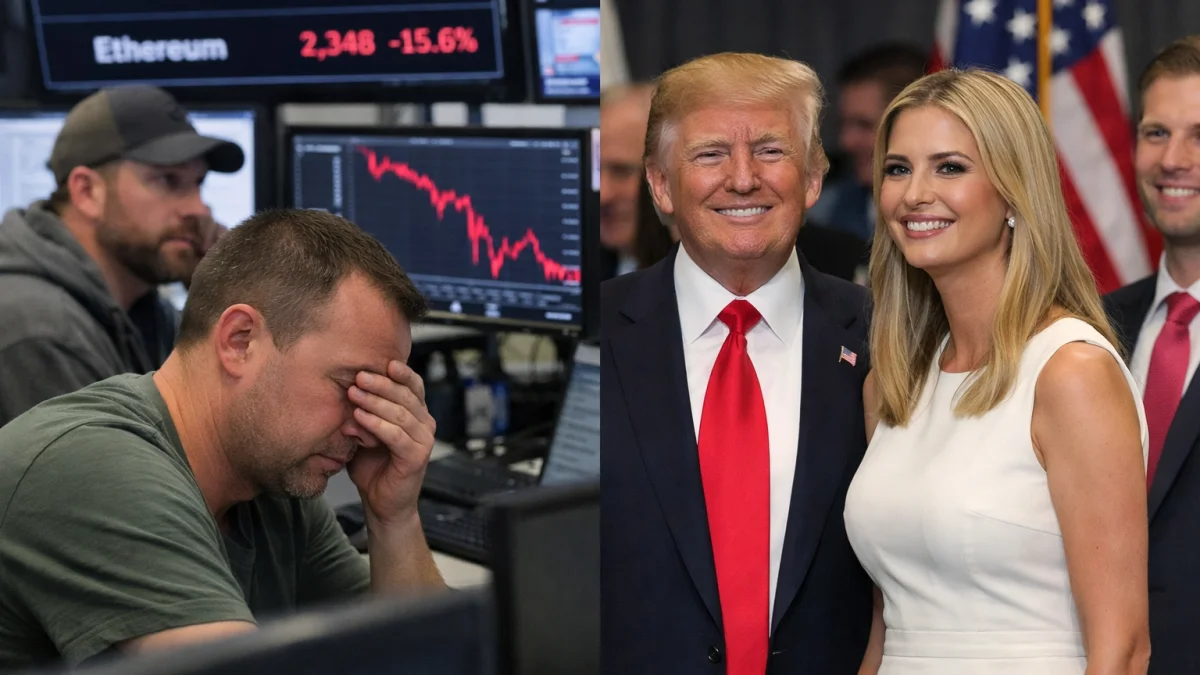
When software engineer Morten Christensen decided to buy into a cryptocurrency linked to President Donald Trump, he knew he was entering one of the market's most volatile corners. The token's rapid rise had attracted global attention, buoyed by Trump's embrace of digital assets and promises to make the United States the "crypto capital of the world."
Months later, the value of his holdings had fallen sharply.
Christensen is among a large group of investors whose experiences illustrate the uneven fortunes created by a wave of Trump-branded cryptocurrency ventures. While many retail buyers have watched the market value of their investments decline, a Reuters examination found that Trump and his family have accumulated at least $2.3 billion from their principal crypto businesses since his return to the White House, often while committing little or none of their own capital.
The contrast has become one of the defining stories of crypto's latest boom—not simply because of the money involved, but because it sits at the intersection of political power, financial innovation and the risks borne by ordinary investors.
For many buyers, the attraction extended beyond the prospect of quick profits. Trump's public support for cryptocurrencies encouraged some supporters to see the investments as both financial opportunities and expressions of confidence in a political movement. Yet digital assets remain highly speculative, with prices capable of soaring and collapsing within weeks.
According to blockchain analytics firm Nansen, roughly 85% of purchasers of World Liberty Financial's WLFI token and about two-thirds of holders of the $TRUMP memecoin are currently sitting on paper losses after prices retreated significantly from their peaks. The $TRUMP token, whose market capitalization once approached $15 billion, has since lost most of its value.
Christensen, interviewed by Reuters, said he understood the risks involved before investing. Another investor, Vincent Deriu, similarly acknowledged that speculative crypto investments can produce painful losses as well as gains. Their experiences reflect a familiar reality in digital asset markets, where retail participants frequently absorb sharp price swings while early insiders often benefit from initial token appreciation.
The Trump family's gains have come from multiple ventures. Reuters found that World Liberty Financial generated the largest share, followed by proceeds from the $TRUMP memecoin and additional crypto-related businesses launched during Trump's second presidency. Revenue has come through token sales, licensing arrangements and equity transactions rather than conventional trading gains.
The scale of those earnings became even clearer after Trump's latest financial disclosure.
The filing, covering 2025, showed that Trump reported more than $1.4 billion in income from crypto ventures during the year alone. Nearly $800 million came from World Liberty Financial, the crypto company he co-founded with his sons Donald Trump Jr. and Eric Trump. Another $635 million was reported from sales tied to Trump-branded meme coins, making digital assets the president's largest single source of income.
Those disclosures illustrate how dramatically Trump's business interests have shifted. For decades, his public identity was closely associated with hotels, golf courses and real estate development. Today, according to official filings, cryptocurrency has overtaken those traditional businesses as the dominant contributor to his reported income.
The rapid growth has also intensified scrutiny from ethics experts and lawmakers.
Critics argue that Trump's financial interests have become increasingly intertwined with an industry that has benefited from his administration's regulatory approach, including support for stablecoin legislation and a lighter enforcement posture toward parts of the crypto sector. They contend that the overlap creates potential conflicts of interest because presidential decisions could influence the value of businesses from which his family profits.
The White House rejects those concerns.
Trump has said he does not personally manage his financial affairs and that independent managers oversee his assets. Responding to questions after the financial disclosures were released, he attributed his wealth to strong market performance, saying that "everybody's profiting because the stock market is up." Administration officials have likewise maintained that the president acts in the interests of the American public rather than for personal financial gain.
Beyond Washington, the story has become a cautionary example for retail investors navigating speculative markets.
Crypto has long promised broader access to financial opportunity, allowing individuals to participate in markets once dominated by institutions. But the structure of many token launches often enables founders and early participants to realize substantial gains before later investors face prolonged price declines.
Analysts note that such outcomes are not unique to Trump-linked projects. Volatility, concentrated ownership and speculative trading have characterized much of the cryptocurrency industry since its emergence. What distinguishes these ventures is the unprecedented overlap between presidential office, political branding and private digital-asset businesses.
For investors like Christensen and Deriu, the experience ultimately reflects a lesson familiar to anyone who has participated in speculative markets: enthusiasm can lift prices rapidly, but it offers no guarantee of lasting value.
As Congress continues debating the future of cryptocurrency regulation and ethics rules surrounding elected officials' financial interests, the fortunes of Trump's crypto empire—and the losses reported by many of its investors—are likely to remain central to a broader discussion about risk, accountability and the evolving relationship between politics and digital finance.