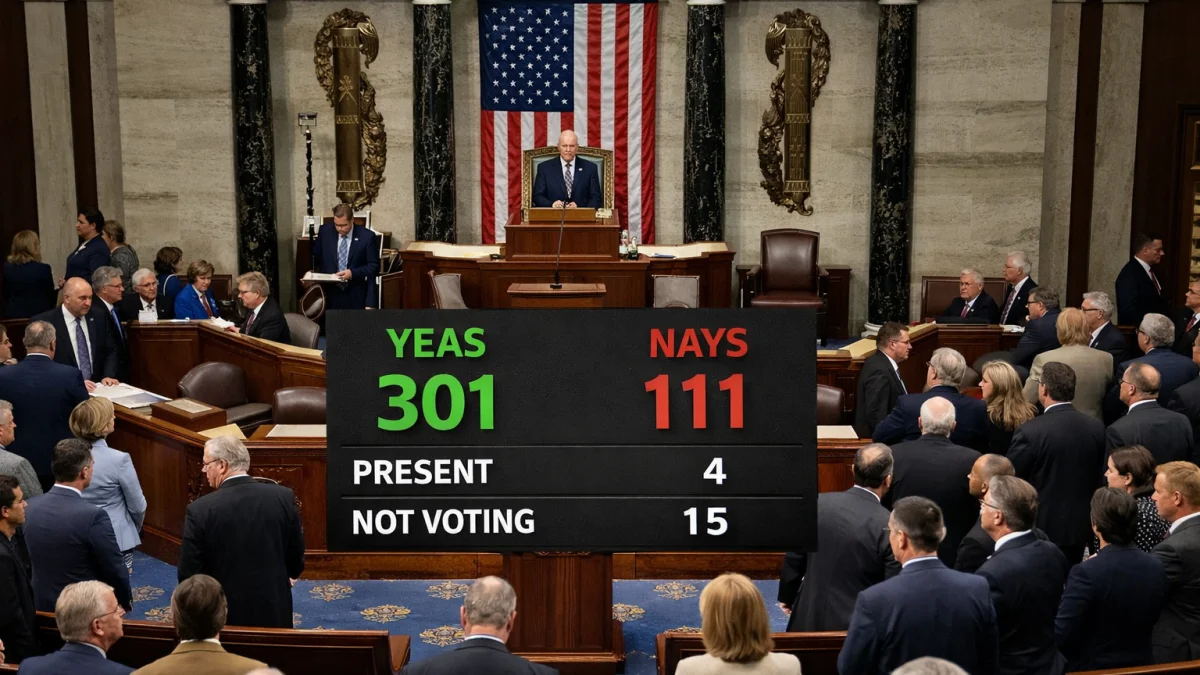
WASHINGTON — The Republican-led U.S. House of Representatives passed a resolution on Wednesday directing President Donald Trump to end U.S. military action against Iran, with four Republicans joining Democrats in a rare bipartisan rebuke, congressional officials said.
The measure passed by a vote of 215-208. The four Republicans who broke with their party were Reps. Thomas Massie of Kentucky, Brian Fitzpatrick of Pennsylvania, Tom Barrett of Michigan and Warren Davidson of Ohio, according to House records.
The resolution, introduced by Rep. Gregory Meeks, the ranking Democrat on the House Foreign Affairs Committee, directs the president to remove U.S. armed forces from hostilities against Iran unless Congress authorizes continued action or U.S. forces face imminent attack. It remains largely symbolic, as it is not expected to become law and would likely face a presidential veto if it advances.
House Speaker Mike Johnson, a Louisiana Republican, condemned the outcome. “Very unfortunate outcome, and it’s very dangerous at a very serious time,” he said.
The vote reflects growing unease among some Republicans over the three-month-old conflict, which began earlier in 2026. Democrats have repeatedly pushed for the measure, arguing Congress never authorized the military campaign.
"This is a significant bipartisan rebuke of President Trump's illegal and costly war in Iran and the first step toward ending it once and for all," Meeks said in a statement following the vote.
Trump has criticized the Republicans who supported the resolution, calling the vote “meaningless.” The administration maintains that its actions against Iran are necessary for national security.
An earlier attempt to bring the resolution to the floor in May was postponed by Republican leaders when it appeared it might pass. The vote proceeded after lawmakers returned from recess.
The resolution now heads to the Senate, where its prospects remain uncertain. Similar efforts in the Senate have advanced previously with limited Republican support, but none have resulted in binding action.
As of Sunday, no further votes were immediately scheduled. Congressional leaders from both parties continued discussions on next steps regarding U.S. policy toward Iran, officials said. Details on potential Senate action remained unclear.