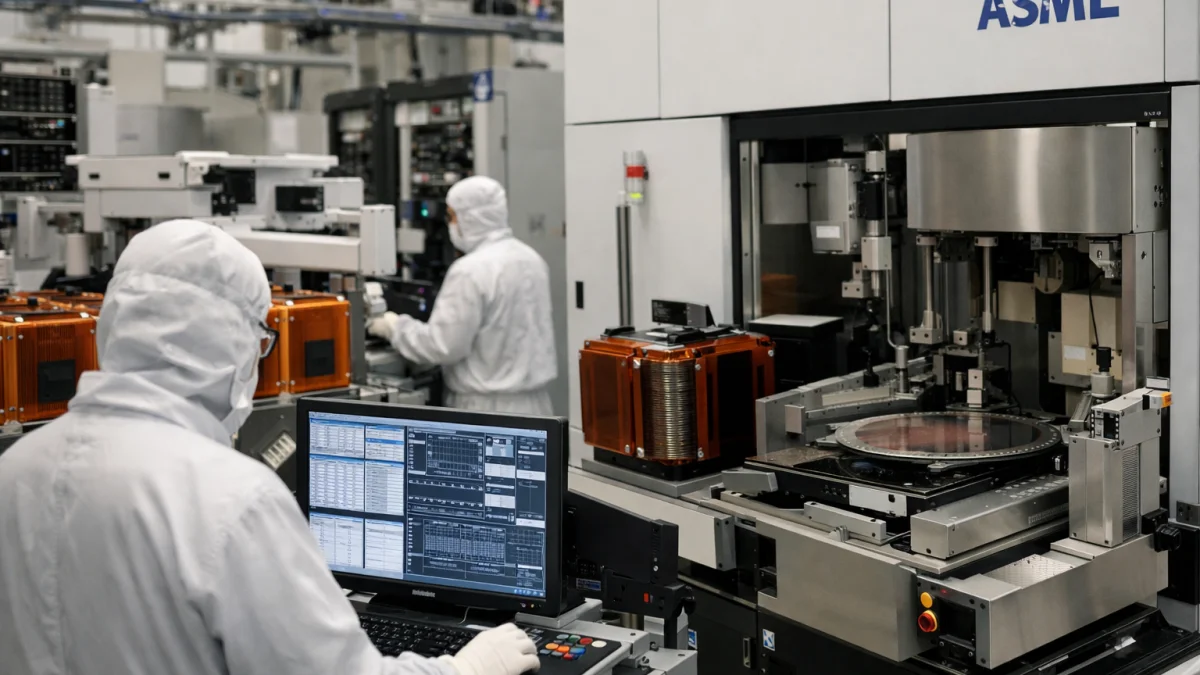
Artificial intelligence-driven investment continues to reshape the global semiconductor industry, with leading chipmakers expanding production plans, raising capital spending and increasing revenue forecasts even as geopolitical tensions, export controls and supply chain risks remain elevated. Recent earnings guidance and investment announcements from major manufacturers, including Taiwan Semiconductor Manufacturing Co. (TSMC), underscore that demand for advanced processors used in AI training and inference continues to outpace expectations across much of the industry.
The latest developments matter because they suggest that AI has become the semiconductor sector's dominant growth engine, altering investment priorities for manufacturers, governments and technology companies alike. Unlike previous chip cycles driven largely by consumer electronics or smartphones, the current expansion is being led by hyperscale cloud providers, AI developers and data center operators seeking increasingly powerful computing infrastructure. That shift has supported robust demand for advanced logic chips, high-bandwidth memory and semiconductor manufacturing equipment even as broader economic uncertainty persists.
TSMC's decision to expand its long-term U.S. manufacturing commitment while raising capital expenditure illustrates how manufacturers are attempting to match unprecedented AI-related demand with additional production capacity. The company cited sustained demand for AI chips as it increased its financial outlook, reflecting continued orders from major technology customers building AI infrastructure. Similar investment patterns have emerged across the semiconductor supply chain, from memory manufacturers to equipment suppliers.
Industry forecasts broadly reinforce that optimism. Gartner projects worldwide semiconductor revenue to exceed $1.3 trillion in 2026, driven primarily by AI processors, networking chips and memory products used in large-scale computing systems. Gartner also expects AI-related semiconductors to account for roughly one-third of total industry revenue this year, highlighting the technology's growing influence on market performance.
Equipment suppliers are also benefiting from the expansion. Semiconductor Equipment and Materials International (SEMI) forecasts global semiconductor manufacturing equipment sales will reach a record level in 2026 as manufacturers continue investing in fabrication capacity. The forecast reflects expectations that AI-related demand will remain sufficiently strong to justify several years of elevated capital expenditure despite cyclical risks.
Yet the industry's strong commercial outlook exists alongside an increasingly complex geopolitical environment. Export controls on advanced semiconductor technologies, strategic competition between the United States and China, and government incentives for domestic manufacturing have fundamentally altered corporate planning. Companies are now making investment decisions that reflect not only commercial demand but also concerns over supply chain resilience, technology security and regulatory uncertainty.
Those geopolitical considerations have accelerated diversification efforts. Governments in North America, Europe and parts of Asia have introduced incentives to expand domestic semiconductor production following disruptions experienced during the COVID-19 pandemic and amid rising strategic competition. At the same time, multinational manufacturers continue balancing investments across multiple jurisdictions to reduce exposure to potential trade restrictions or regional instability.
Industry executives increasingly identify supply chain flexibility as a strategic priority. A joint survey by KPMG and the Global Semiconductor Alliance found that most semiconductor leaders expect revenue growth in 2026, while many also rank adapting supply chains to geopolitical disruption among their highest priorities. Executives cited geographical diversification and operational resilience as increasingly important as governments strengthen industrial policies tied to advanced technologies.
Financial markets nevertheless demonstrate that optimism about AI does not eliminate volatility. Semiconductor shares have experienced periods of sharp selling despite strong earnings and investment announcements, reflecting investor concerns over valuations, the sustainability of AI spending and broader geopolitical developments affecting global markets. Episodes of heightened tensions in the Middle East and uncertainty surrounding trade policy have periodically weighed on technology stocks even as company fundamentals remain comparatively strong.
The concentration of AI demand among a relatively small number of hyperscale customers also presents longer-term questions. While cloud providers continue announcing major investments in AI infrastructure, analysts note that future industry growth will depend partly on whether enterprise adoption broadens beyond the largest technology companies. Memory pricing, electricity availability for data centers and manufacturing capacity expansion also remain important variables that could influence the pace of future investment.
Another emerging challenge concerns infrastructure beyond semiconductor fabrication itself. Industry surveys suggest executives increasingly view energy availability, skilled labor and advanced packaging capacity as potential constraints as AI computing requirements continue expanding. These issues extend the industry's focus beyond chip production toward the broader ecosystem required to support AI deployment at scale.
The current evidence indicates that AI demand continues to provide substantial momentum for the semiconductor industry despite an environment shaped by geopolitical competition, trade restrictions and supply chain realignment. Companies remain committed to expanding manufacturing capacity while governments continue pursuing technology security and domestic production objectives. Whether the industry's rapid growth can be sustained will depend on confirmed trends in AI infrastructure investment, continued customer demand, evolving export policies and the successful execution of large-scale manufacturing expansions that are now being closely monitored by investors, policymakers and industry participants.