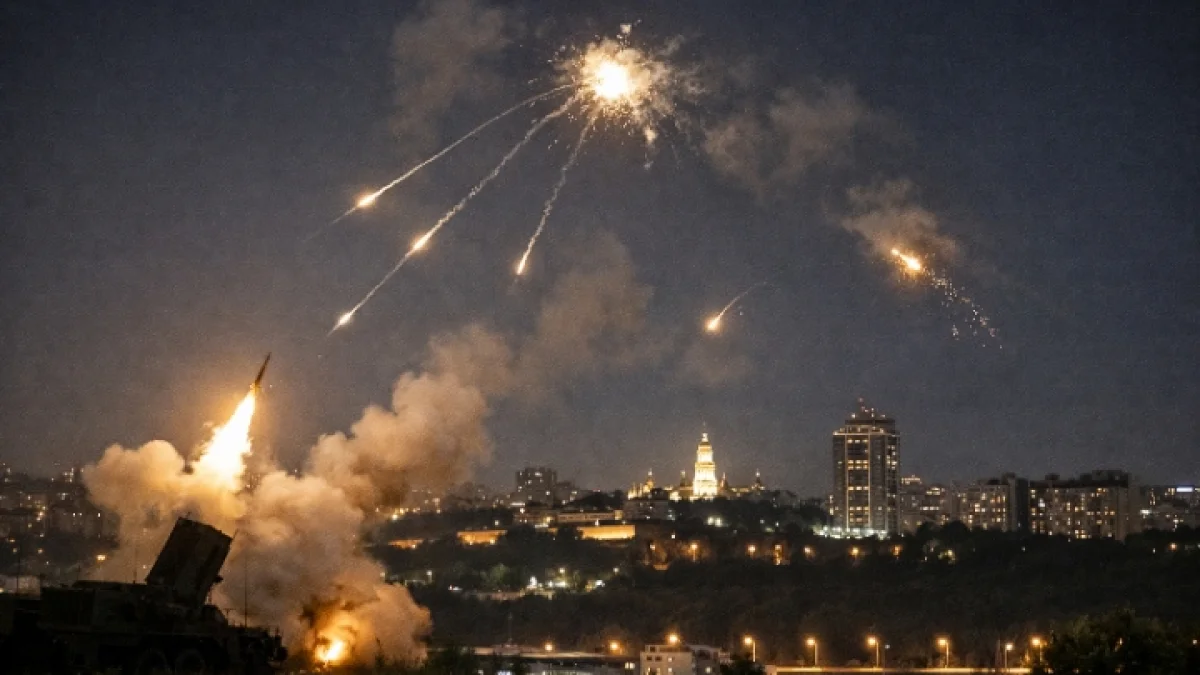
Russia's latest overnight missile and drone assault on Kyiv has reinforced a pattern that has become increasingly evident in recent months: while Ukraine continues to intercept large numbers of drones and cruise missiles, it remains significantly more vulnerable to concentrated ballistic missile attacks because of persistent shortages of advanced air-defense interceptors. Ukrainian officials said Russia launched 41 missiles and 125 drones overnight, with Kyiv the primary target. The attack killed at least one person, injured more than a dozen others and caused widespread damage across several districts of the capital.
The significance of the latest strike extends beyond the immediate casualties and destruction. It illustrates how the evolving balance between offensive missile capabilities and defensive interceptor inventories is shaping the operational environment of the war. Ukraine's air force reported intercepting most of the drones involved in the attack but a substantially smaller proportion of ballistic missiles, highlighting a capability gap that Kyiv has repeatedly warned about.
That gap reflects both technological and logistical realities. Ballistic missiles travel at much higher speeds than drones and many cruise missiles, requiring sophisticated systems such as the U.S.-made Patriot to intercept them effectively. Ukrainian officials, including President Volodymyr Zelenskyy, have repeatedly argued that shortages of Patriot interceptor missiles—not simply launcher systems—have become one of the country's most pressing military constraints.
The latest assault also demonstrates Russia's continued adaptation of its long-range strike campaign. Throughout 2026, Moscow has increasingly combined large drone swarms with cruise and ballistic missiles in complex attacks designed to complicate Ukrainian defensive planning. Military analysts have long noted that such mixed attacks can force defenders to allocate interceptors against multiple threats simultaneously while increasing the likelihood that some missiles penetrate air defenses. The recurring use of ballistic missiles places additional pressure on Ukraine because those weapons require its most limited and expensive defensive assets.
The attack follows several similarly large Russian strikes earlier this month that exposed comparable vulnerabilities. During previous assaults, Ukrainian authorities acknowledged that none of the ballistic missiles launched in some attacks had been intercepted, even as air defenses continued achieving relatively high success rates against drones. Those episodes reinforced assessments that interceptor availability, rather than the absence of trained personnel or warning systems, has become a central operational challenge.
Russia says its strikes target military-related facilities supporting Ukraine's defense effort. Ukrainian authorities, meanwhile, report repeated damage to residential neighborhoods, transport infrastructure and civilian facilities in Kyiv. Independent verification of every individual target is often not possible during ongoing hostilities, but emergency services have documented fires and structural damage across multiple districts following the latest attack.
The latest bombardment also unfolded amid an expanding cycle of reciprocal long-range strikes. Ukraine has intensified attacks on Russian oil facilities, logistics hubs and maritime assets using domestically produced drones and other long-range capabilities. Russian officials have linked recent strikes on Kyiv to military objectives, while Ukrainian officials argue their own operations are intended to reduce Russia's capacity to sustain its invasion. The growing reach of both countries' strike capabilities has broadened the conflict beyond frontline combat into campaigns targeting logistics, energy infrastructure and military-industrial assets.
For Ukraine's international partners, the attack is likely to renew debate over sustaining air-defense support. Western governments have provided Patriot systems and other advanced defenses since Russia's full-scale invasion began in 2022, but production capacity for interceptor missiles remains limited and competing global security demands have affected inventories. Officials in Kyiv continue to argue that expanding domestic production partnerships and accelerating deliveries are essential if cities are to remain protected against increasingly sophisticated missile attacks.
Strategically, the latest assault highlights that the effectiveness of air defense is no longer measured solely by the number of incoming weapons intercepted. Even when Ukrainian forces destroy most drones, a relatively small number of ballistic missile impacts can inflict significant damage because of their speed, payload and difficulty of interception. This dynamic gives Russia an opportunity to achieve operational effects disproportionate to the number of missiles that evade defenses, while forcing Ukraine to make difficult decisions about conserving scarce interceptor stocks.
The current confirmed picture is that Russia continues to conduct large, combined missile and drone attacks against Kyiv while Ukraine maintains a high interception rate against many aerial threats but faces acknowledged shortages in defenses against ballistic missiles. Ukrainian officials are continuing rescue and damage assessments, Russia maintains that its strikes were directed at military-linked targets, and Western governments remain focused on the pace of additional air-defense assistance. How quickly new interceptor supplies become available, and whether the scale or composition of Russian strike packages changes further, remain key developments being officially monitored.