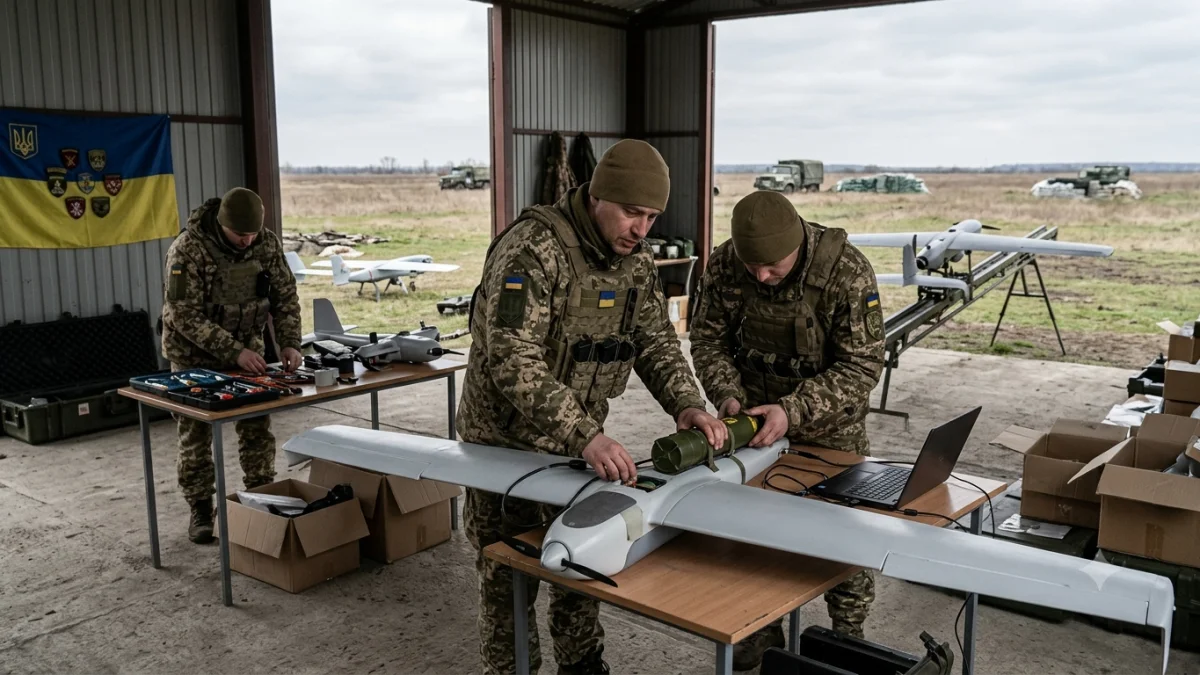
Ukraine's expanding long-range drone campaign has become a central element of its wartime strategy, reaching deeper into Russian territory while coinciding with renewed political changes in Kyiv that underscore the challenge of sustaining military innovation alongside domestic reform. The latest wave of strikes targeted logistics hubs, warehouses and energy-related facilities that Ukrainian officials said support Russia's drone and military supply chains, even as Russia reported intercepting hundreds of drones across multiple regions.
The developments are significant because they illustrate how the conflict has evolved beyond a conventional contest along the front lines into a sustained campaign of strategic disruption. Unable to match Russia's larger industrial base or manpower, Ukraine has increasingly relied on domestically produced drones and precision strikes to raise the costs of Russia's war effort, complicate logistics and force Moscow to devote additional resources to defending infrastructure far from the battlefield. Analysts have increasingly described the campaign as an attempt to erode Russia's operational resilience rather than achieve immediate territorial gains.
Recent strikes have reflected that approach. Ukrainian President Volodymyr Zelenskyy said long-range operations were directed at facilities supporting drone production and navigation equipment, while Russian authorities reported casualties, warehouse fires and disruptions across several regions. Russia's Defence Ministry said hundreds of Ukrainian drones were intercepted, highlighting both the growing scale of Ukrainian operations and the expanding burden placed on Russian air-defence networks. Although Russian claims and Ukrainian battlefield assessments cannot always be independently verified, both sides acknowledge that long-range drone warfare has become an increasingly prominent feature of the conflict.
Military analysts argue that Ukraine's drone campaign serves multiple objectives. Beyond damaging individual facilities, repeated attacks require Russia to disperse air-defence systems, strengthen protection of industrial sites and invest additional resources in securing transport routes, fuel depots and logistics centres. Recent assessments from the Institute for the Study of War suggest Ukrainian strikes have increasingly targeted oil infrastructure, transport networks and air-defence assets supporting occupied Crimea and Russian military operations. Those assessments conclude that the campaign is creating broader logistical pressures even when individual attacks produce limited physical damage.
The campaign has unfolded alongside continued Russian adaptation. Moscow has expanded production of strike drones, increased the size of combined missile and drone attacks, and introduced technological changes intended to reduce interception rates. Analysts say Russia has experimented with faster drones, altered electronic frequencies and increasingly complex strike packages that combine ballistic missiles, cruise missiles and unmanned aircraft. Those adaptations have placed growing pressure on Ukraine's air-defence inventory while increasing risks to civilian infrastructure.
The military contest therefore increasingly resembles a cycle of innovation and counter-innovation. Ukrainian forces continue developing longer-range drones and new operational tactics, while Russian forces adjust production methods, electronic warfare capabilities and air-defence deployments. Battlefield reporting indicates that both armies have integrated drones into virtually every level of combat, from reconnaissance and logistics to direct attacks against personnel, armour and infrastructure.
At the same time, Ukraine's domestic political developments have drawn renewed attention because wartime technological innovation depends heavily on institutional continuity. Changes within the Ukrainian government, including leadership adjustments affecting the defence establishment, have prompted debate over procurement, military management and the balance between political oversight and operational effectiveness. Supporters of the government's changes argue reforms are intended to improve wartime administration and maintain accountability. Critics have questioned whether leadership turnover could disrupt programmes that accelerated Ukraine's drone production and defence modernisation.
Those debates extend beyond immediate military considerations. Ukraine continues pursuing governance reforms linked to its longer-term European integration while simultaneously managing a large-scale war. Academic research examining Ukraine's wartime governance has noted that the country has sought to maintain institutional reform despite sustained military pressure, arguing that resilience has depended not only on battlefield performance but also on preserving state capacity and administrative effectiveness.
For Russia, the growing reach of Ukrainian drone strikes presents strategic and political challenges. Although Russia retains substantially greater military resources and continues large-scale missile and drone attacks against Ukrainian cities, repeated strikes inside Russian territory expose vulnerabilities in protecting critical infrastructure across a vast geographic area. Independent military assessments suggest Moscow must increasingly balance frontline requirements against the need to defend industrial facilities, transport networks and energy infrastructure deeper inside Russia.
The broader strategic picture remains one of mutual adaptation rather than decisive advantage. Russia continues to demonstrate the capacity to launch large combined attacks despite Ukrainian long-range operations, while Ukraine has shown an ability to sustain increasingly sophisticated drone campaigns despite continuing pressure on its air defences and infrastructure. Recent missile attacks on Kyiv illustrate that Russia retains significant strike capability even as Ukraine expands operations inside Russian territory.
The confirmed picture as of July 19 is that Ukraine is continuing to expand long-range drone operations while Russia is adapting its military and defensive posture in response. Kyiv is simultaneously managing wartime reforms affecting its defence institutions, an issue closely watched by domestic observers and international partners. Officials and independent analysts are monitoring whether Ukraine can maintain the pace of military innovation and institutional reform, and whether Russia's evolving defensive measures materially reduce the effectiveness of Ukraine's expanding drone campaign.