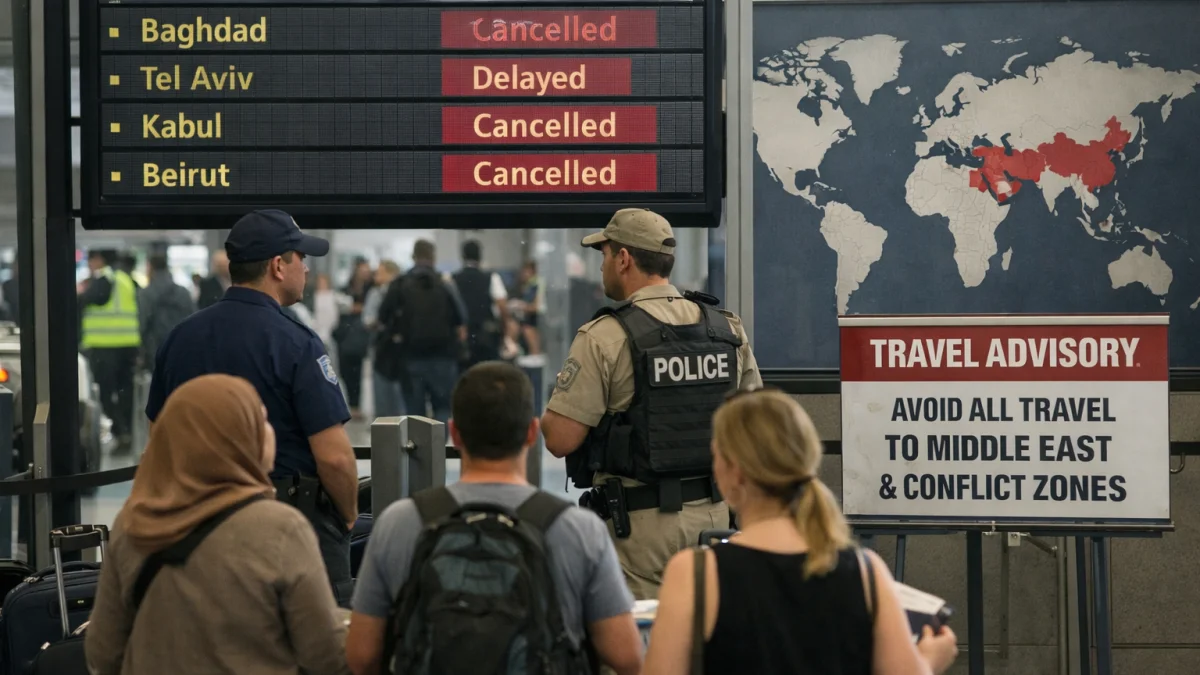
LONDON — Governments including the United States, Australia, Canada and several European authorities have updated or reinforced travel advisories for parts of the Middle East and other active conflict zones, urging travelers to reconsider non-essential travel or avoid affected areas as regional security risks remain elevated.
The advisories, issued or updated in recent weeks, cite the possibility of further military action, missile and drone attacks, terrorism, civil unrest and disruptions to commercial air travel following renewed instability across parts of the region. Officials have emphasized that security conditions could change rapidly with little warning.
The U.S. Department of State continues to advise against travel to countries including Iran and Iraq under its highest advisory level, while maintaining warnings for several other destinations in the region where travelers are urged to reconsider travel because of security concerns. The department has advised U.S. citizens already in affected areas to monitor local media, follow instructions from local authorities and review contingency plans.
Australia's Department of Foreign Affairs and Trade has also maintained heightened advice for several Middle Eastern destinations. Canberra said the regional security situation could deteriorate quickly despite earlier adjustments that lowered advisory levels for some countries from "Do Not Travel" to "Reconsider your need to travel." Australian authorities continue to recommend postponing non-essential travel and monitoring official updates.
The European Union Aviation Safety Agency has separately advised commercial aircraft operators to avoid the airspace over Iran, Iraq and Lebanon through at least the end of August, citing the risk that renewed military activity could threaten civilian aviation. Airlines have continued to adjust flight routes and schedules in response to the evolving security environment.
Several governments have also warned travelers that transportation disruptions, including flight cancellations, airport congestion and temporary airspace closures, may occur with little notice. Travelers have been advised to confirm flight arrangements with airlines, ensure travel documents remain valid and register with consular services where available if staying in higher-risk areas.
The latest advisories follow renewed regional tensions that prompted governments to reassess risks for citizens abroad. While some destinations have seen advisory levels eased compared with earlier emergency measures, officials across multiple countries continue to stress that conditions remain unpredictable and that travelers should rely on official government guidance before making travel decisions.