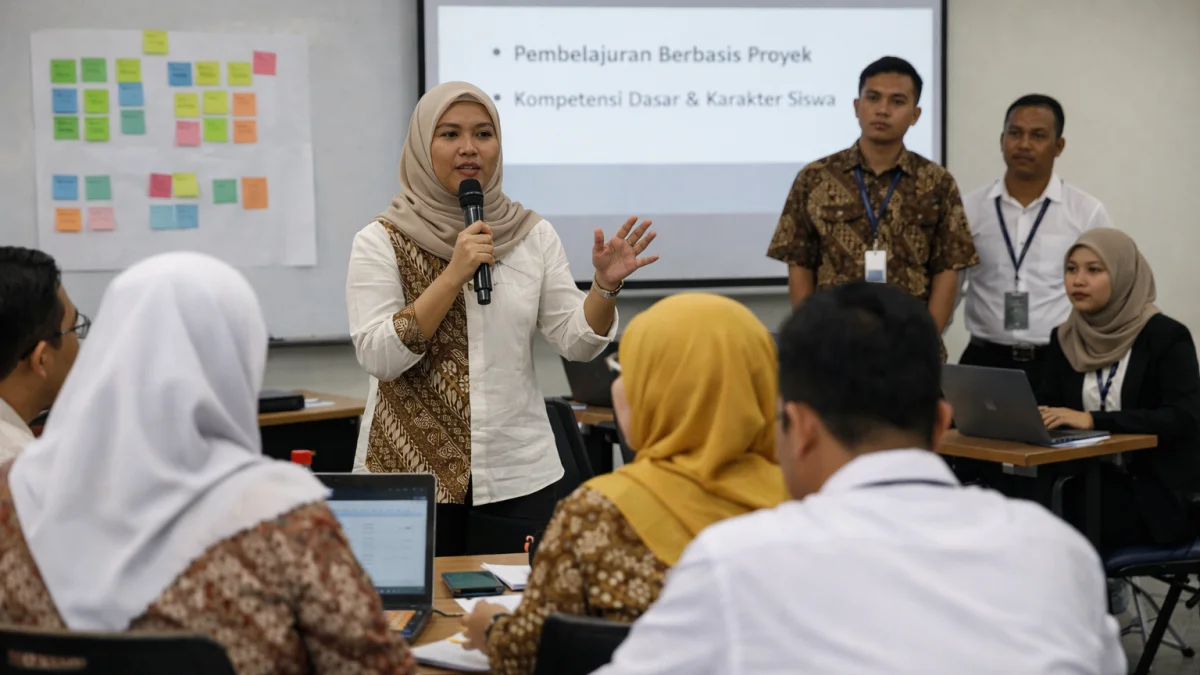
Teachers gathered in Jakarta in early July carrying notebooks rather than lesson plans. Over four days of workshops, they discussed curriculum design, boarding-school operations, student welfare, character education and international academic standards. By the end of the program, they had also drafted practical documents ranging from student orientation guidelines to dormitory rules, performance indicators and plans for a learning management system.
The participants were not preparing for an ordinary school year. They are among the first 54 educators selected to serve in five senior high schools under Indonesia's new SMA Unggul Garuda initiative, a flagship government program intended to cultivate students capable of competing for places at leading universities around the world.
For Indonesia, the workshops underscored a central challenge behind an ambitious education project: building elite schools begins with preparing the people who stand in front of the classroom.
The government has presented the Garuda schools as part of a long-term investment in human capital. While public attention has often focused on new campuses, scholarships and internationally benchmarked curricula, education officials have repeatedly emphasized that teachers will determine whether the initiative succeeds.
Deputy Minister of Higher Education, Science and Technology Stella Christie described the schools as a long-term investment envisioned by President Prabowo Subianto to help develop the country's future human resources. Addressing the newly selected educators, she said the schools' success depended on their teachers, who were expected to nurture future leaders with "global insight and local sensitivity."
That message reflects a broader philosophy behind the program. Government officials say improving facilities and designing an international-standard curriculum are important, but neither can substitute for capable educators who can translate ambitious policies into daily classroom practice.
The preparation workshops therefore extended beyond academic instruction. Teachers received briefings on school governance, boarding-school management, character development, strategies for meeting international standards, strengthening students' English proficiency, improving academic performance and providing university admissions counseling. Officials said the sessions also produced operational documents intended to ensure consistency as the schools open.
Deputy Minister Fauzan used the occasion to stress another expectation. Excellence, he told participants, required more than intelligence and good health. Professional integrity, responsibility and sound judgment would be equally important for educators entrusted with preparing future generations. He also encouraged teachers to continue learning, adapting and serving as role models as education evolves.
The emphasis on teachers comes as Indonesia expands the Garuda program nationwide. According to the Ministry of Higher Education, Science and Technology, the initiative combines newly built schools with existing schools undergoing transformation. Officials say the program seeks to broaden access to high-quality education, particularly for talented students from regions where educational opportunities have historically been more limited.
Earlier this year, the ministry announced the first student admissions for the 2026-2027 academic year. Four new Garuda schools are expected to enroll their inaugural classes, with students selected from across Indonesia. The government has said education will be fully funded through state scholarships so that admission is based on talent and achievement rather than family income. STEM education, critical thinking and character development form the core of the academic model.
Recruiting teachers has been a significant undertaking in its own right. The ministry launched a national recruitment process for teachers and education staff months before students arrived, describing the effort as highly selective. Officials argued that identifying qualified educators early was necessary to establish the academic culture the schools hope to foster from their first intake.
Education researchers have long argued that teacher quality is one of the most influential factors affecting student learning. Indonesia also faces new expectations as classrooms increasingly incorporate digital technologies and artificial intelligence.
A nationwide survey of Indonesian teachers published in 2026 found that educators were already using artificial intelligence for lesson planning, assessment and instructional materials, although adoption remained uneven. Researchers reported that many teachers viewed AI as a way to reduce preparation time while also identifying infrastructure limitations and the need for tools better aligned with classroom realities. The findings suggest that continuous professional development will remain important even after teachers begin working in the new schools.
For policymakers, that creates a balancing act. Elite schools are expected to produce internationally competitive graduates, but they must also remain connected to Indonesia's broader education system. Officials have repeatedly said Garuda schools are intended not only to educate talented students but also to strengthen the country's long-term capacity for scientific and technological innovation.
Whether those ambitions are ultimately realized will depend on many factors beyond infrastructure and admissions. Students will arrive with different backgrounds, aspirations and academic experiences. Teachers will be responsible for turning policy into everyday practice through lessons, mentoring, assessment and guidance.
The workshops in Jakarta ended not with a ceremonial announcement but with practical preparations for the opening of a new school year. For the educators who took part, the documents they completed and the discussions they held marked the beginning of responsibilities that extend well beyond their classrooms.
As Indonesia moves ahead with one of its most ambitious education initiatives in recent years, officials have made clear that the country's investment is not only in new schools, but also in the teachers expected to shape the students who pass through them.